Buying Guide
How Long Does a Privacy Hedge Last?
Realistic lifespan ranges for South Florida privacy hedges, clusia, podocarpus, cocoplum, ficus, plus the factors that decide a 50-year hedge from a 5-year failure.
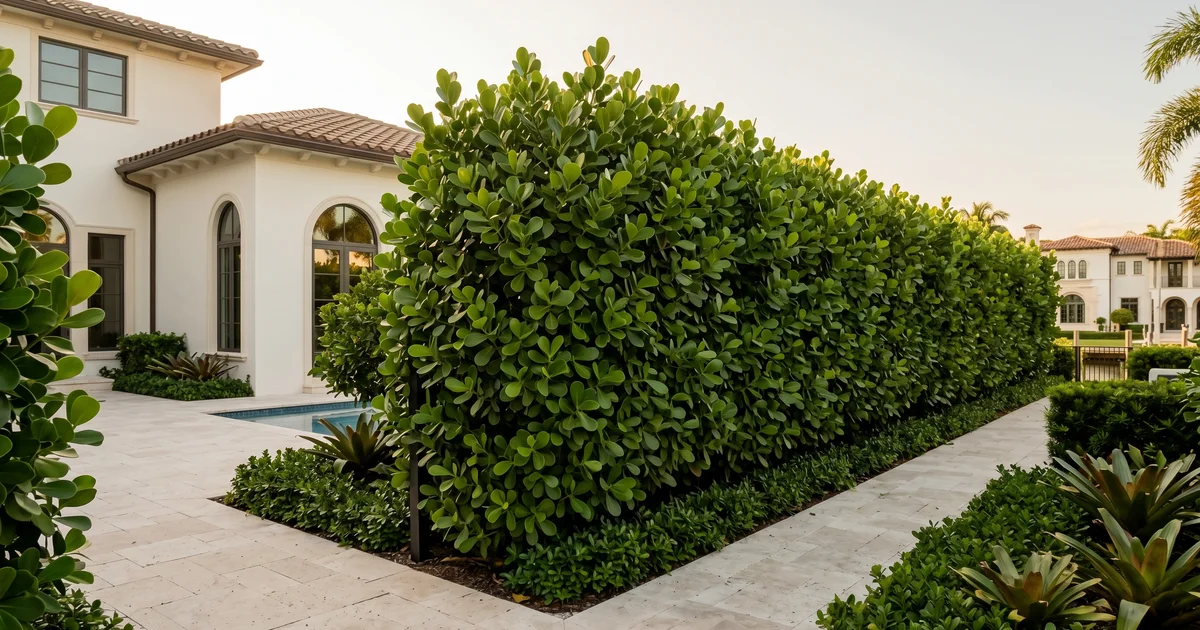
A privacy hedge is one of the longest-lived investments you can put on a South Florida property. Done right, the right species will outlive most fences, most pools, most roofs, and in some cases most of the people who planted it. Done wrong, the same plant can fail in five years and have to be ripped out and started over. This guide walks through realistic lifespan ranges by species, what actually decides whether your hedge sees its fifth decade or fails before its fifth birthday, and how lifespan changes the math when you compare a hedge to a fence.
Planning a hedge install? This post covers lifespan. For full install and planning, see our pillars on Clusia Hedges, Podocarpus Hedges, or Cocoplum Hedges.
The Short Answer
A well-installed, well-maintained privacy hedge in South Florida typically lasts 30 to 50 years or more. Some species comfortably push past that, mature Podocarpus hedges in well-drained Miami yards routinely cross 50 years and keep going. The shortest realistic lifespan for a properly installed premium hedge is around 20 to 25 years, and that usually only happens when species choice was wrong for the site or when a hurricane took the hedge out before the roots were fully established.
Compare that to a wood privacy fence in South Florida humidity, which typically lasts 10 to 15 years before serious repair or replacement, or a vinyl fence at 20 to 30 years. A well-chosen privacy hedge outlasts almost every fence option on the market. It also gets better-looking with age, which a fence never does.
Lifespan by Species
Different hedge plants have very different long-term performance in South Florida. The numbers below are realistic install-to-end-of-life ranges, not theoretical maximums. They assume the plant is in the right yard for the species and is getting normal care.
Clusia, 30 to 50+ years
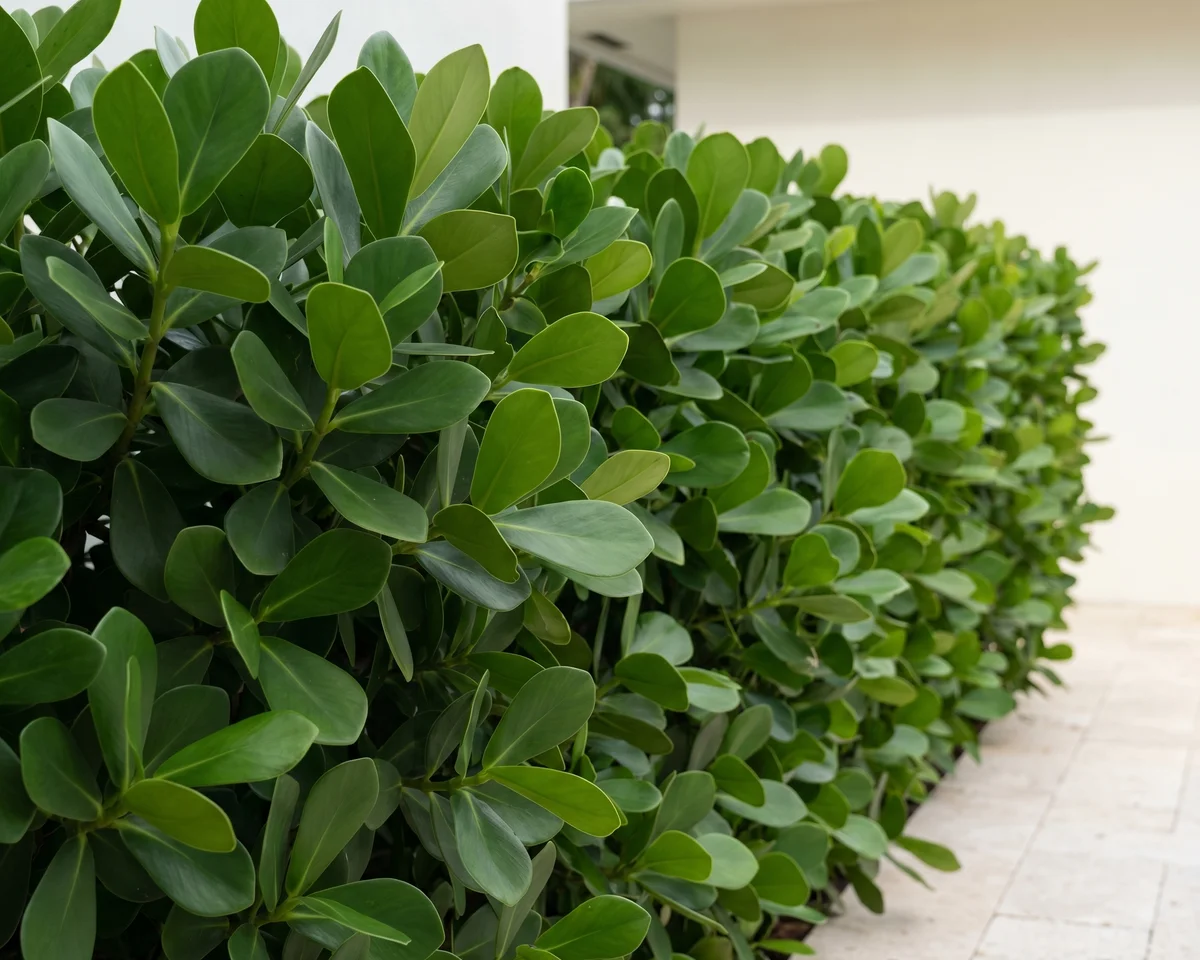
Clusia (both Clusia guttifera and Clusia rosea) handles South Florida conditions exceptionally well over decades. The combination of strong salt tolerance, sun durability, drought resilience, and very low pest pressure means a mature Clusia hedge mostly just keeps going. Mature hedges thicken and gain authority over time rather than declining.
The honest upper bound is harder to pin down because Clusia became a popular privacy hedge in South Florida relatively recently. The oldest installed Clusia hedges we see in the field are 40 to 50 years old and still performing at premium quality. The plant itself in native habitat can live well past a century. As a maintained privacy hedge, plan on 40 years as a confident baseline and treat anything beyond that as upside.
Podocarpus, 50+ years, often much longer
Podocarpus (Podocarpus macrophyllus) is the longest-lived premium privacy hedge plant commonly installed in South Florida. Mature Podocarpus hedges at established estates routinely cross 50 years. The species is long-lived in its own right, individual Podocarpus specimens at botanical gardens and old estates can be over a century old.
What makes Podocarpus so durable is the combination of a deep robust root system, very low pest pressure (the podocarpus aphid is manageable and doesn’t kill the plant), tolerance for a wide range of soils, and a slow steady growth pattern that doesn’t push the plant into weak wood. The trade-off for that longevity is a slower fill-in window during the first few years, which we cover in our how fast do Podocarpus hedges grow guide.
Cocoplum, 25 to 40 years
Cocoplum (Chrysobalanus icaco) is a Florida-native plant with strong long-term performance, especially in coastal yards where salt would shorten the lifespan of less salt-tolerant species. The native status helps, the plant evolved for South Florida conditions and doesn’t fight the climate the way an imported plant might.
The shorter range than Clusia or Podocarpus reflects two things. First, cocoplum is more sensitive to compacted or poorly drained soil over decades, and second, individual cocoplum plants in a hedge run sometimes need to be replaced earlier than the run as a whole. A well-cared-for cocoplum hedge can still cross 40 years comfortably, but expect a few plant-level replacements along the way.
Walter’s Viburnum, 30 to 50 years
Walter’s viburnum (Viburnum obovatum) is a Florida-native option that performs reliably over the long term in the right conditions. It tolerates shade better than most privacy hedges, prefers slightly moister soil than the coastal options, and has the same long-lived native advantages as cocoplum. Lifespan in well-suited conditions matches Clusia.
Where Walter’s viburnum runs shorter is on overly dry, very sandy, full-sun coastal sites, those conditions stress the plant over decades. On shaded inland yards it can be the longest-lived option in the planting.
Silver Buttonwood, 30 to 50 years
Silver buttonwood (Conocarpus erectus var. sericeus) is a coastal native that thrives on direct salt exposure and beachfront conditions where most other hedges would shorten their lifespans. Mature silver buttonwood hedges at beachfront homes can comfortably cross 40 years. The plant tends to read more naturalistic than architectural, which limits its use to specific landscape styles.
The longevity is comparable to Clusia on coastal sites and slightly shorter inland, where it doesn’t have the coastal-stress advantage as much to lean on.
Ficus, Historically 50+ years, now 10 to 30 due to whitefly
Old ficus hedges from the 1970s and 1980s in South Florida often cross 50 years. The plant is naturally long-lived, dense, and fast-growing. The reason it isn’t on the recommended-for-new-installs list anymore is the ficus whitefly, which arrived in South Florida around 2007 and has fundamentally changed the calculus of owning a ficus hedge.
A ficus hedge installed today, without aggressive ongoing whitefly treatment, may not see its 10th birthday. With consistent professional treatment, ficus hedges can still be sustained at premium quality, but the ongoing cost of treatment, the risk of skipping a treatment season, and the catastrophic outcome when whitefly pressure overwhelms a hedge make ficus a much riskier long-term bet than it used to be. Most premium installers in South Florida have stopped recommending ficus for new installs entirely. See our page on ficus hedge removal for what to do if you have a struggling ficus run.
Areca Palm, 20 to 40 years per clump
Areca palm is not technically a privacy hedge, but it’s often used as one and the lifespan question comes up. Individual areca clumps live 20 to 40 years in South Florida. The clumps thin over time, send up replacement canes, and gradually shift the overall density of the planting. Long-term, an areca screen requires more replanting and refreshing than a true hedge does.
Viburnum suspensum and Viburnum odoratissimum, 15 to 25 years
The non-native viburnums commonly sold as fast-growing privacy hedges have meaningfully shorter realistic lifespans in South Florida than the natives or the premium picks. Pest pressure (especially viburnum scale and chilli thrips), inconsistent soil tolerance, and a tendency to thin out from the bottom with age all contribute. A 20-year viburnum hedge is doing well. Most start showing serious decline at 15 to 18 years.
What Actually Decides Lifespan
Species choice sets the upper bound. Everything below decides whether your hedge gets near that bound or falls short of it.
Install Quality
The single biggest factor a homeowner can control. A privacy hedge installed by a crew that knows what they’re doing, correct spacing, proper soil prep, right starter size for the run, planted at the right depth, mulched correctly, has a fundamentally longer expected lifespan than the same plants installed badly. Plants installed too deep, too close together, in compacted soil, or without root collar clearance can fail in years rather than decades, even with premium species.
A hedge installed for a season, fast, cheap, and pretty on day one, often shows decline by year three. A hedge installed for thirty years looks great on day one too, but the decisions that produced it are different.
Drainage
South Florida has two soil patterns that matter for hedge longevity: well-drained sandy soil (most of the coastal ridge, Miami Beach, Coral Gables uplands), and slow-draining or seasonally wet soil (anywhere with limestone close to the surface, infill sites, low-lying neighborhoods). The first is friendly to almost every hedge species. The second is the most common reason a hedge that should have lasted 40 years fails at 15.
Standing water at the root zone, even just seasonally during the heaviest rain months, stresses every premium privacy hedge species. Podocarpus and Clusia both tolerate occasional saturation but not chronic wet feet. Cocoplum handles it slightly better but still prefers well-drained sites for maximum lifespan. If your yard ponds after a heavy rain, addressing drainage at install, not after the hedge starts struggling, is what produces a 40-year run instead of a 15-year one.
Pest Pressure
For most of the species on this list, pest pressure is a manageable maintenance item. For ficus, it’s the central question. For viburnum, it’s a significant ongoing concern. For Clusia, Podocarpus, cocoplum, and the natives, pest pressure can be addressed when it shows up without threatening the hedge’s long-term lifespan.
The mistake that shortens hedge lifespan from pests isn’t usually that pests showed up. It’s that they were ignored long enough that the hedge took structural damage. A handful of treatments over decades, applied when pressure first shows up, keeps a premium hedge healthy for its full expected lifespan.
Climate Events
Hurricanes are the biggest non-pest threat to a South Florida privacy hedge over decades. A mature hedge with established roots almost always survives a storm, even a major one, see our piece on whether a privacy hedge survives a Florida hurricane for the long version. A young hedge in its first or second year, still establishing roots, is more vulnerable.
Cold fronts matter less for the temperate species (Podocarpus shrugs at South Florida cold) and more for tropical-leaning species (Clusia can lose some leaves in a hard cold front but rarely takes structural damage). Across a 40-year hedge lifespan in South Florida, you should expect to weather two to four major hurricanes and dozens of cold fronts. Premium species handle this routinely.
Maintenance Consistency
The hedge doesn’t need heroic maintenance to reach its full lifespan. It needs consistent maintenance, a trim or two per year, occasional fertilization, irrigation that works when needed, treatment when pests show up. Long-term hedge owners who treat the hedge as a permanent landscape feature, the way they would treat a stone wall, get the full lifespan. Owners who let the hedge slip into neglect for a decade and then try to revive it usually trade lifespan for the time it took to neglect it.
The good news is that the maintenance burden of a premium South Florida hedge is genuinely light. Clusia and Podocarpus both want very little. Cocoplum and the natives are also low-input. None of them are demanding plants.
Lifespan vs Fence, The Real Comparison
When homeowners ask “should I get a hedge or a fence,” lifespan is often the missing piece of the math. Here’s what a fence really costs over the same window a hedge would cover:
- Wood privacy fence: 10 to 15 years before significant repair or replacement in South Florida humidity. Over a 40-year hedge lifespan, you’d replace a wood fence three to four times.
- Vinyl privacy fence: 20 to 30 years. Over a 40-year hedge lifespan, you’d replace it once and probably need to start planning the second replacement.
- Aluminum or steel fence: 25 to 40 years depending on coastal corrosion. Comparable to a hedge in raw lifespan but doesn’t add living value to the property.
- Concrete or masonry wall: 50+ years, comparable to the longest-lived hedge species. Highest upfront cost of any privacy solution.
A privacy hedge is the only solution on this list that increases in value over time. A 30-year-old wood fence is worth less than a new wood fence. A 30-year-old mature Clusia hedge is worth more than the same plant installed last week. That’s the long-game difference between a fence and a hedge.
Decade-by-Decade, What a Hedge Actually Looks Like Over Time
Year 1 to 3, Establishing
The hedge is filling in laterally and gaining height. Most of the time and energy is going to root establishment. A well-installed hedge already reads finished from day one if the starter size was right; smaller starter sizes are still growing into each other during this window. Watering matters more in this period than at any other point in the hedge’s life.
Year 3 to 10, Maturing
The hedge is fully filled in, thickening up, and developing the mature shape that defines its long-term look. Maintenance settles into the rhythm it will hold for decades, a trim or two per year, occasional fertilization, normal attention.
Year 10 to 25, Peak
The hedge is at peak performance, full, dense, established root system, mature shape, minimal maintenance needs. This is the period that justifies the original install decision. The hedge reads timeless rather than recent.
Year 25 to 40, Mature
The hedge is now an established landscape feature, often referenced by neighbors and home buyers as part of the property’s identity. Some species may benefit from light renovation pruning during this window, cleaning out interior deadwood, reshaping a section that has drifted, occasionally replacing an individual plant that didn’t keep up with the run.
Year 40+, Long-lived
The hedge is, at this point, older than most other landscape features on the property. Some species comfortably keep going. Others may be approaching the end of their useful life as a maintained privacy hedge and could be candidates for full renovation or selective replacement.
When to Renovate vs Replace
A premium South Florida hedge that’s underperforming after 15 to 20 years usually doesn’t need to be replaced. It needs to be renovated. Common renovation interventions:
- Rejuvenation pruning, cutting back into older wood to force new growth and reset the hedge’s shape. Most premium species respond well.
- Soil amendment, adding organic matter and addressing pH issues that have accumulated.
- Replacement of failed individual plants, pulling out the one or two that didn’t keep up and replacing with starter plants matched to the rest of the run.
- Drainage correction, fixing a low spot that has been quietly stressing the hedge for years.
Replacement of the entire hedge is rarely the right call before year 30 to 40, and even then only when species choice was wrong for the site or when an uncorrectable problem (severe pest collapse, irreparable drainage, root damage from adjacent construction) has compromised the run beyond repair.
The decision to renovate vs replace is usually one we make on a site walk. Most hedges we look at have more useful life left than the owner expected.
Closing, Planning for the Long Haul
The right way to think about a privacy hedge is as a permanent landscape feature, the same way you’d think about a stone wall or a mature shade tree. Done right with the right species, a privacy hedge installed today should still be defining the yard when the kids who grew up in the house bring their own kids back to visit. That long horizon is the case for paying for premium install quality and premium species, those decisions are amortized across decades of value.
For most South Florida yards, the long-lifespan answer is Clusia or Podocarpus, installed cleanly, on a site with good drainage. Those two will quietly do their job for forty years and ask very little in return. That’s the deal.
Want help thinking through which species fits your yard and what a long-lifespan install looks like for your property? Our free quote process starts with a real site walk, not a sales pitch.
Tagged
- privacy hedges
- south florida
- clusia hedge
- podocarpus hedge
- cocoplum hedge
- hedge care
- buying guide
Ready for a privacy hedge that looks finished from day one?
Get a free estimate from a South Florida specialist who handles delivery, installation, and the result you actually want.