South Florida Privacy Hedge Specialists

Florida-Friendly Landscaping hedges, installed properly.

Right plant in the right place. Drip-zoned irrigation, FFL-standard mulch, conservative fertilizer, and a hedge line that clears HOA architectural review on the first pass.

Same-day replies Miami · Fort Lauderdale · West Palm Beach Never sold or shared
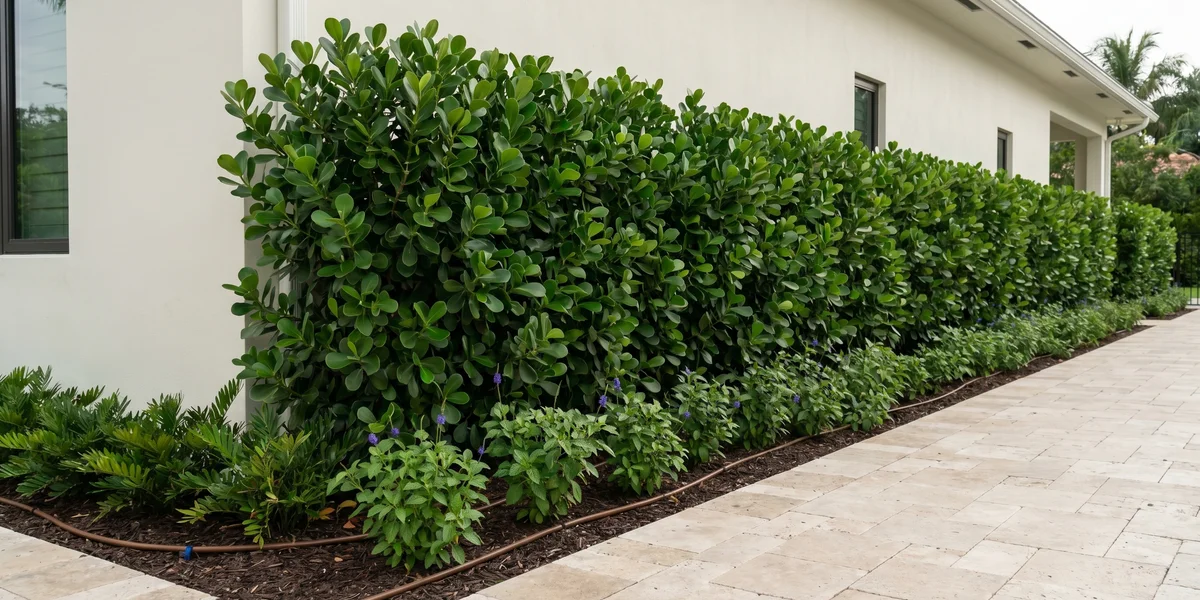
A South Florida home with an FFL-aligned native hedge along the property line, used to illustrate the certified landscape standard.

FFL is a framework, not a fence.

The nine principles describe how to landscape — they do not pick the hedge for you. We do that part.

Florida-Friendly Landscaping is the University of Florida IFAS Extension program built around nine principles for sustainable residential landscape practices. The framework is voluntary and free to apply, with formal county certification available to homeowners who want the credential. Two pieces of it have real legal weight: Florida Statute 720.3075 prevents HOAs from prohibiting FFL practices, and local water management districts sometimes grant stricter watering allowances to FFL-certified yards.

None of that tells a homeowner which hedge to plant. That is where most people stall. Mr. Clusia plants FFL-aligned privacy hedges every week across Miami-Dade, Broward, and Palm Beach. We know which species qualify, which install practices fit the principles, and which HOA review patterns trip people up. We build the install around your yard rather than around a brochure.

If FFL credit, water-restriction breaks, or smoother eco-aligned HOA approval matter to your project, this page is what we would walk you through in a quote.

Why FFL-align your hedge

Five reasons homeowners ask for an FFL-aligned hedge install rather than a generic one.

Lower long-term inputs

FFL-aligned installs use less water, less fertilizer, and fewer pesticides over a decade. Lower utility bills, lower maintenance line items, lower environmental load.

Smoother HOA review

In eco-aligned communities, FFL species are the path of least friction through architectural review. Florida Statute 720.3075 also prevents HOAs from prohibiting FFL practices outright.

Water-restriction resilience

FFL-certified yards in some jurisdictions get stricter watering allowances during droughts. Even uncertified, FFL practices like drip irrigation and proper mulching reduce hedge water use by 20 to 35 percent.

Wildlife and pollinator value

FFL principle 5 is 'attract wildlife.' Florida-native hedge species do this naturally — birds, butterflies, pollinators, and beneficial insects all increase on FFL-aligned hedge runs.

Soil and stormwater alignment

Mulch placement, drip irrigation, and species-matched plant selection reduce stormwater runoff and soil erosion across the hedge bed. Important on canal-adjacent and slope-adjacent properties.

Future-proof against tightening rules

Water-management districts and FFL-aligned HOAs are tightening, not loosening, eco standards. An FFL-aligned hedge installed today positions the property well for the regulatory direction of the next decade.

What's included with an FFL-aligned install from Mr. Clusia

One team, one quote, one finished FFL-aligned hedge line.

FFL Species Selection

We match a Florida-native species to your specific yard exposure. Cocoplum for coastal, Walter's viburnum for shade, Simpson's stopper for narrow runs, yaupon holly for tall formal screens.

HOA-Review Prep

We draft species choice, height, and setback in a form architectural review will sign off cleanly. Specific to your community's rules if you share them.

Drip-Zoned Irrigation

Hedge irrigation gets its own zone, drip-line based, scheduled for establishment then tapered. Avoids the over-watering that turf-zone-shared beds suffer from.

FFL-Standard Mulch

Two to three inches of natural mulch (pine bark, melaleuca, eucalyptus, or pine straw) within the hedge dripline, kept off the trunks. Cypress mulch is excluded per FFL guidance.

Conservative Fertilization Schedule

Most FFL-aligned native hedges thrive on one slow-release application per year. We document the schedule and hand it off so future maintenance stays in alignment.

Care Handover + FFL Documentation

We provide written notes on species, install date, mulch depth, and irrigation zoning — useful for both ongoing care and formal FFL re-certification visits.

FFL-strict or FFL-aligned with non-native species?

Two valid paths. The strict version maximizes credit; the aligned version trades a bit of strictness for design flexibility.

FFL-strict (Florida-native species only)

  • Cocoplum, Simpson's stopper, Walter's viburnum, yaupon holly
  • Maximum credit toward formal FFL certification
  • Strongest HOA approval path in eco-aligned communities
  • Highest long-term water/fertilizer savings
  • Highest wildlife and pollinator value
  • Slower fill than imported standards

FFL-aligned with well-adapted non-native species

  • Clusia or Podocarpus where the design genuinely calls for them
  • FFL principles applied to install, irrigation, mulch, fertilizer
  • Less strict for formal certification but still well-aligned
  • Faster fill if design timeline is tight
  • Workable in most South Florida HOAs
  • Lower wildlife value than the native path

How an FFL-aligned install works

Four steps from your first call to a hedge that fits the framework.

1

Tell us about the yard and the FFL goal

Share whether you are formally certifying with your county IFAS Extension or just applying FFL practices, plus your usual hedge basics — city, length, exposure.

2

We match species and install practices

We walk the site, recommend the right native (or honestly note when a well-adapted non-native fits the case), and scope drip irrigation, mulch, and fertilizer alongside the plant choice.

3

Delivery and install, by the framework

Nursery-grown plants, FFL-standard mulch, drip-zoned irrigation, and a hedge line laid by our own crew. Each step in the install follows the nine principles.

4

Care handover + documentation

We walk the hedge with you, hand over the watering and shaping rhythm, and provide the FFL documentation you can use for ongoing maintenance or formal certification.

Project Highlight

A Coral Gables home with an FFL-certified native hedge perimeter installed by Mr. Clusia, replacing failing non-native hedges and shared-zone irrigation.

Carrying a Coral Gables property through FFL certification

An eco-aligned Coral Gables homeowner wanted formal FFL certification but had failing non-native hedges and turf-zone shared irrigation that put the whole landscape out of alignment.

The Challenge

The yard had inherited a generic landscape from a prior owner: a thinning ficus hedge on the perimeter, areca palm clumps as informal screens, and shared turf-zone irrigation that ran the hedge beds twice a day. Pest pressure on the ficus was constant, water bills were high, and the prior FFL application had been declined.

Our Solution

We removed the ficus, replaced the perimeter with cocoplum on the sunny street-facing edge and Walter's viburnum on the shaded north side, broke the hedge beds out into their own drip-zone irrigation, laid FFL-standard pine-bark mulch, and switched the fertilizer schedule to one slow-release application per year per species. Architectural review was prepped with native-species documentation.

The Outcome

FFL certification cleared on resubmission. Annual hedge water use dropped roughly 35 percent in the first full year. Pest interventions on the perimeter went from monthly to none. The yard now reads as a finished native landscape that supports wildlife instead of fighting it.

Homeowners who chose FFL-aligned hedges

Real feedback from South Florida properties that put in an FFL-aligned hedge install with Mr. Clusia.

"The FFL part was the reason we picked them. They actually understood the nine principles instead of treating it as a marketing label. The certification visit cleared in one pass and we have not touched the hedge irrigation since."

H

Hannah & Vikram P.

Homeowners, Coral Gables

"I wanted to lower the water bill and stop using as much fertilizer on the perimeter. They swapped us out of imported hedges into a cocoplum-and-Walter's-viburnum perimeter and the numbers actually moved. Water use down about a third the next billing cycle."

R

Ramon C.

Homeowner, Pinecrest

"Our HOA had been pushing back on our native plant plan. Mr. Clusia drafted the architectural review submission around FFL principles and Florida Statute 720.3075, and the board signed off the same week. It is the install we should have done five years ago."

S

Sarah W.

Homeowner, Boca Raton

Florida-Friendly Landscaping, applied to a hedge install

The nine Florida-Friendly Landscaping principles, as they apply to a hedge

The full FFL framework is broader than hedge work, but the nine principles map cleanly onto privacy hedge installation. The short version of how each one shows up on a hedge install:

  1. Right plant, right place. Match the species to the actual exposure of the run. Cocoplum on coastal, Walter's viburnum on shaded, yaupon holly on inland-tall.
  2. Water efficiently. Drip-line irrigation on a dedicated hedge zone, tapered aggressively after establishment.
  3. Fertilize appropriately. Slow-release applications, conservative schedule, soil-test guided where useful.
  4. Mulch. Two to three inches of natural mulch within the dripline, kept off the trunks. Cypress mulch is excluded.
  5. Attract wildlife. Native species feed pollinators and birds; this principle is automatic on the strict version of FFL hedges.
  6. Manage yard pests responsibly. Responsive rather than preventive. No routine pesticide cycles on healthy plants.
  7. Recycle yard waste. Pruned material composts or chips on site rather than going to the curb.
  8. Reduce stormwater runoff. Mulched beds and species-matched plantings absorb rainfall instead of shedding it.
  9. Protect the waterfront. Specific to canal-front and waterfront lots; species and fertilizer choices avoid runoff impact.

None of these are exotic ideas. Most well-installed hedges already follow several of them by default. The FFL framework just formalizes the approach.

Which species qualify as FFL-aligned

Six South Florida privacy hedge species form the strong-alignment FFL list:

  • Cocoplum (Chrysobalanus icaco). The highest-volume FFL-aligned hedge we plant. Coastal, drought-hardy, salt-immune. Red-tip and green-tip varieties; horizontal cocoplum belongs in low borders, not privacy lines.
  • Simpson's stopper (Myrcianthes fragrans). Fine-textured, narrow, wildlife-friendly. Best for narrow side yards and modern naturalistic homes.
  • Walter's viburnum (Viburnum obovatum). The FFL pick for shaded side yards. The 'Densa' cultivar is the residential default.
  • Yaupon holly (Ilex vomitoria). The FFL pick for tall formal screens. Inland and northern South Florida lots.
  • Wild coffee (Psychotria nervosa). Shaded understory hedge, smaller scale, 4 to 8 feet. Best under tree canopy.
  • Marlberry (Ardisia escallonioides). Less common in the trade, useful on shaded hammock-style lots.

For the broader take on which natives we install most, see our pillar on native hedges for South Florida.

Species that do not fit FFL cleanly (but can still appear in FFL-aligned yards)

FFL alignment is a spectrum, not a binary. Several common South Florida hedge species do not earn strong FFL alignment by themselves, but can appear in FFL-aligned landscapes when site conditions justify them and other principles are followed:

  • Clusia. Non-native, well-adapted, drought-tolerant once established, salt-tolerant. Not on most native FFL plant lists. Acceptable in FFL-aligned yards when other principles are met, but the FFL-strict homeowner usually picks cocoplum instead.
  • Podocarpus. Non-native conifer-relative widely used as a tall formal hedge. Not on FFL native plant lists. Most often replaced by yaupon holly in FFL-strict installs.
  • Areca palm. Non-native and produces a privacy screen rather than a true hedge. Does not align cleanly with FFL preferences.
  • Ficus. Non-native, pest-prone (rugose spiraling whitefly), and high-maintenance under FFL principle 6. FFL-aligned yards typically replace ficus rather than plant it.

How FFL affects HOA approval

Three practical ways FFL shows up in HOA hedge work:

  • Species selection. Florida Statute 720.3075 prevents HOAs from prohibiting FFL practices. An HOA cannot legally require a specific non-native species when an FFL-aligned native would serve the same function. If a board insists on Podocarpus and a homeowner wants yaupon holly, the homeowner has the legal high ground.
  • Turf reduction. Some HOAs require lawn coverage along property lines. FFL practices allow native plant beds, including hedge runs, to replace turf in those areas under the "right plant, right place" principle.
  • Watering restrictions. HOAs typically defer to local water management districts on watering schedules. FFL-certified yards sometimes have stricter watering allowances, which can affect what the HOA can require for irrigation.

Most South Florida HOAs are not adversarial about FFL-aligned hedges. The conflict cases are rare and usually involve homeowners trying to remove existing turf, not just installing a hedge. Our blog on FFL-certified hedges covers the architectural review process in more depth.

When FFL is the right priority — and when it is not

FFL-strict alignment is the right priority when long-term sustainability, eco-aligned community standards, native wildlife value, or water-restriction resilience are stated goals. It is also the right priority when the homeowner is formally pursuing certification through their county UF/IFAS Extension office.

FFL alignment is not the right primary lens when the design specifically wants the bold tropical look of Clusia, when the timeline demands a hedge finished within one growing season, or when estate-scale supply pushes the project toward predictable nursery stock in 25-gallon hedge-grade sizes. In those cases the install can still follow FFL principles around mulch, irrigation, and fertilizer even if the species choice is non-native. The framework is flexible enough to accommodate that nuance.

Florida-Friendly Landscaping questions, answered

The FFL questions South Florida homeowners ask most often before a hedge install.

There is no single 'FFL certified hedge' species list. A hedge is FFL-aligned when the species is appropriate for the site, preferably Florida native, and the install and maintenance practices follow the nine FFL principles around water, fertilizer, mulch, pest management, and stormwater.

Plant an FFL-aligned hedge built for your yard.

Share a few details and we will put an FFL-aligned hedge plan in front of you — species, install practices, and HOA-review notes if your community requires them.