The best privacy hedges for South Florida, in detail
Every hedge plant on this list is available somewhere in Miami-Dade, Broward, or Palm Beach. Not every plant is a good answer for your yard. This section goes through each option in honest detail so you can tell which one fits your property before you ask for a quote.
1. Clusia (Clusia guttifera and Clusia rosea)
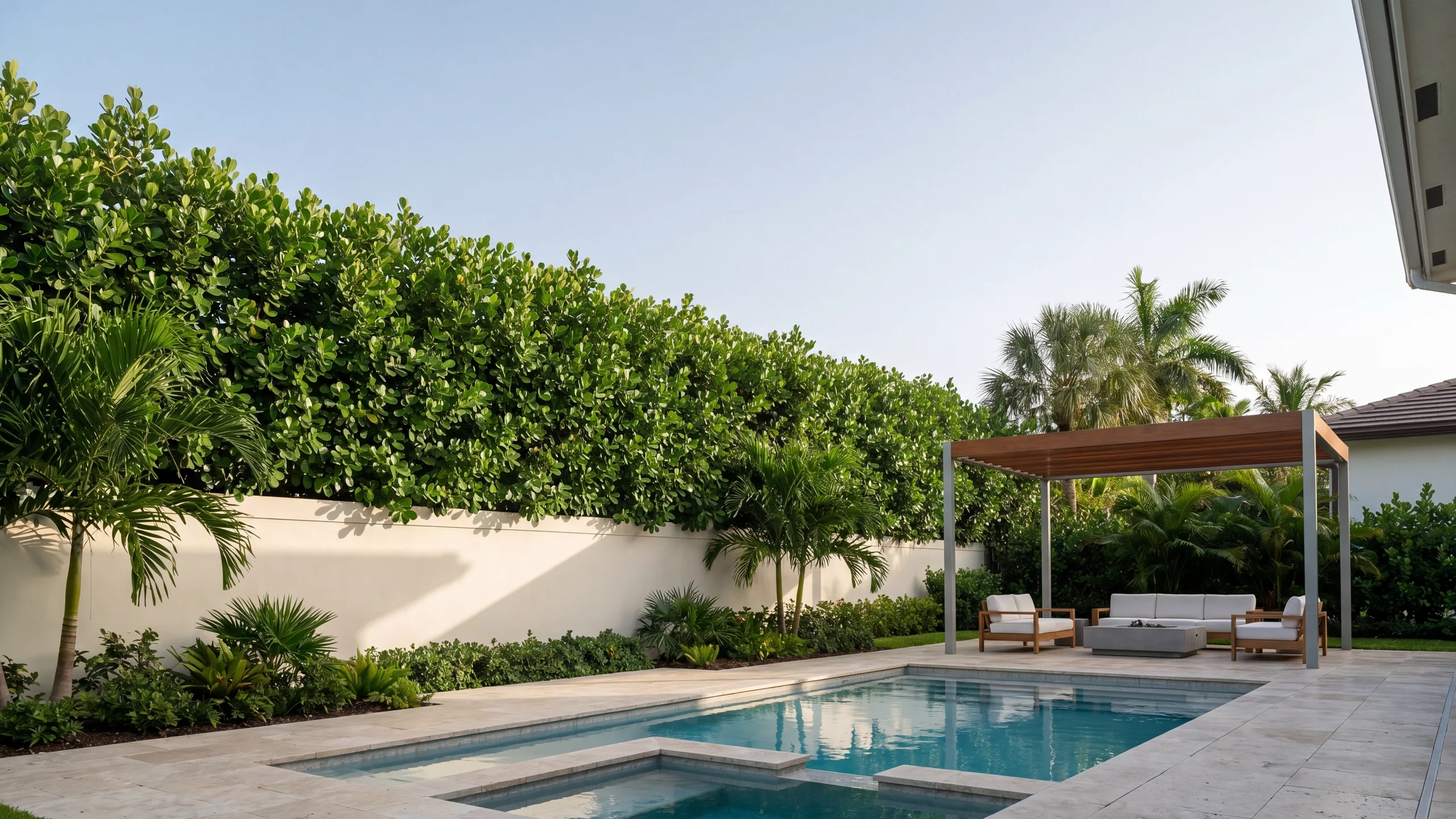
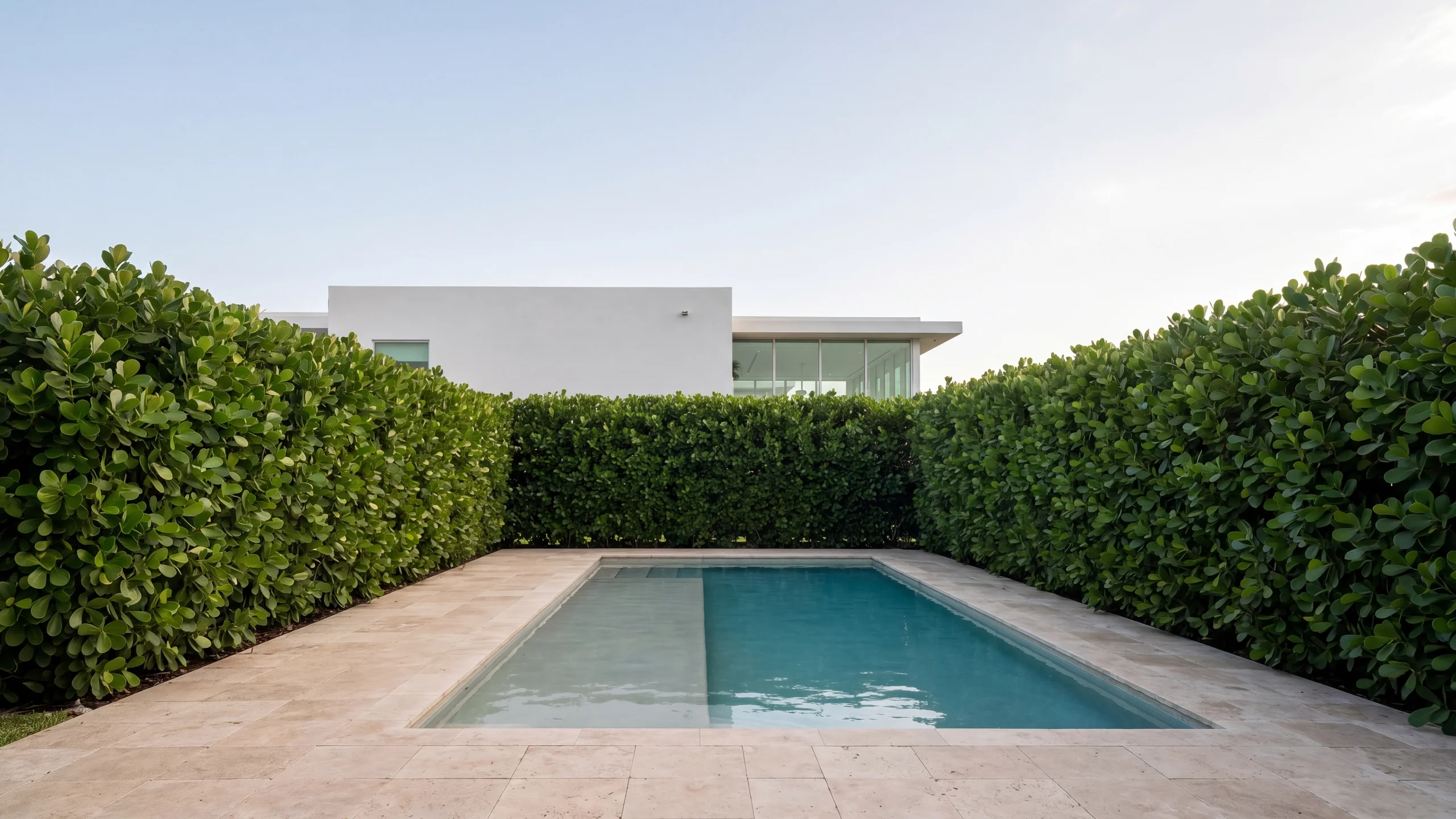
Clusia is the default premium privacy hedge in South Florida. Clusia guttifera, or small-leaf Clusia, is the form used most often for clean, tight privacy hedges. Clusia rosea, the autograph tree, has larger, bolder leaves and a more rustic feel. Both thrive in the region.
Clusia is a full-sun plant with strong salt and wind tolerance, which makes it the right default on coastal, near-coastal, and canal-front lots. It is clean around pools, light on leaf drop, and comfortable in the 6 to 12 foot range. It reads lush, tropical, and resort-style. For the majority of South Florida yards, it is the right answer.
When it is not the right answer: deeply shaded hedge runs under tree canopies, hedges that need to push cleanly past 12 feet, and formal estate homes that want a crisp architectural line. For those, see Podocarpus. If Clusia is the right fit and you plan to plant it yourself, we sell Clusia plants for sale by container size, delivered across South Florida.
2. Podocarpus (Podocarpus macrophyllus)
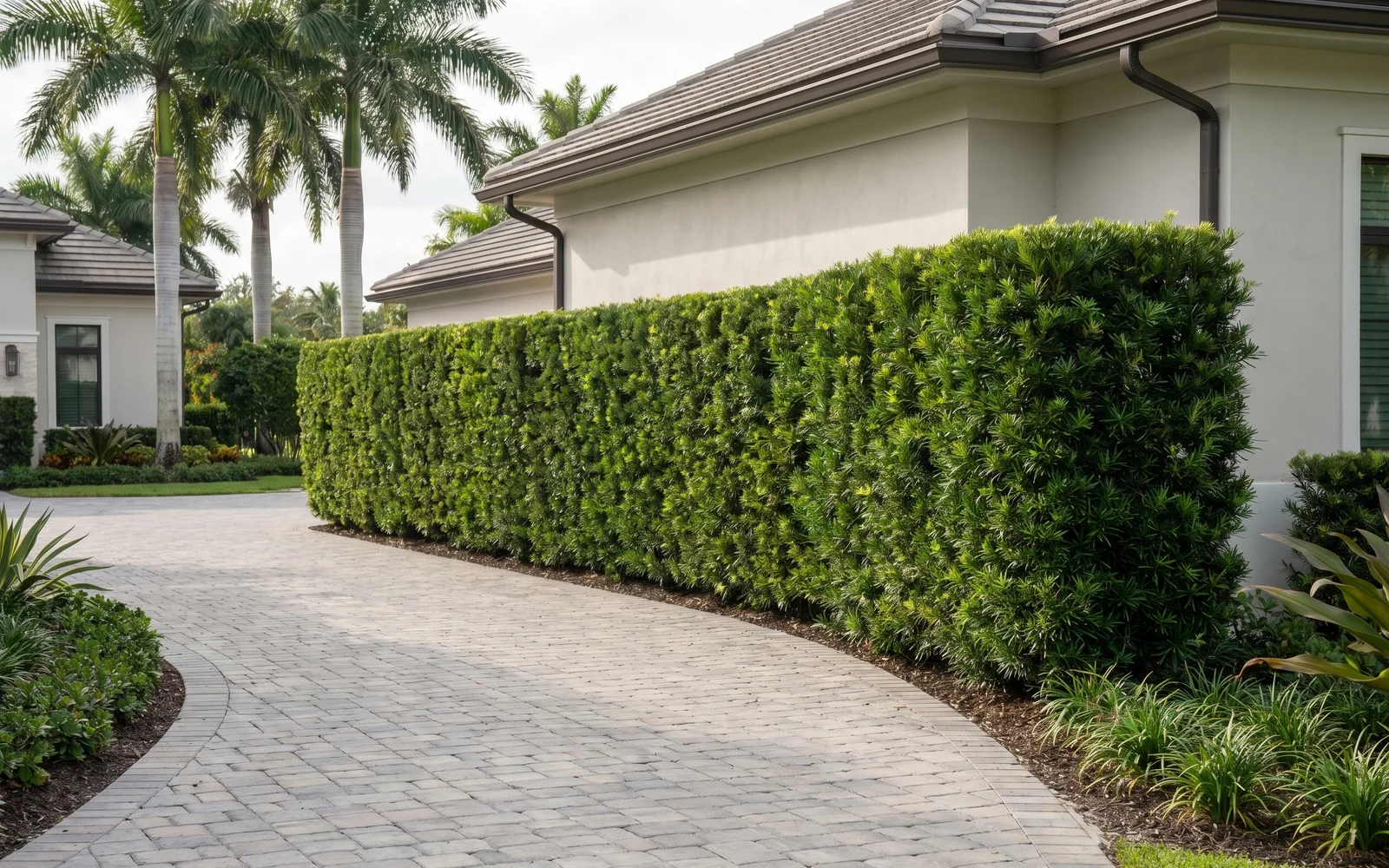
Podocarpus is the tall, formal alternative. Fine needle-like foliage, upright vertical form, and a willingness to be clipped into sharp architectural lines. It handles partial shade better than Clusia, which is the single biggest reason it gets chosen on a given yard.
Podocarpus is the right call on shaded side yards, tight narrow runs, and estate homes that want a hedge in the 12 to 15 foot range or taller. It pairs naturally with Mediterranean, traditional, and large estate architecture. It can be pushed higher for two-story blocks and street-facing estate screens.
When it is not the right answer: full sun on an open, tropical lot that wants a softer lush look, heavy coastal salt exposure, or pool decks where fine-needle leaf drop can become a filter and waterline issue over time.
3. Cocoplum (Chrysobalanus icaco)
Cocoplum is a Florida-native privacy hedge with an exceptional salt tolerance profile, strong enough to handle direct ocean spray that would burn most other species. The plant comes in three commonly installed forms: Horizontal (the most popular hedge form, with a denser low-spreading habit), Red Tip (named for the bronze new growth), and Green Tip (the more upright, taller form).
Cocoplum is the right call on direct beachfront yards, canal-front and waterfront lots with constant salt spray, FFL-aligned (Florida-Friendly Landscaping) yards, and homeowners who specifically want a native plant doing the privacy work. It tolerates drought once established, which matters on lots that may not get irrigated consistently.
When it is not the right answer: shaded interior runs (cocoplum needs full sun), poorly drained sites that hold standing water, and yards where a strictly formal, sharp-clipped architectural hedge is the goal. The natural form is softer than Podocarpus and less precise than a hard-pruned Clusia line.
4. Walter's Viburnum (Viburnum obovatum)
Walter's viburnum is a Florida-native viburnum (not to be confused with the non-native Viburnum suspensum or odoratissimum further down this list). It tolerates partial shade better than most premium privacy hedges, prefers slightly moister soil, and develops into a dense, soft-textured hedge with small dark-green leaves.
Walter's viburnum is the right call on shaded side yards, FFL-aligned yards that want a native option in the Podocarpus role, and properties that want a softer, more naturalistic privacy look than the formal architectural feel of Podocarpus.
When it is not the right answer: very dry full-sun coastal lots that stress the plant over the long term, and tall formal estate hedges where Podocarpus is a better architectural fit.
5. Simpson's Stopper (Myrcianthes fragrans)
Simpson's stopper is a Florida-native long-lived hedge plant with fine-textured small dark-green leaves, smooth reddish bark, and a slower growth rhythm than most options on this list. The slower growth is offset by exceptional longevity and a refined fine-textured look that fits modern naturalistic landscape design.
Simpson's stopper is the right call on narrow runs where slow lateral growth is acceptable, modern architectural homes that want a refined native option, and any FFL-aligned yard that wants a long-term low-input plant.
When it is not the right answer: yards that need a finished privacy wall on a tight timeline, and traditional or estate homes where the fine-textured look might read too understated against the architecture.
6. Areca palm (Dypsis lutescens)
Areca palms are not a privacy hedge, even though they are often asked for as one. They are tall multi-trunk clumping palms that create a beautiful tropical backdrop, add vertical height, and carry the eye up. What they do not do is create a continuous ground-to-top privacy wall. There is always some gap at the base of the clump.
Areca palms are the right call behind a pool, along a rear property edge where height matters more than ground-level screening, and in combination with a true hedge. Many premium yards run Clusia along the property line for privacy and stage Areca palms behind or above the hedge for the tropical skyline. For the full head-to-head, see our Clusia vs Areca palm for privacy comparison.
When it is not the right answer: as the only plant on a privacy line where ground-level sightlines matter, in pool-adjacent runs where frond and seed drop will land in the water, or in yards that routinely see winter cold fronts cold enough to brown the fronds.
7. Viburnum, non-native (Viburnum suspensum and Viburnum odoratissimum)
The non-native viburnums commonly sold as fast-growing privacy hedges. Viburnum suspensum is the more compact form. Viburnum odoratissimum is a taller, faster grower often used for larger screens.
Non-native viburnum is the right call when budget matters more than premium appearance, when the owner is doing a DIY-ish install, or when a quick, inexpensive green screen is the immediate priority. In good conditions it performs well. In South Florida, its performance is more variable than Clusia or Podocarpus, and pest and disease pressure shows up more often.
When it is not the right answer: premium street-facing edges, estate homes where consistency and longevity matter, and yards that have already cycled through underperforming hedge plants. Many homeowners come to us after a viburnum install did not age the way they were hoping, and they want a more reliable long-term choice.
8. Ficus (Ficus nitida / Ficus benjamina)
Ficus used to be the go-to South Florida privacy hedge. Dense, fast, tall, and very effective when healthy. That reputation is now shadowed by the ficus whitefly. The pest has hit ficus hedges hard across Miami-Dade, Broward, and Palm Beach, and treatment has become an ongoing part of owning a ficus hedge.
Ficus is the right call in a narrow set of situations: where a ficus hedge already exists and is healthy, where ongoing whitefly treatment is acceptable, and where the owner specifically wants ficus for historical or stylistic reasons. In those cases, a ficus hedge can still look excellent.
For new installs on a yard that has never had ficus, we typically recommend Clusia or Podocarpus instead. The pest pressure is real, treatment is an ongoing cost, and root systems on mature ficus can damage pool decks and hardscape in ways that take years to show up.
Privacy hedges at a glance: comparison table
The eight species above, compared on the attributes that actually drive the buying decision. This is the table to send to anyone in your household before they ask the same questions you already asked.
| Species | Mature height | Sun preference | Salt tolerance | Growth speed | Florida native | Best use |
|---|---|---|---|---|---|---|
| Clusia | 6 to 12 ft | Full sun | Very high | Fast (1 to 2 ft/yr) | No | Default residential privacy hedge |
| Podocarpus | 8 to 20 ft | Full sun to part shade | High | Moderate | No | Tall formal architectural screens |
| Cocoplum | 6 to 10 ft | Full sun | Exceptional (direct spray) | Moderate | Yes | Coastal lots, drought-prone, FFL yards |
| Walter's Viburnum | 6 to 12 ft | Full sun to part shade | Moderate | Moderate | Yes | Shaded side yards, native mid-height |
| Simpson's Stopper | 6 to 12 ft | Full sun to part sun | Moderate | Slow to moderate | Yes | Narrow runs, modern naturalistic homes |
| Areca palm | 15 to 25 ft | Full sun | Moderate | Fast | No | Backdrop / behind a true hedge (not standalone) |
| Viburnum (non-native) | 6 to 15 ft | Full sun | Low to moderate | Fast | No | Budget-conscious mid-tier installs |
| Ficus | 8 to 30 ft | Full sun | Moderate | Very fast | No | Existing healthy runs only, not recommended for new installs |
Quick picker by yard situation
If you would rather skip the long version, the situation-by-situation shortcut. Match your yard to the closest scenario and the recommended hedge follows.
- Standard sunny backyard, 6 to 12 ft target height: Clusia.
- Tall formal driveway or two-story estate screen: Podocarpus.
- Direct beachfront or daily salt spray: Cocoplum.
- Shaded side yard along the house: Podocarpus or Walter's viburnum, depending on whether you want a formal or naturalistic look.
- Pool-adjacent privacy hedge: Clusia (cleanest leaf-drop profile). See our pool-yard hedges guide for the full breakdown.
- FFL-aligned or native-only yard: Cocoplum (full sun), Walter's viburnum (part shade), or Simpson's stopper (narrow runs). See our native hedges guide.
- Modern naturalistic landscape, refined fine texture: Simpson's stopper.
- Budget priority over premium appearance: Non-native viburnum, knowing the lifespan and pest trade-offs.
- Existing healthy ficus that needs to be kept: Maintain ficus with ongoing treatment.
- Backdrop behind a real hedge for tropical height: Areca palm.
How to pick between them in your own yard
Here is the decision flow we use on a real site walk, simplified for homeowners reading at home.
- Start with sun or shade. If full sun, Clusia leads. If partial shade, Podocarpus or Walter's viburnum lead.
- Check the height you need. Under 12 feet, Clusia is the easy call. Over 12 feet, Podocarpus usually wins.
- Factor in coastal exposure. Direct beach or canal with constant salt, Cocoplum. Coastal-adjacent, Clusia. Interior lots, either Clusia or Podocarpus.
- Match the home. Modern, tropical, coastal, or contemporary, Clusia. Formal, estate, traditional, or Mediterranean, Podocarpus. Native/naturalistic, Cocoplum or Walter's viburnum.
- Think about the pool. Close to a pool, lean Clusia for leaf-drop behavior.
- Plan for the future. Pick the plant that will still look right in year five, not just year one. See our privacy hedge lifespan guide for the long view.
Outside of the three leaders, Walter's viburnum and Simpson's stopper come in for native and shade-tolerant work, Areca palms come in as a backdrop complement (not a standalone privacy wall), and the non-native viburnum and ficus options have their own niches but are not the right default for most South Florida homes.
What a finished install looks like in practice
The difference between a premium privacy hedge and an average one is usually not the species. It is the starter size, the spacing, the soil prep, and the crew. A Clusia hedge installed at full privacy height, at tight consistent centers, on properly prepped soil, by a crew that has done it hundreds of times, reads as a finished wall on the day we leave the property.
That same plant installed as small starters at loose spacing by a general landscaper often takes years to fill in, if it ever fully does. The species matters, but execution is where premium privacy hedges earn their price.
What we install most often, and why
On a typical month, the great majority of our installs are Clusia on sunny yards, Podocarpus on shaded or tall formal yards, Cocoplum on direct coastal yards and FFL-aligned properties, and combination plans that use Clusia for privacy and Areca palm for tropical height. This is not a marketing preference. It is what works reliably on South Florida homes.
If you are making this decision for your yard, the ranking above is the real answer from inside the work. Start with Clusia unless something about your yard points somewhere else, and use the quick picker or decision flow to confirm.