Noise reduction hedges in South Florida
Privacy hedges get chosen for sightline reasons most of the time. The acoustic benefits are often a pleasant surprise after install. For homeowners whose primary reason for a hedge is a noisier-than-expected yard, a little planning up front produces a much better result than a generic privacy install. This section covers how to do that.
What a hedge realistically delivers for noise
Measured perfectly, a dense, mature hedge can reduce broadband noise in a yard by a modest number of decibels. The effect is most pronounced on high-frequency content, which is the frequency range where human ears are most sensitive to traffic and pool-equipment noise. The honest takeaway is that the perceived change is usually larger than the measured change, and both are real.
What the hedge does not deliver is acoustic silence. Homes right on a major road, next to a fire station, or directly beside a loud commercial property will still hear the source even with a well-designed hedge. The hedge takes the edge off, reduces reflected noise, and changes how the yard feels. It does not remove the source.
The role of height
Height is the single biggest variable in how much a hedge reduces noise. A six-foot hedge is a visual screen with modest acoustic benefit. An eight- to ten-foot hedge is where most of the real noise reduction starts. A twelve-foot hedge, usually Podocarpus for South Florida, is the right call for homes with serious street, canal, or neighboring-property noise pressure.
The reason is geometry. Noise sources that sit below the top of the hedge have to go over or through the hedge to reach the listener. The more of that path the hedge occupies, the more energy it takes out of the sound. A short hedge leaves the direct path mostly open above the plants.
The role of density
Density matters nearly as much as height. A gappy hedge lets sound leak through the gaps, which is the acoustic equivalent of a door left open in an otherwise insulated wall. Dense species, tight install centers, and larger starter plants all increase the continuous foliage mass the sound has to travel through.
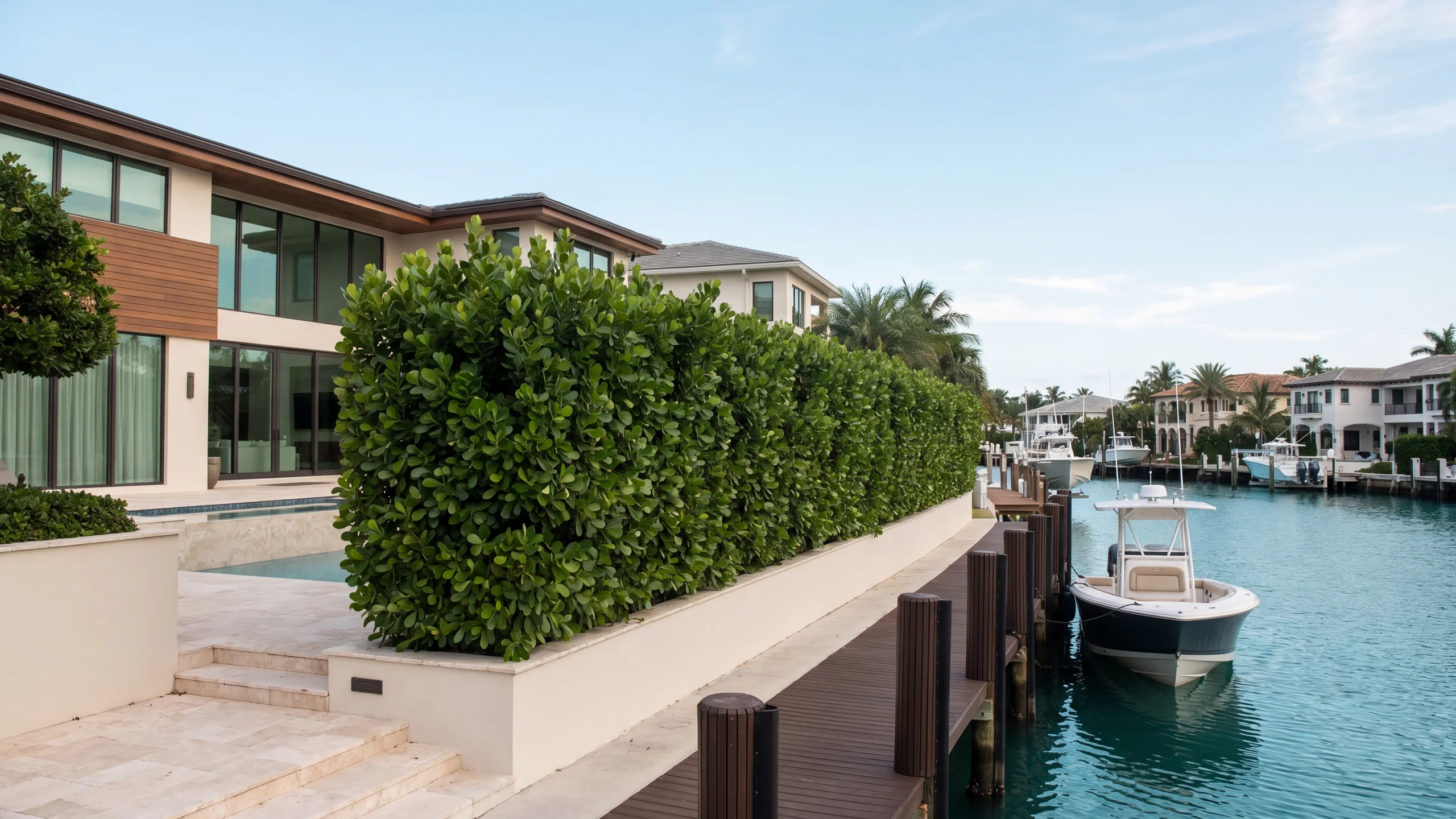
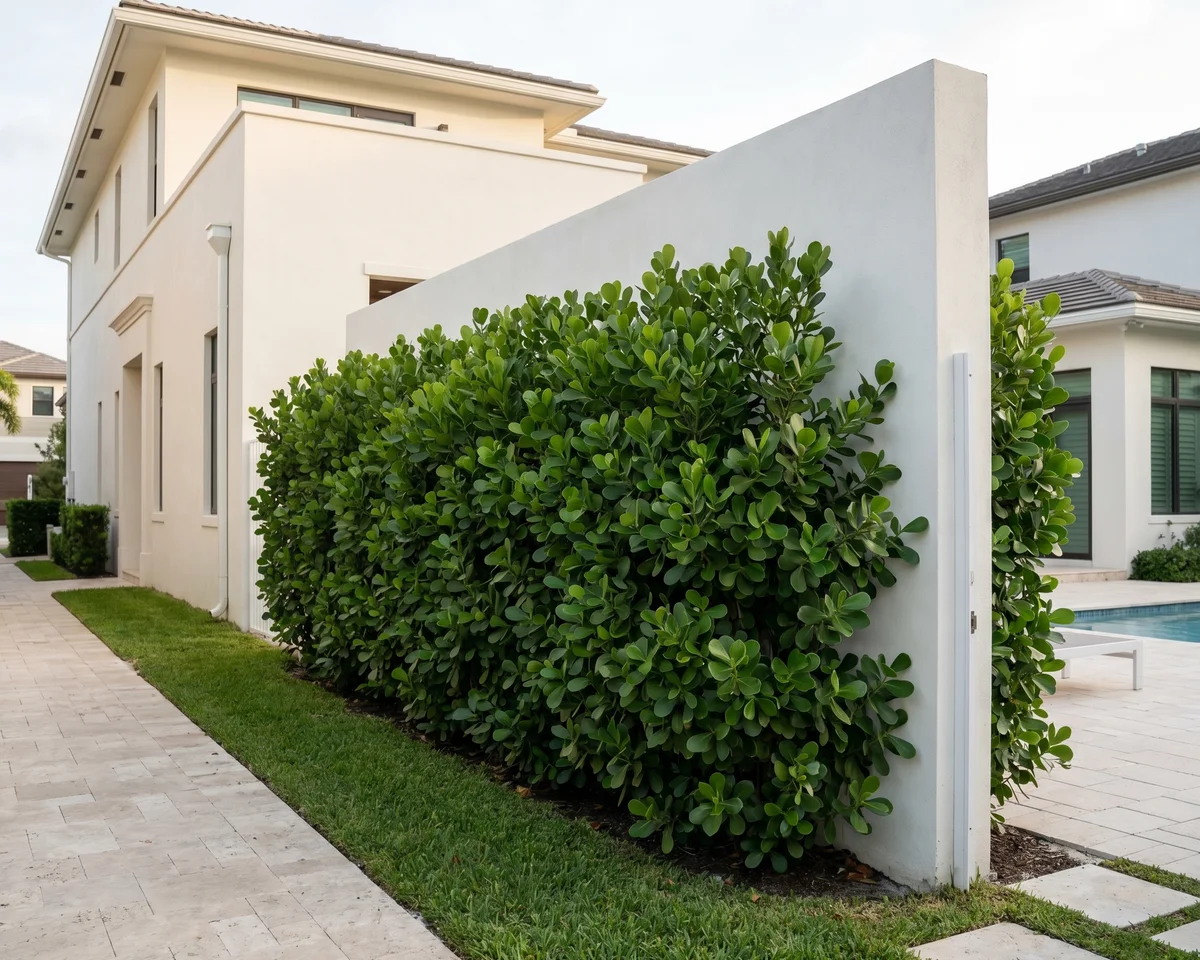
For South Florida, Clusia with large starter plants at two to three foot centers produces a dense continuous hedge that performs well acoustically. Podocarpus at similar tight centers produces an even more solid wall, especially at taller heights. Loose plantings, regardless of species, produce much weaker results.
The role of depth
Depth is the quietest but most powerful acoustic factor, and the one most homeowners do not consider. A single row of plants has less acoustic mass than a staggered double row, or a hedge with lower shrubs at its base and taller hedge species behind it. Layered planting dramatically improves sound absorption.
For homes with very high noise pressure, a layered install is usually the right answer. A front row of Clusia along the property line, a secondary row of Podocarpus or mixed greenery behind it, and occasional taller plants behind both produces an acoustic barrier that a single-row hedge cannot match. This is more expensive, but it is the difference between reducing noise and meaningfully transforming the yard.
Placement relative to the noise source
Acoustic barriers work best when they are close to the source rather than close to the listener. Running the hedge along the property line nearest the road or noise source is almost always more effective than planting it closer to the house. The hedge needs to intercept the sound before it spreads into the yard, not after.
This matters especially when the home is set back from the road. Installing a hedge directly in front of the house but leaving the road-facing property line open will not deliver the same acoustic benefit as installing the hedge along the road-facing edge. The physics does not care about where the quote was easier to fit. It cares about where the sound arrives first.
Continuous vs broken hedge lines
Any break in the hedge leaks sound. Gates, driveway openings, gaps between plantings, and sparsely planted corners all reduce overall acoustic performance. A hedge meant for noise reduction needs to be continuous from end to end on the run that faces the source.
Driveway openings are often the toughest case. On properties where the hedge cannot literally be continuous, a few design moves help: planting close to the edges of the opening, using taller plants near the opening to raise the overall acoustic mass, and adding side returns that funnel the sound path rather than leaving it open directly into the yard.
Best South Florida hedges for noise reduction
Three hedge options cover the vast majority of noise-reduction installs in Miami, Fort Lauderdale, and West Palm Beach:
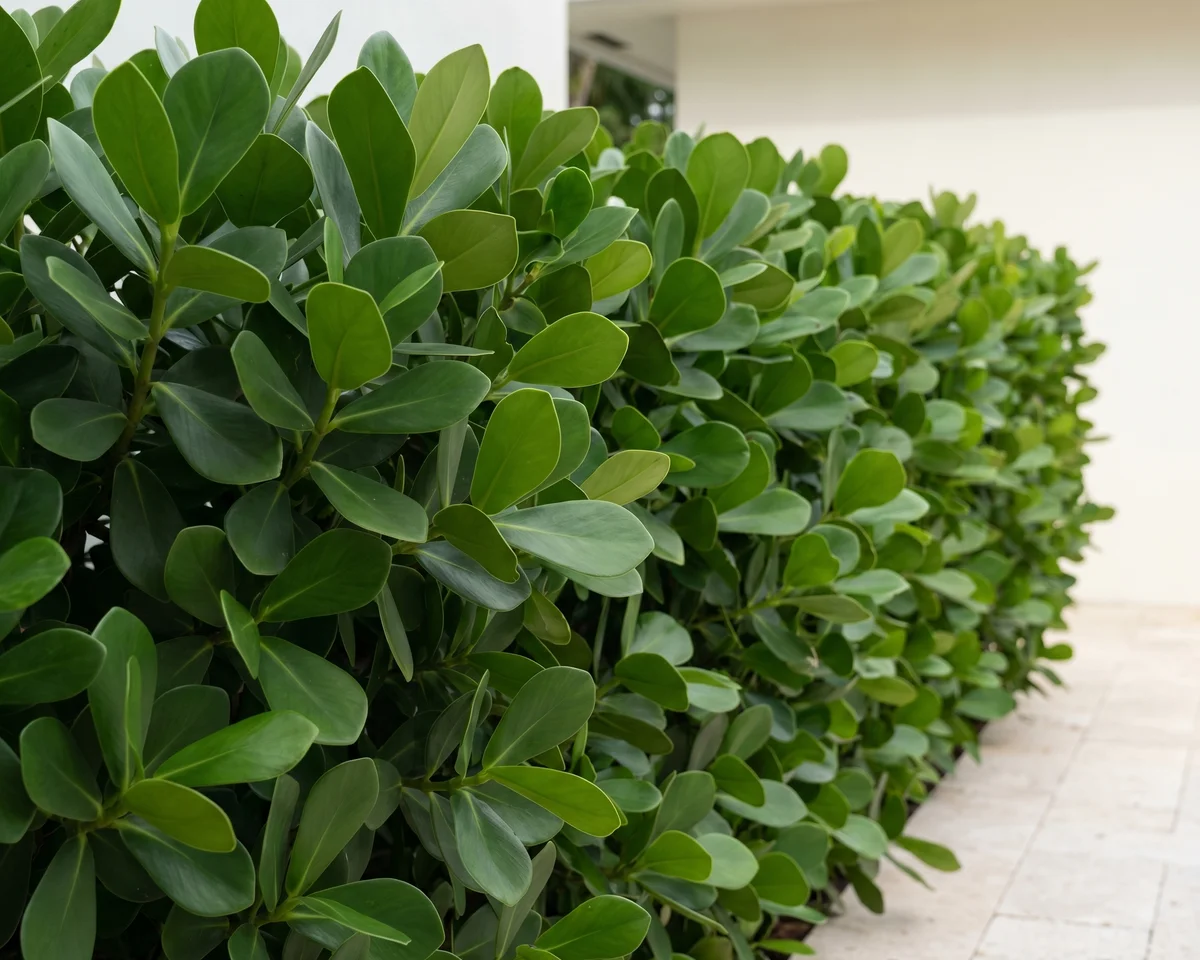
- Clusia is the default pick for sunny, coastal, and pool-adjacent yards. Broad glossy leaves absorb sound well, and the plant's dense form at install-height delivers real acoustic benefit immediately.
- Podocarpus is the strongest option for tall, dense, formal hedges. Its fine foliage at tight spacing produces a thick acoustic mass, and it can be pushed to heights that Clusia cannot. For homes with significant noise pressure, Podocarpus at 12 to 15 feet is often the right call.
- Mixed layered plantings, where Clusia or Podocarpus is combined with a second row of complementary greenery, produce the strongest acoustic result on properties with severe noise problems.
Which of these fits your yard depends on the same factors any hedge decision depends on: sun exposure, the look of the home, and the height and width available. The acoustic goal adds a priority on density and height, but it does not change the underlying species call.
Realistic expectations, set up front
Homeowners happiest with noise-reduction hedges are the ones who understood what to expect before install. The yard will be noticeably quieter on a typical day. Harsh high-frequency edges like engine whine and pool equipment whir will be softened. The reflective echo off a fence will be gone. The sound on the worst days will still be there, just quieter and more diffused.
Homeowners who expect silence are often disappointed, even when the hedge is doing everything it should. Setting the expectation honestly up front is part of the job. The payoff, when the expectation is right, is a yard that feels substantially better to spend time in, which is ultimately the reason anyone plants a noise-reduction hedge in the first place.