A plain-English deep dive: Clusia vs Podocarpus in South Florida
Clusia and Podocarpus are not competitors. They are two different answers to the same question, and the right answer depends on the yard. This section covers the differences that actually change the decision, written for homeowners choosing between them for the first time.
What each plant actually is
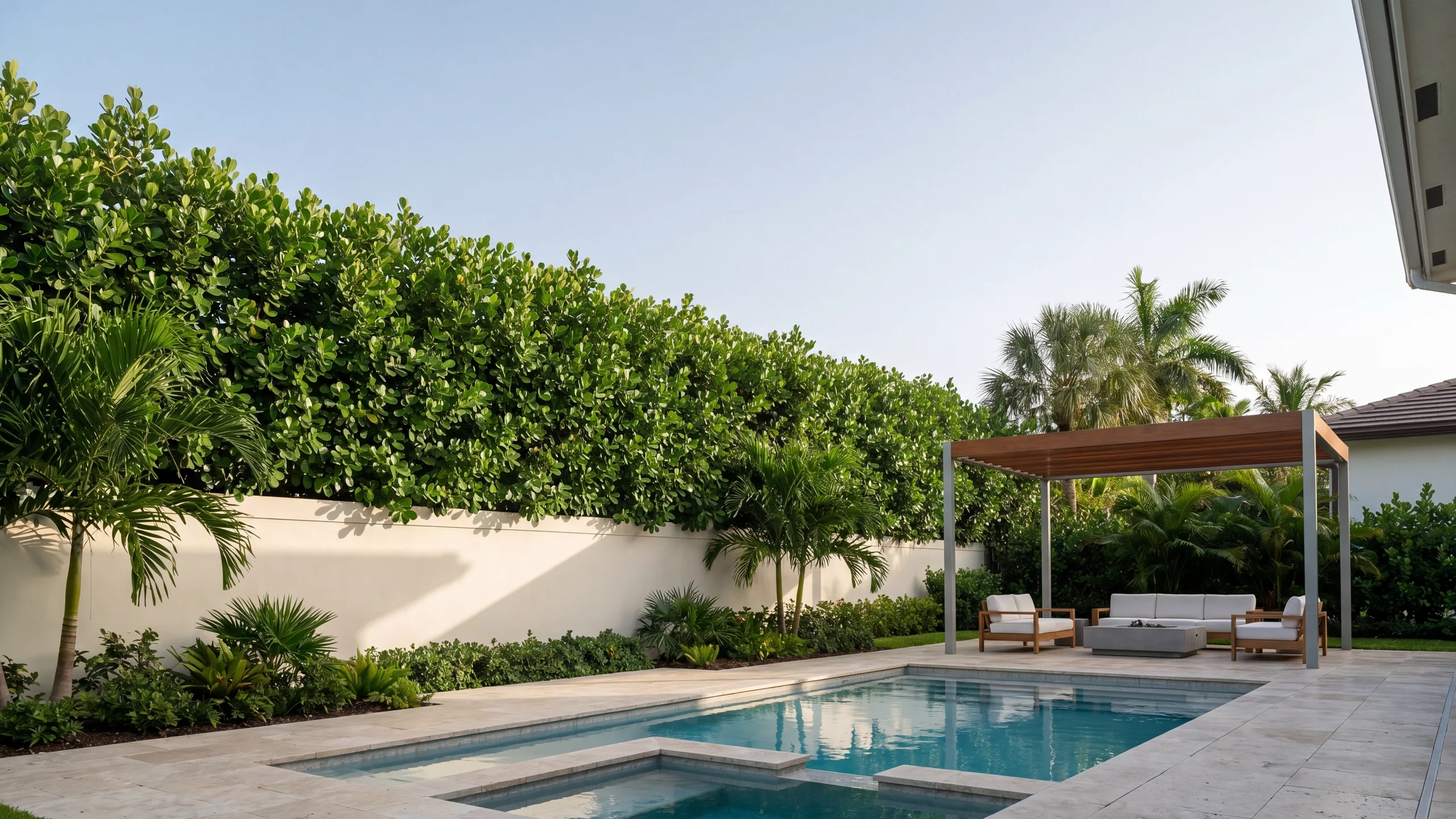
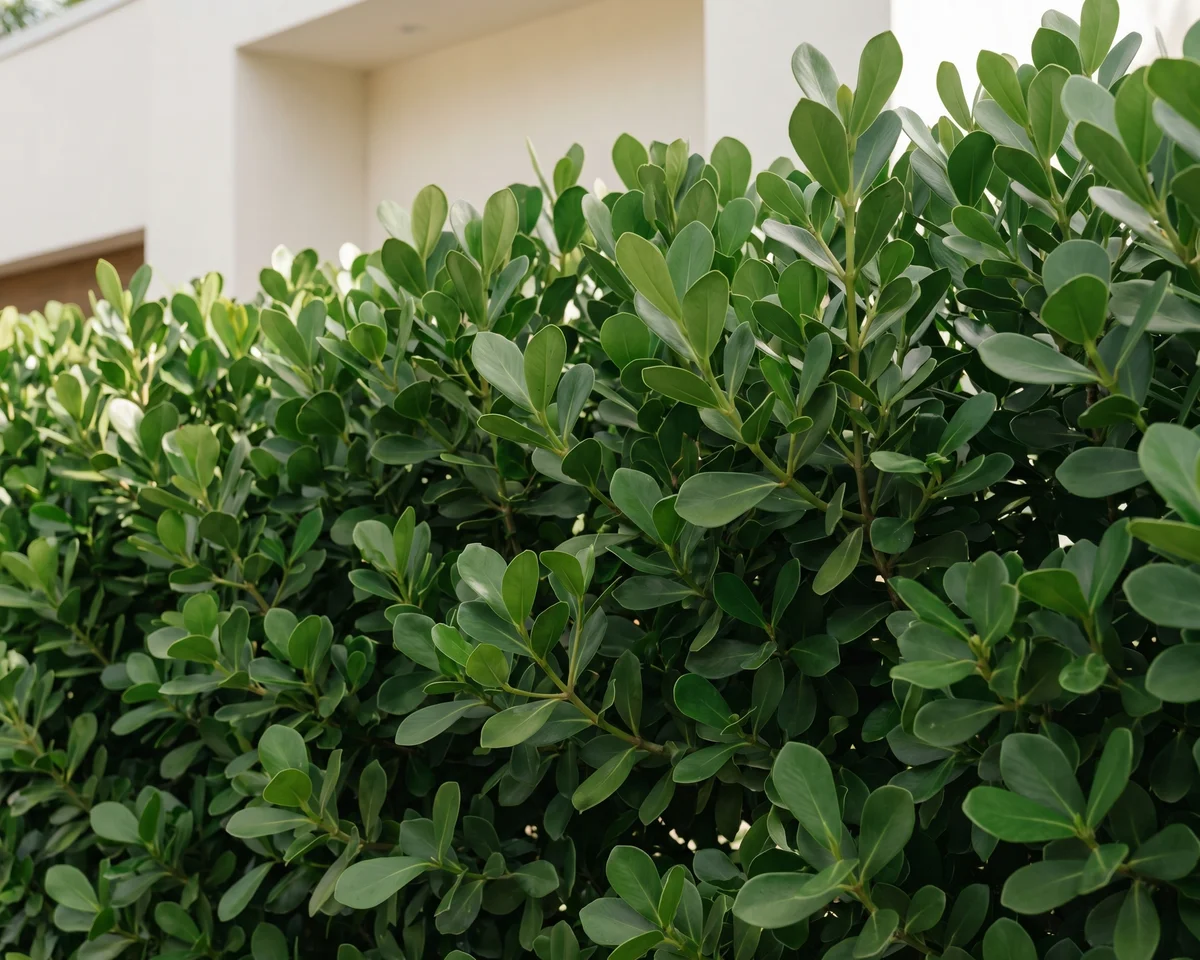
Clusia, usually Clusia guttifera or Clusia rosea, is a broadleaf evergreen shrub native to the Caribbean and Central America. It has the tropical look most people picture when they picture South Florida privacy. Leaves are broad, glossy, and slightly waxy. The hedge fills in rounded and full rather than narrow and architectural.
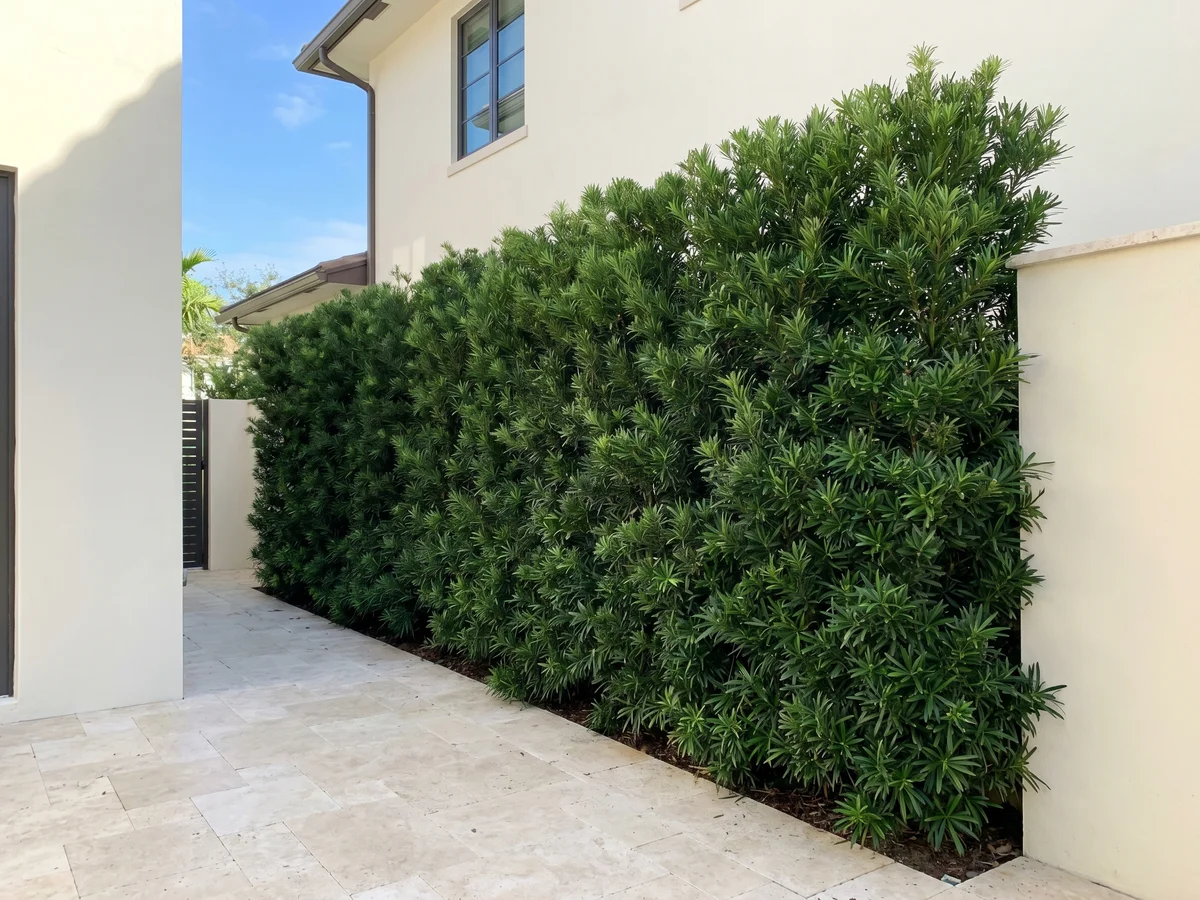
Podocarpus, usually Podocarpus macrophyllus, is a fine-textured evergreen with needle-like foliage and an upright, vertical habit. It originally comes from East Asia and has been used in formal landscaping for a long time. In the ground, it reads closer to a clean, clipped yew than a lush tropical hedge.
Sun, shade, and where each one thrives
This is usually the deciding factor. Clusia is a full-sun plant. It does its best work on open lots, street-facing property lines, pool screens, and yards that get most of the day in direct light. In partial or deep shade, Clusia slows down, thins out, and never quite fills in the way it does in sun.
Podocarpus handles a wider range of light. It still prefers sun, but it holds up under partial shade, near tree canopies, and along the shaded side of a two-story home. If the hedge line is not in full sun, Podocarpus is almost always the better call.
Height and scale
Clusia is comfortable in the 6 to 12 foot range. It can be held shorter if the yard only needs a waist-high to head-high screen, and it can push toward 12 feet for a street-facing or second-story block. Above that, Clusia works harder and starts to lose some of its clean rounded look.
Podocarpus is the plant of choice when the hedge needs to go taller. It is comfortable at 8 to 15 feet for a mature privacy wall and can be pushed higher for an architectural screen on a large estate or a tall two-story home. For hedge lines meant to match the scale of a big home, Podocarpus usually wins.
Footprint and width
Clusia wants room. It is a rounded plant and performs best when it has enough width to fill out naturally. In a tight side yard or a narrow run between a path and a property line, Clusia can feel crowded and take more pruning to control.
Podocarpus has a narrower natural footprint. It holds a tighter silhouette and fits runs where you do not have feet of garden to give up. For narrow side yards, townhouse property lines, and urban lots with limited depth, Podocarpus earns its place.
Style and how each one reads
A Clusia hedge reads lush, tropical, and resort-style. It pairs naturally with modern homes, coastal homes, and anything with a relaxed South Florida aesthetic. It is the plant behind a lot of the finished pool yards and privacy screens homeowners save photos of.
A Podocarpus hedge reads formal and intentional. It pairs with traditional, Mediterranean, and estate-style homes. Clipped tightly, it has a structured, clean-line look that is hard to replicate with any other South Florida hedge plant.
Coastal and salt exposure
Clusia is one of the most salt and wind tolerant hedge plants available for South Florida yards. On beachfront, near-beach, canal-front, and waterway-adjacent properties, Clusia handles the exposure that thins out less tolerant alternatives. For coastal installations, Clusia is usually the safer bet.
Podocarpus tolerates some salt and wind but not to the same degree. On protected interior lots, it is not an issue. On exposed coastal runs where the plant is taking direct salt spray, Podocarpus is not the plant we would reach for first.
Maintenance, growth rate, and long-term care
Both hedges are considered low-maintenance once established. Clusia tends to grow a bit faster in peak growing conditions and takes light pruning to keep its rounded form. It does not need constant shaping to look good.
Podocarpus grows slower but takes a clipped line and holds it longer. Owners who want a hedge that looks crisp and architectural between trims usually appreciate how Podocarpus keeps its shape. Owners who want a softer, more natural green wall usually prefer the way Clusia reads without heavy shaping. Our Podocarpus growth rate guide breaks down real timelines by starter size.
Pool adjacency and leaf drop
Leaf drop is often a quiet factor that matters more than homeowners expect. Clusia drops larger leaves at a relatively light rate. Around a pool, the leaves are easy to skim and the overall upkeep is manageable. This is part of why Clusia is such a common choice for pool-yard privacy.
Podocarpus drops fine, needle-like foliage, which can be a bigger issue around pool filters and waterline tile. It is not unusable near a pool, but many pool-side installs do better in Clusia specifically because the leaf drop behaves more predictably in the water.
Cost, availability, and what you actually pay for
Neither plant is a commodity. Pricing is driven by starter size, total length of the run, access to the yard, and how finished you want the hedge on day one. All else equal, Clusia and Podocarpus are in a comparable range for an installed privacy hedge. The larger the starter plant and the tighter the spacing, the more of your budget goes into the hedge itself.
When pricing looks dramatically lower than a premium installed hedge should cost, it almost always comes back to thin stock, loose spacing, or a DIY-grade planting crew. An honest quote tells you what you are getting, not just a number.
When each hedge is the clear winner
Not every yard is a toss-up. For most decisions, one plant is obviously the right call and the other is a compromise. The short guide below covers the clean, easy cases.
Pick Clusia when
- The hedge line is in full sun most of the day.
- You want a hedge in the 6 to 12 foot range, not higher.
- The home has a modern, coastal, or tropical aesthetic.
- The property is on or near the coast, a canal, or the Intracoastal.
- The hedge sits next to a pool where leaf drop matters.
- You want the yard to feel finished on install day.
Pick Podocarpus when
- The hedge line sits in partial shade or under a tree canopy.
- You need the hedge to reach 12 to 15 feet or taller.
- The home is formal, traditional, Mediterranean, or estate-style.
- The side yard is narrow and you cannot give up width.
- You want a crisp, clipped, architectural hedge line.
- The hedge has to block a second-story sightline from a neighbor.
Can you mix Clusia and Podocarpus on the same property?
Yes, and often it is the right answer. Many South Florida homes end up with Clusia along the sunny front and street-facing runs and Podocarpus along a shaded or narrow side yard. Using each plant where it belongs gives you a finished property instead of forcing one species into a job it was not built for.
What we avoid is mixing the two along the same continuous hedge line. The textures and forms are too different to read as one coherent hedge, and the visual break at the transition always looks unintentional. Separate runs are fine. Blended runs are not.
Which one costs less to own over time?
Both plants are inexpensive to maintain once the root system is set. The more meaningful difference is in replacement and replanting. A Clusia hedge that gets planted in deep shade will eventually need to come out. A Podocarpus hedge forced into heavy salt exposure will eventually need to come out. The long-term cost is almost always tied to picking the wrong plant for the site, not the plant itself.
This is the part of the call we take seriously during the quote. A hedge meant to live for years should be chosen for the site, not chosen to match what you saw on another yard.