Hedge installation cost, properly explained
Homeowners asking about hedge installation cost almost always want the same thing: a realistic number for what their specific yard is going to cost to hedge properly. The number depends on real site variables, so no honest page will give a single figure without seeing the yard. What an honest page can do is walk through the factors that actually drive the number, so the quote you eventually receive makes sense.
Plants are usually the biggest line
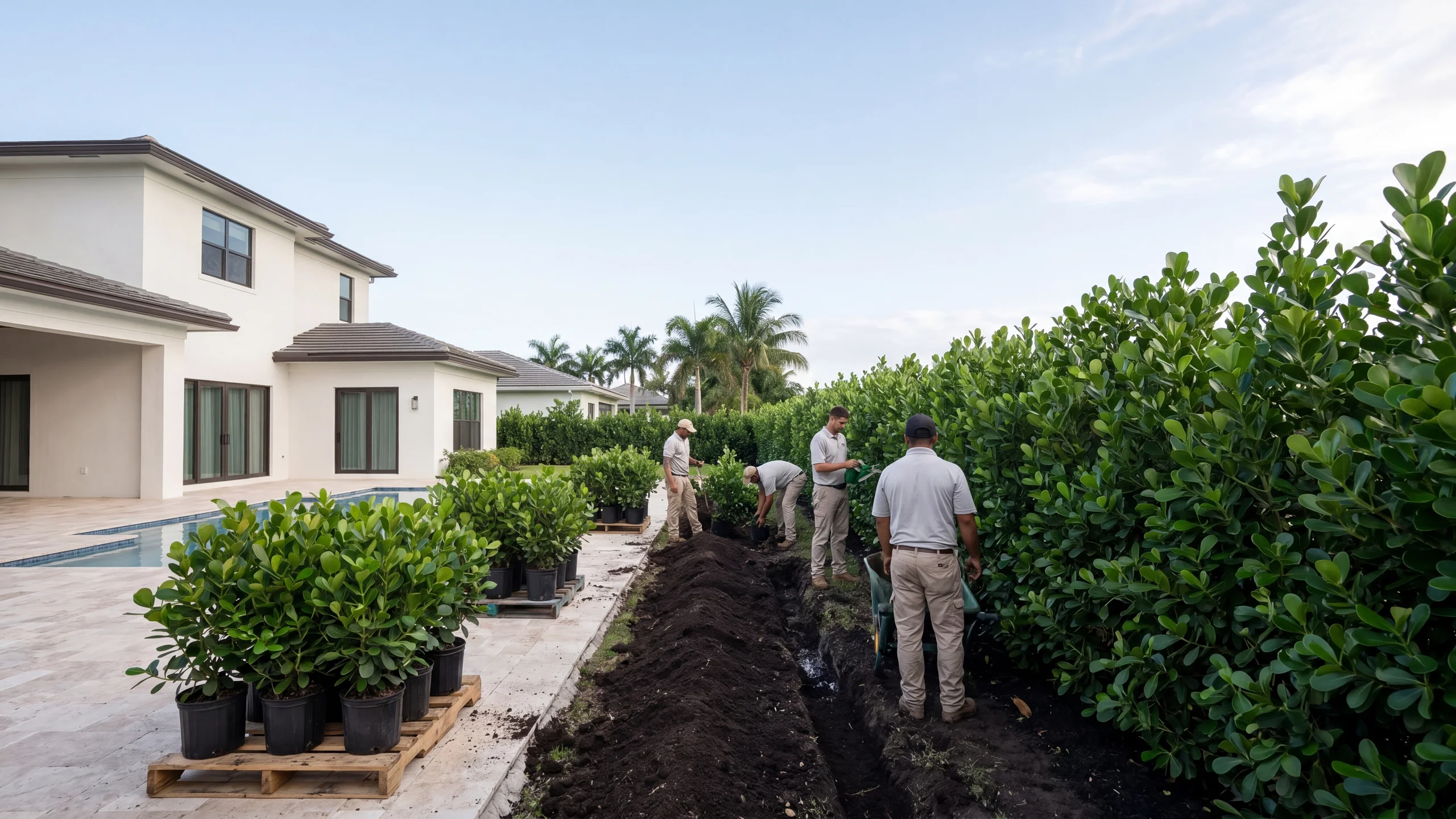
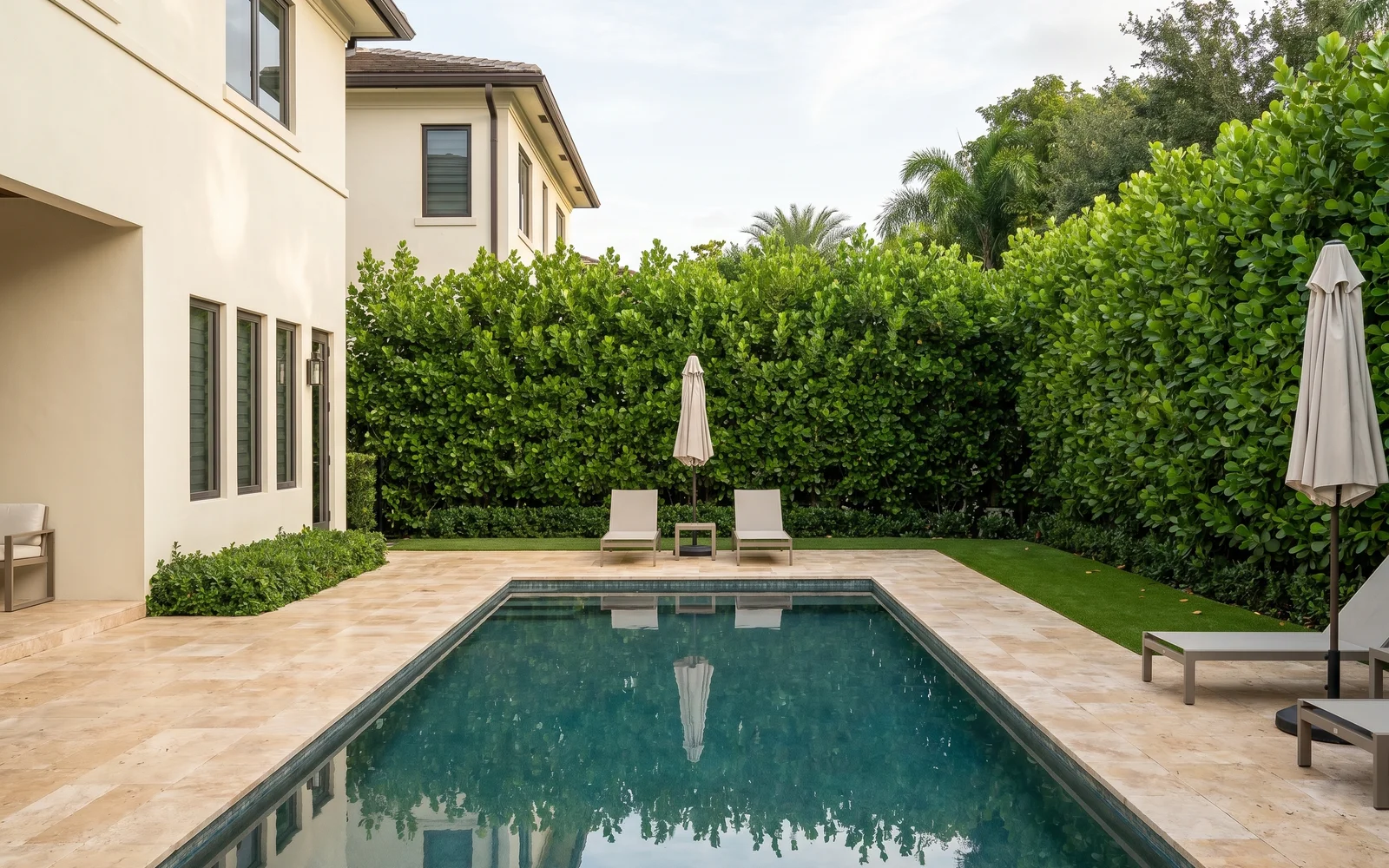
On a typical premium install, plant cost is the largest single line item. This is because hedge-specification starter plants are not the small container shrubs sold for general landscape use. They are larger, taller, and more developed, and they are priced accordingly. A hedge built from these plants produces a finished privacy wall on install day, which is what most homeowners are actually buying.
You can lower the plant line by choosing a smaller starter size, but you are trading day-one finish for up-front savings. A hedge planted at smaller sizes costs less up front and looks less finished for a growing season or two. Whether that trade is worth it depends on how important the immediate result is to you.
Spacing multiplies plant count
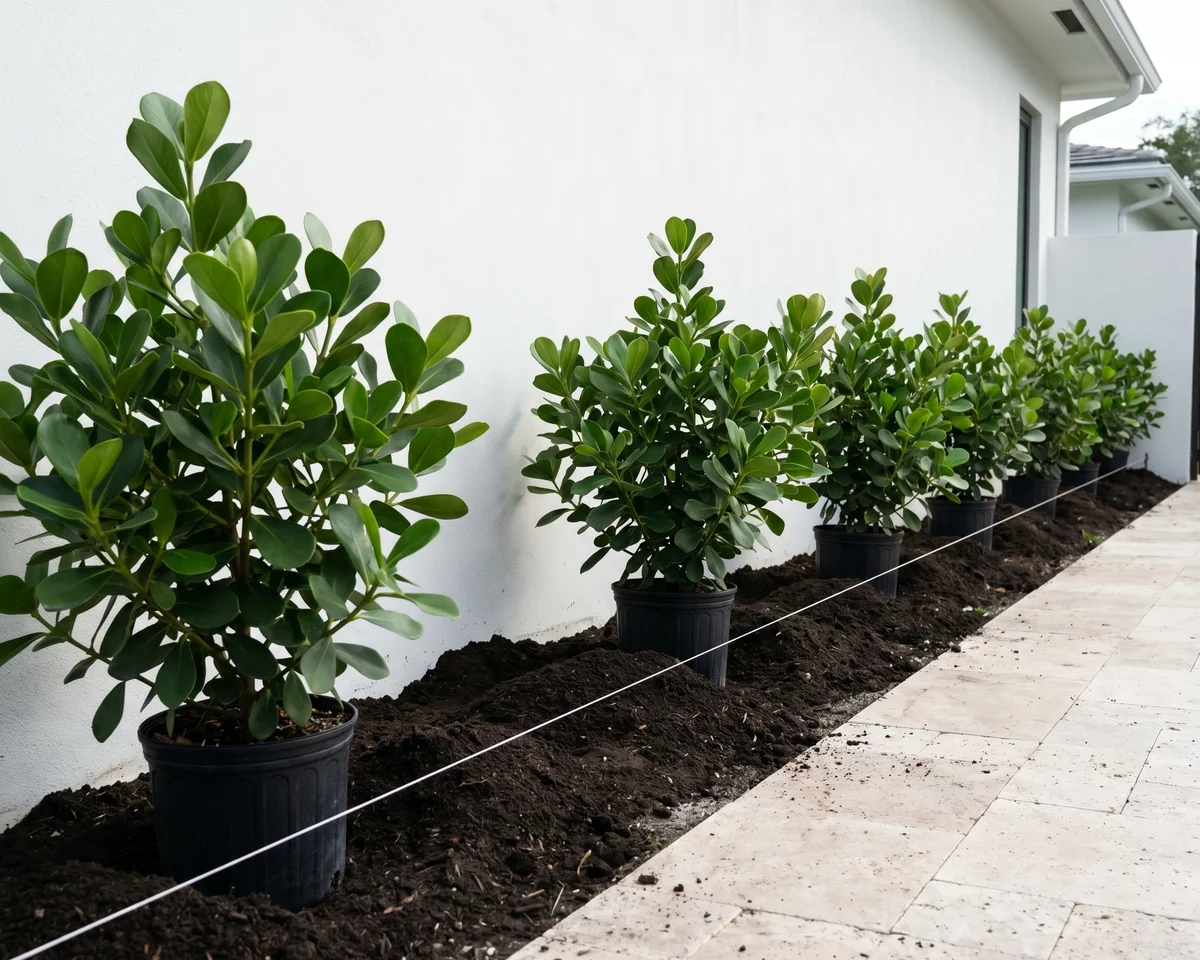
Spacing decides how many plants go into a hundred feet of hedge, and spacing is set by plant size. In 3-gallon at 1 to 1.5-foot centers, a hundred feet needs about 68 to 101 plants. In 15-gallon at 2 to 2.5-foot centers, about 41 to 51 plants. In 25-gallon at 3 to 3.5-foot centers, about 29 to 34 plants. Smaller plants need tighter spacing and more of them but cost less each; larger plants sit wider and need fewer but cost more each.
Premium installs default to tighter centers because the finished result is better. Budget-conscious installs sometimes choose wider centers because the up-front savings are meaningful. Both are legitimate choices. A quote that shows the spacing and plant count clearly lets you see which choice you are actually buying.
Run length is a multiplier, not a rate
Many homeowners expect a hedge quote to work like a flat per-foot rate. In practice, longer runs are often cheaper per foot than short runs because fixed costs like site mobilization, crew travel, and delivery do not scale down for short jobs. A 20-foot hedge and a 200-foot hedge are not priced in the same way.
For short runs, the per-foot price can feel high compared to a longer neighbor's hedge. This is not markup. It is how the fixed costs of running a professional crew are distributed across a smaller scope. Asking for a break on short-run pricing rarely works, because the numbers already reflect the real math.
Access changes the labor line
Yards with easy access take less time and cost less to install. Yards with narrow gates, tight driveways, long walk-in paths to the hedge line, or obstacles in the work area take longer. In extreme cases, install crews need to switch to hand-carry methods or smaller equipment, which adds hours to the job.
Access is a quiet driver that shows up in the install labor line on a careful quote. If access is difficult, a crew that ignores it will underprice the job and then cut corners on install day to make the schedule. A realistic quote accounts for it up front.
Soil and prep work
Most standard South Florida yards do not need major soil work before a hedge install. Sandy coastal soil is a known substrate for Clusia and Podocarpus, and both species handle it well. Sites that have been recently disturbed by construction, that have drainage issues, or that have depleted soil from a previous failed hedge may need amendment or grading before planting.
Prep work adds cost when it is needed. It also protects the long-term performance of the hedge. A quote that includes soil prep is usually giving the hedge the best chance to establish cleanly, not padding the price. A quote that skips prep entirely on a site that actually needs it is saving money in the wrong place.
Removal of existing plants
If the install is replacing a failed hedge, old plants have to come out. For standard shrub removal, this is a straightforward scope. For failed ficus hedges with aggressive root systems, removal is a significant job that requires full root-ball extraction rather than surface grinding. The removal line on a replacement install can range from modest to substantial depending on what is coming out.
The cheapest way to remove a ficus is to grind the visible stump and move on. That shortcut is one of the most common sources of price variance between quotes, and it is the one that almost always comes back to bite the homeowner. A properly priced removal protects the new hedge.
What a premium quote actually includes
A premium hedge install quote in South Florida typically covers:
- Hedge-specification plant stock at the correct starter size for a finished look.
- Tight consistent centers so the hedge reads as one line from install day.
- Proper soil prep and drainage checks where the site needs them.
- Full removal of old plants or hedge mass, including root-ball extraction where applicable.
- Install labor by a dedicated crew accountable for the finished result.
- Plant warranty or establishment guarantee on the installed hedge.
When a quote is dramatically cheaper than the market, one or more of these line items is usually missing or thinned out. The low number is almost always paying for the absence of something that matters rather than finding real savings.
What a cheap quote usually cuts
The common cost-cutting levers on a cheap hedge install quote are predictable:
- Smaller plant starters, often retail-grade rather than hedge-specification.
- Wider spacing that lowers plant count at the cost of day-one finish.
- Minimal soil prep, even on sites that need it.
- Surface grinding on removal jobs instead of extraction.
- Subcontracted labor paid by the job rather than by the quality of the outcome.
- No establishment warranty or a very limited one.
Each of those cuts saves money on the quote and costs money later. Some homeowners make the trade anyway, with eyes open. Most do not realize what they are trading when they choose the lowest bid.
How South Florida hedge cost scales by species and size
National cost guides quote a wide flat per-foot range that averages everything from arborvitae in cooler markets to subtropical ficus runs, which is not very useful for a Miami, Fort Lauderdale, or West Palm Beach homeowner who actually needs to plan. Instead of a number that goes stale the day it is published, the table below shows how cost scales across the real Clusia and Podocarpus installs we do, by species and starter size. Where each option lands in real dollars depends on your yard, so every project gets an itemized quote rather than a price off a chart.
| Species | Starter size | Plant height at install | Relative cost tier | Day-one finish |
|---|---|---|---|---|
| Clusia guttifera | 3-gallon | 2 to 3 ft | Lowest upfront | Fills in over 1 to 2 seasons |
| Clusia guttifera | 7-gallon | 3 to 4 ft | Value / most common | Reads as a hedge in months |
| Clusia guttifera | 15-gallon | 4 to 6 ft | Premium residential | Finished on install day |
| Clusia guttifera | 25-gallon | 6 to 8 ft | Premium plus | Finished on install day, premium |
| Podocarpus macrophyllus | 7-gallon | 4 to 6 ft | Value, runs above Clusia | Reads as a hedge in months |
| Podocarpus macrophyllus | 15-gallon | 6 to 8 ft | Premium residential | Finished on install day |
| Podocarpus macrophyllus | 25-gallon | 8 to 10 ft | Premium estate | Finished on install day, premium estate |
How to read the tiers. Cost climbs as you move down each species block, because a bigger starter is a bigger plant. Podocarpus sits a step above Clusia at the same size because nursery growth is slower and supply is tighter. Within any single tier, the actual number still moves with spacing, access, and prep: a 15-gallon Clusia on a clear flat front yard with easy crew access sits at the low end of its tier, the same plant on a tight side yard with hand-carry access sits higher. Removal of failed plants, soil amendment, and irrigation tap-ins are separate line items on top. And longer runs land lower per foot than short runs, because the fixed cost of mobilizing a crew spreads across more footage.
What actually sets your number
Rather than a chart price that would be wrong for most yards, the honest way to plan is to understand what moves your total up or down. In rough order of impact: starter size (the single biggest lever), run length (short runs cost more per foot), species, site access and prep, any existing hedge removal, and add-ons like irrigation. Two homeowners on the same street with the same run length can land in different places because those variables stack differently on each lot. That is why we quote from a site walk, itemized line by line, so you can see exactly what each choice costs on your property instead of guessing from a range.
How to compare quotes honestly
A useful way to compare hedge quotes is to line them up by the variables that actually matter. Ask each bidder to specify: plant species, starter size, spacing, plant count, soil prep approach, removal scope, and warranty. Then compare the quotes on those terms, not on the total alone.
When the specifications are aligned, the prices usually cluster. When the specifications diverge, the price spread often tells you exactly which lines the cheaper bidder cut. A middle quote with clear specs typically beats the cheapest quote and the most expensive one because it reflects the right balance of plant, labor, and prep for the real site.
Why the cheapest quote almost always costs more
The cheapest quote is rarely the cheapest install over time. Hedges that were planted too small, too far apart, into unprepared soil, with residual roots from a failed removal tend to underperform for years. The rework costs, whether that is eventual replacement, ongoing maintenance, or just lost enjoyment of the yard, compound over time.
Most homeowners who come to us to fix someone else's failed install describe a similar pattern. They chose the cheapest bid, the hedge did not perform, and the call to fix it costs more than the difference between the cheapest and the right quote would have been in the first place. This is the quiet reason most premium installs come back with referrals to the crew that did them. Quality on install day is the cheapest version of a hedge over ten years.