Clusia spacing, explained properly
"How far apart to plant Clusia" is one of the most searched questions about the plant, and one of the most poorly answered ones online. Most spacing advice is a single number with no context, which is why so many homeowners end up with a hedge line that never quite reads as a hedge. This section covers how real spacing decisions are actually made on South Florida yards.
Why starter size drives everything
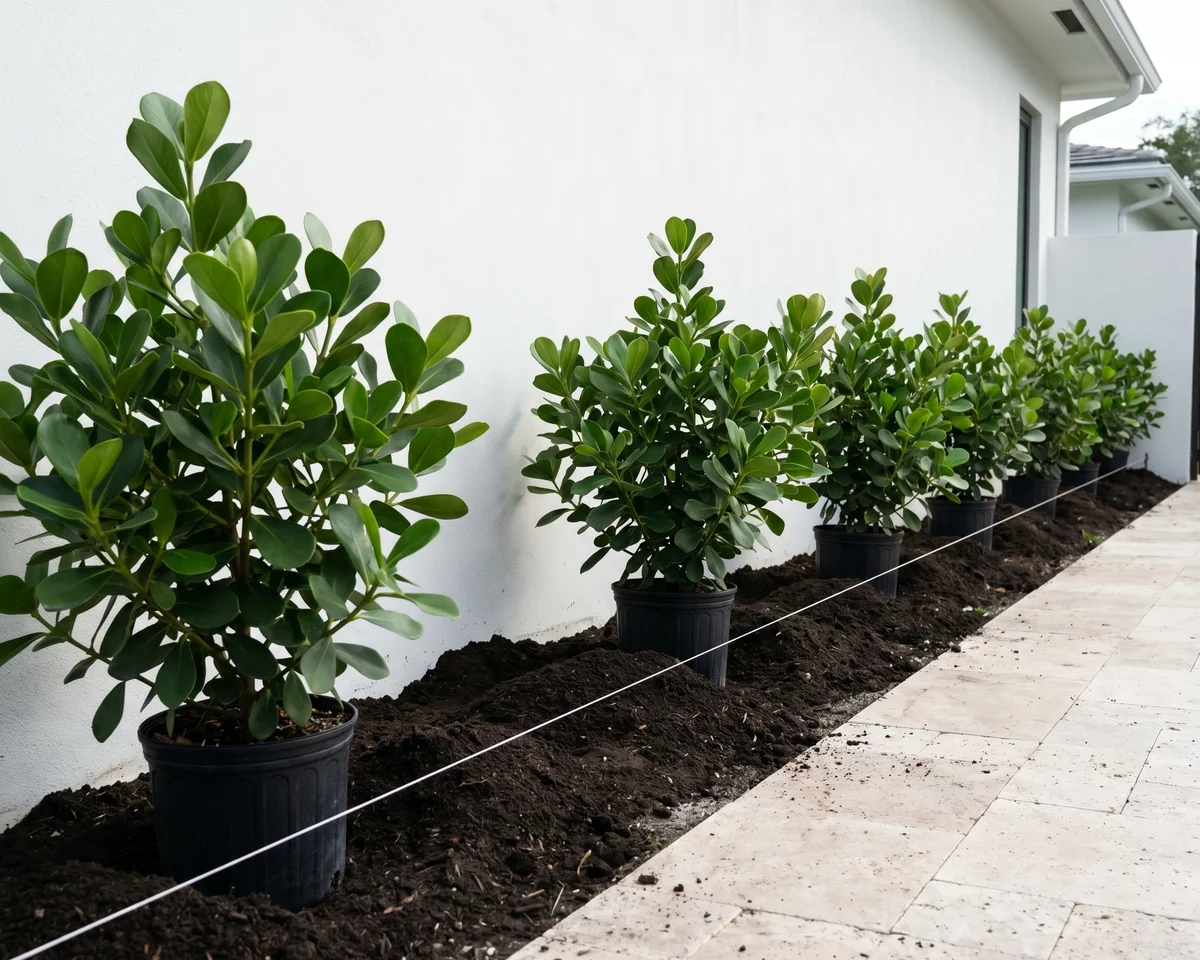
Spacing does not exist on its own. It only makes sense with a starter plant size attached to it. A 7-gallon Clusia at 2-foot centers reads as a finished wall, because a 7-gallon plant is wide enough to touch its neighbors at that distance. A 3-gallon Clusia at that same 2-foot spacing is planted too far apart for its size, leaving gaps that take years to close, if they ever do. Once you know the spacing, the next decision is the starter size, which we cover on our Clusia plants for sale page. If you have not measured the run yet, start with how to measure a hedge line.
The right way to think about it: starter size tells you the correct centers. Larger starters sit on wider centers and still touch because the plants are already wide. Smaller starters need tighter centers so the row closes into one line. Match the two and the hedge reads clean; mismatch them, especially small plants set wide, and you get a row of separate shrubs.
The two common spacing patterns
Most Clusia privacy hedges we install fall into one of two patterns. Understanding both makes the trade-off obvious.
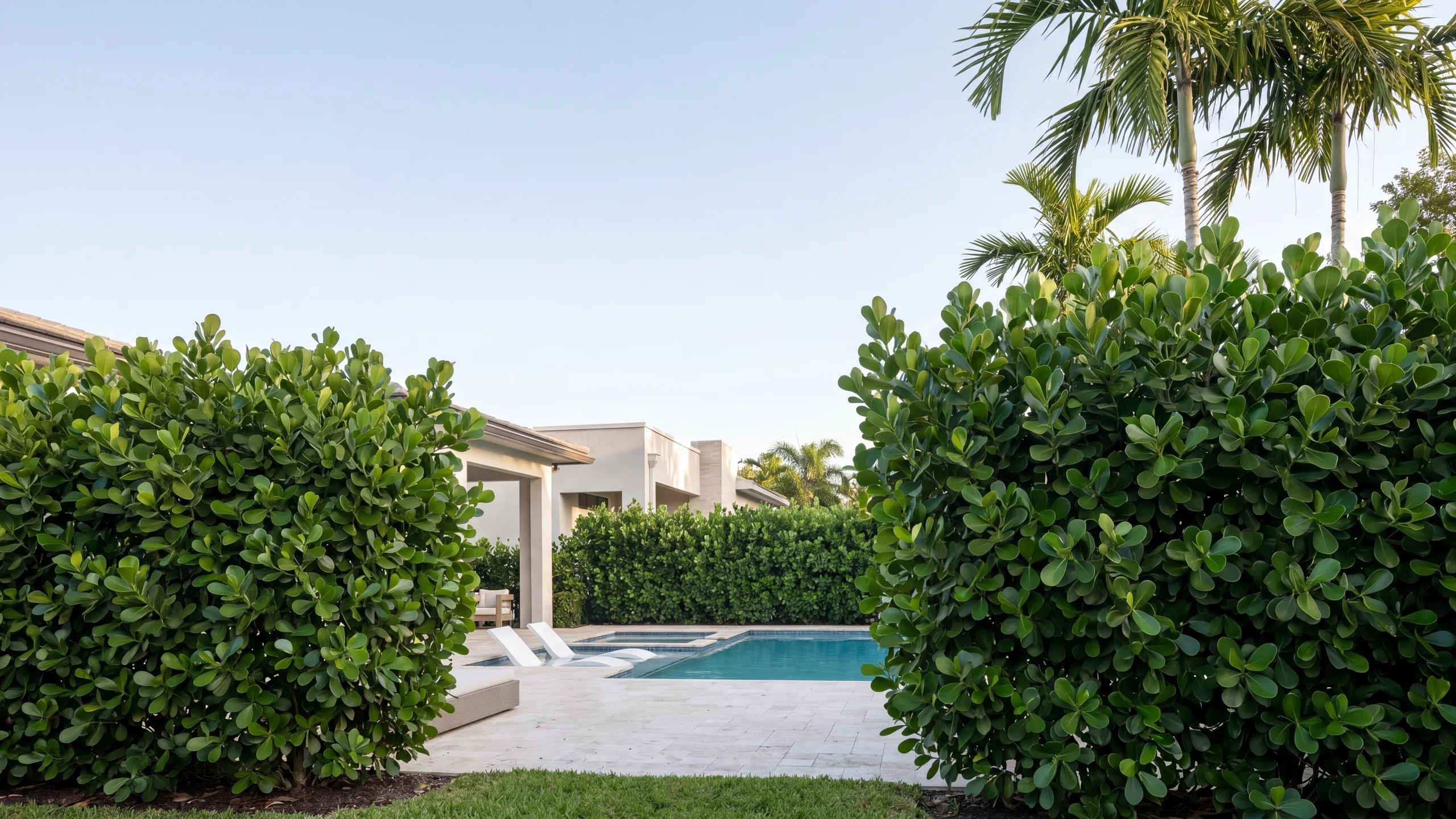
Finished-now install. Larger Clusia starters (15 to 45-gallon) on their matched centers, roughly 2 to 4 feet depending on size. The plants are already tall and wide, so adjacent plants nearly touch on install day and the hedge reads as one continuous wall immediately. This is the premium option most homeowners want when they describe "a finished yard on day one." It is how we plant most of the Clusia privacy hedges we install across South Florida.
Fill-in install. Smaller Clusia starters (3 to 7-gallon) on tight centers, roughly 1 to 2 feet. Set tight, the row still closes laterally fairly quickly, but the plants take a growing season or two to reach full height. This is a budget-conscious option that produces a fine hedge over time. It is not the same product as a finished install. Not sure which fits your yard? Get a free quote and we will match the size and spacing to your run.
Clusia spacing by gallon size
The clearest way to think about spacing is as a function of the gallon size of the starter plants. Larger containers carry larger, wider plants, which sit on wider centers while still touching; smaller plants need tighter centers to close the line. The table below is what we actually plan from on real installs.
| Container size | Plant height at install | Spacing (on center) | Plants per 10 ft | Day-one finish |
|---|---|---|---|---|
| 3-gallon | 2 to 3 ft | 1 to 1.5 ft | 7 to 10 | Fills in over 1 to 2 seasons |
| 7-gallon | 3 to 4 ft | 1.5 to 2 ft | 5 to 7 | Reads as a hedge within months |
| 15-gallon | 4 to 6 ft | 2 to 2.5 ft | 4 to 5 | Finished on install day |
| 25-gallon | 6 to 8 ft | 3 to 3.5 ft | 3 to 4 | Finished on install day, premium |
| 45-gallon and larger | 8 ft and up | 3.5 to 4 ft | 2 to 3 | Tall finished hedge, premium estate work |
Two notes on the table. First, "plants per 10 ft" is rounded to whole plants because you cannot install a fraction of a Clusia. Second, the "day-one finish" column assumes a properly run install with healthy starter stock. Mixed sizes, struggling plants, or wider centers than the recommendation will not produce the finish listed.
Single row vs staggered double row
Almost all residential Clusia hedges in South Florida are a single row. Single rows are faster to install, use fewer plants, and produce a clean line on most property edges.
For tall street-facing hedges, long estate runs, or hedges that need to read extra solid from day one, a staggered double row is sometimes the better answer. Two rows of Clusia installed slightly offset from each other produce a thicker, more visually solid hedge than a single row at the tightest possible spacing. It also costs more, because it is nearly double the plants.
For most homeowners, a well-planned single row at tight centers with good starter plants is more than enough. Staggered double rows are a specific solution for a specific problem.
How to calculate plant count for your run
The math is simple, and it matters because plant count drives the install budget.
Plant count for a straight run is roughly the run length in feet divided by the spacing in feet, plus one plant. A 30-foot run of 25-gallon Clusia at 3-foot centers is about 11 plants. A 60-foot run of 15-gallon at 2.5-foot centers is about 25 plants. A 100-foot run of 7-gallon at 1.5-foot centers is about 68 plants, and the same run in 3-gallon at 1-foot centers is about 101. Smaller plants mean tighter centers, which means more plants. Rounding up to a whole plant is normal. Rounding down is not.
Corners, gates, and utility access can change the count. Most real hedges are not one straight line, so the final number from a site walk will often be slightly different from a napkin calculation. That is normal.
What wider spacing actually costs you
The quiet risk with wider spacing is that the hedge never fully closes up visually. Clusia plants at 4 or 5 foot centers can look like a row of individual shrubs even years in, especially if any of them struggle in a given spot on the run. A hedge line that reads as separate plants is not acting as a hedge, regardless of how mature each plant looks on its own.
Tighter spacing fixes this by removing the visual gap before it ever forms. The plants meet early, fill each other out, and never really read as individual shrubs. This is what homeowners usually mean when they describe a hedge that looks like a continuous green wall.
What tighter spacing costs you
Tighter spacing costs more per foot because it uses more plants. It also requires a bit more care during install because plants that are meant to nearly touch on day one leave less room for error. The upside is a premium finish. The downside is the line-item cost on the quote.
For yards where the hedge matters to the look and value of the home, tighter spacing is almost always worth the difference. For yards where a green line is enough and the owner does not mind a fill-in window, looser spacing can be a sensible choice.
Common Clusia spacing mistakes
- Copying spacing numbers from plant tags. Plant tag spacing is a survival range, not a hedge spec. Real hedge spacing is tighter than what nurseries print for general landscape use.
- Mixing large and small starter plants in the same run. A Clusia line with visibly different starter heights looks uneven for years. We match sizes intentionally across a run.
- Treating Clusia guttifera and Clusia rosea as interchangeable. They need different spacing. Mixing them along one line creates a visual inconsistency that never settles out.
- Loose spacing to save plant count. Cutting plant count by widening centers is the most common reason a hedge never looks finished. The savings are rarely worth the result.
- Planting too close to structures. Clusia wants room to fill out in width, not just height. Planting against a fence or structure crowds the plant and restricts the hedge's growth on that side.
Spacing for specific hedge heights
A quick reference for how spacing tends to shift with finished height. These are common starting points, not strict rules.
- 6-foot hedge: 15-gallon starters on 2 to 2.5-foot centers for a finished look.
- 8-foot hedge: 25-gallon starters on 3 to 3.5-foot centers.
- 10-foot hedge: 25 to 45-gallon starters on 3 to 3.5-foot centers, sometimes staggered double row.
- 12-foot hedge: 45-gallon starters on 3.5 to 4-foot centers, often staggered double row for visual density.
The taller the hedge, the more width each plant claims at maturity, and the more the spacing can relax without creating gaps. This is why tall hedges often use a staggered double row at the same tightness as a single-row shorter hedge would.
When to ignore this page and just ask
Spacing is one of those topics where reading about it helps you talk through the plan, but the real answer comes from looking at the yard. A site walk takes into account sun exposure, soil, neighboring plants, hardscape, the finished height you want, and the specific starter stock we have available. That combination changes the right spacing for your hedge more than any internet guide can.
If you are at the point of pricing a real install, skip the guesswork. A quick quote walk-through gives you the actual number of plants, the actual centers we would install at, and a final plan you can compare to any other bid cleanly.