A plain-English guide to planning a Clusia hedge in South Florida
Most of the decisions that make or break a Clusia hedge happen before the first plant goes in the ground. This section covers the ones worth understanding before you request a quote, written for homeowners, not horticulturists.
What Clusia actually looks like in the ground
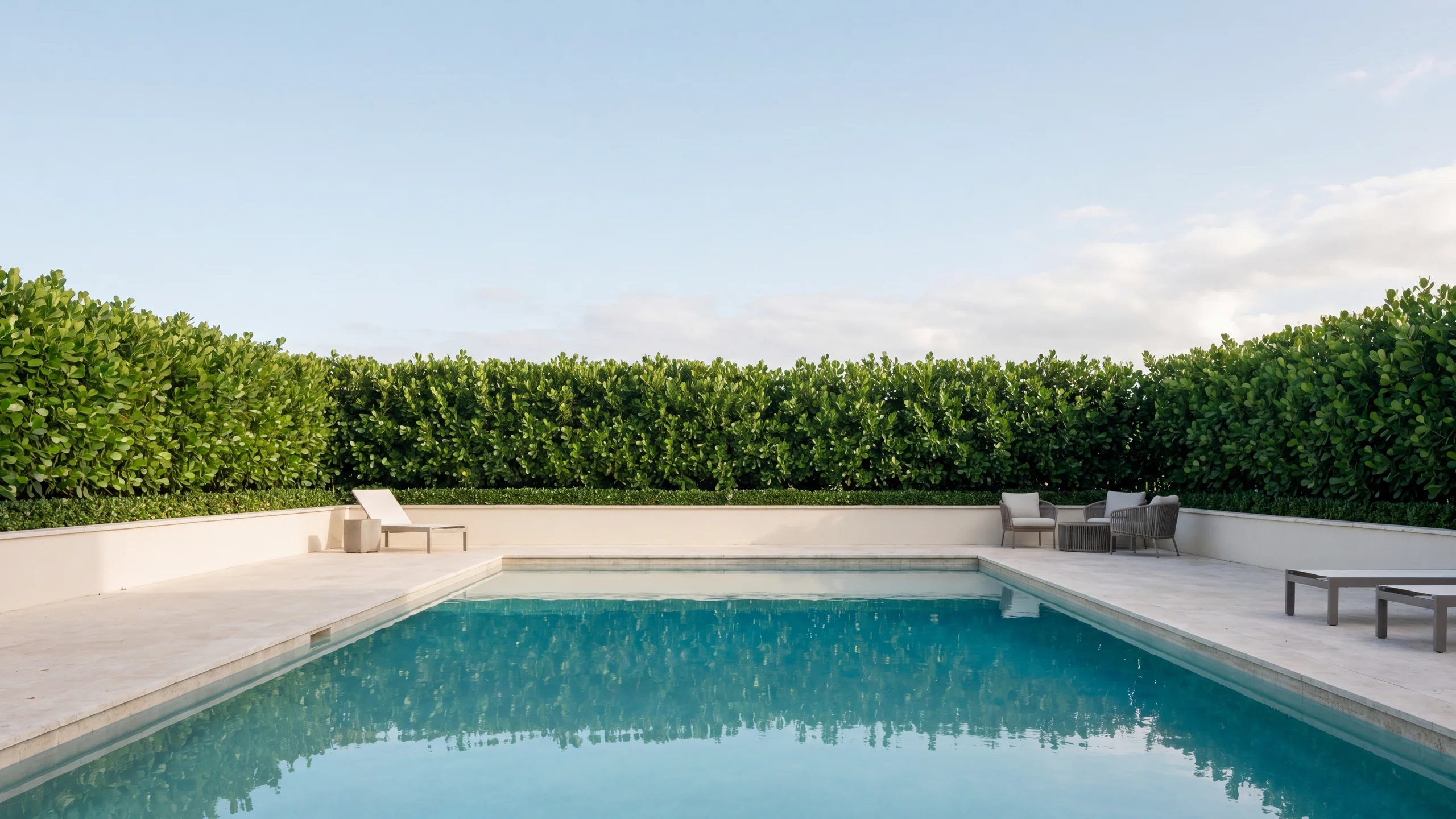
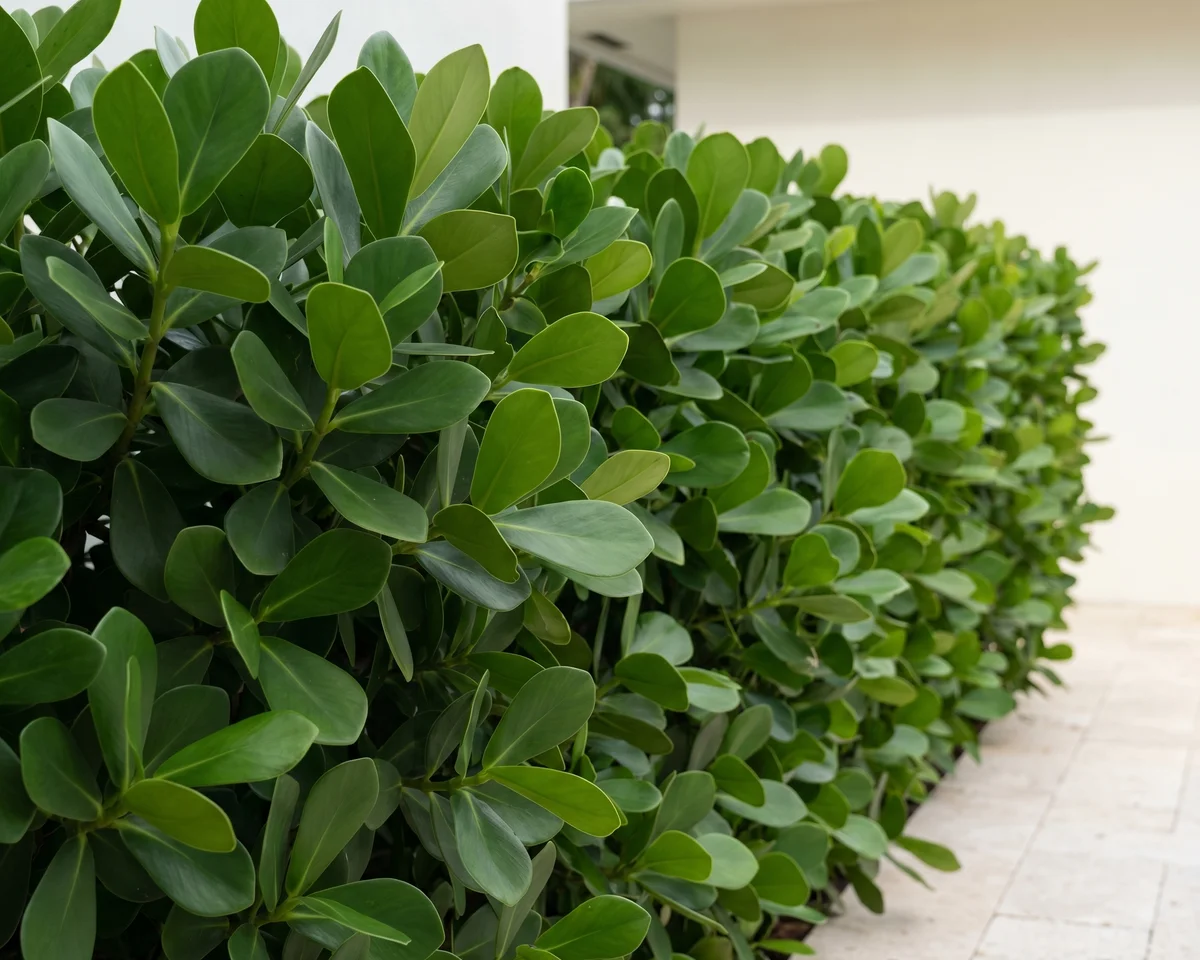
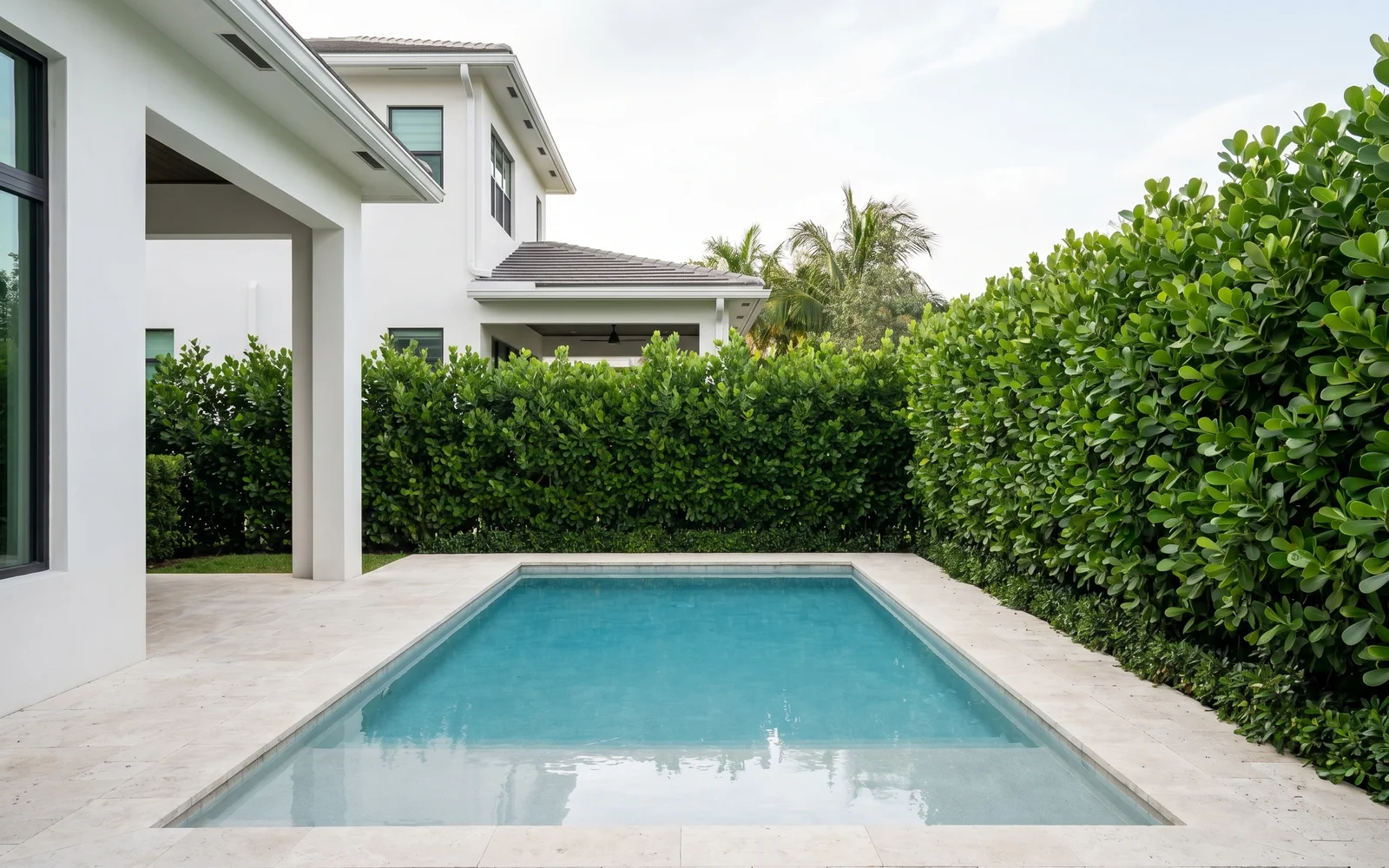
Clusia reads tropical, rounded, and full. The leaves are broad, glossy, and slightly waxy, so the hedge line catches light cleanly instead of looking flat. When it is installed correctly, the plants fill together into one continuous green mass rather than a row of separate shrubs. We explain the difference in our guide to a Clusia shrub versus a Clusia hedge.
Two Clusia types are common in South Florida hedge work. Clusia guttifera, often called small-leaf Clusia, is the most popular hedge form because it grows tight and clean. Clusia rosea, sometimes called the autograph tree, has bolder, larger leaves and a more rustic look. Both work. Which one fits your yard depends on scale, style, and finished height. Our guide to Clusia guttifera vs Clusia rosea walks through how to tell them apart before you buy.
Where Clusia performs best
Clusia is at its best in full sun, on open lots, along pool screens, and on property lines that get most of the day in direct light. It has strong salt and wind tolerance, which is why it is a default choice for coastal and near-coastal yards in Miami-Dade, Broward, and Palm Beach counties. Sandy, well-drained soil is a natural fit.
Clusia is not the right plant for every situation. Deeply shaded hedge runs under heavy tree canopies or tight against the shaded side of a two-story home usually ask for a different plant. Podocarpus tends to be the stronger call there. We will tell you that directly during the quote rather than sell the wrong hedge.
Starter size and spacing
Two planning levers decide how finished a Clusia hedge looks on day one: the starter size of the plants we install, and how tightly they are spaced. A taller starter at wide spacing never reads as one hedge. A shorter starter at tight spacing fills in visually but stays short for longer.
For a Clusia hedge meant to provide privacy from the first evening, we typically use a solid starter height and tight, consistent centers so adjacent plants nearly touch when they go in. For tall or wide runs, a staggered double row is sometimes the better solution. You do not need to memorize any of this. It belongs in the quote, not in your notebook.
What a Clusia hedge asks for once it is in
Early on, a new Clusia hedge wants consistent water while the root system sets. That is the single most important window. After the plant is established, Clusia is drought tolerant and usually only needs supplemental water during long dry stretches.
Shaping is light. Most owners run a seasonal trim to keep the hedge tidy and let it continue to thicken, and our guide on how to trim a Clusia hedge walks through the cuts that keep it full to the ground. Fertilizing during the growing season helps, especially in sandy coastal soil that drains nutrients quickly, and we cover what to use in our guide to the best fertilizer for Clusia hedges. Beyond that, Clusia is a low-drama plant in South Florida conditions.
Common Clusia planning mistakes, and how to avoid them
The recurring issues we see on yards where a Clusia hedge did not turn out right almost always trace back to the plan, not the plant.
- Mismatched starter sizes along one run. When plants of very different heights are set into the same hedge, the line looks uneven for years. We match sizes intentionally.
- Spacing too loose. A Clusia line that is not tight enough never quite reads as a single hedge, even when the plants are healthy. The screen stays visually broken.
- Planting Clusia in deep shade. The plant will survive, but it will thin and struggle. For shaded runs we usually recommend Podocarpus and explain why.
- Treating Clusia rosea and Clusia guttifera as the same product. They look different in the ground. Mixing them along one hedge line creates a visual inconsistency that does not settle out over time.
- Installing too close to a pool deck footing or a neighbor's structure. A hedge needs room to mature in width, not just height. We plan around it.
When Clusia is the right call, and when it is not
Clusia is the right call when you want a dense, tropical, evergreen privacy hedge in a sunny South Florida yard and you want the hedge to read finished on install day. That covers most of the requests that come in.
It is not the right call when the hedge line is deeply shaded, unusually narrow, or needs to push well above standard Clusia heights for a tall architectural screen. In those cases Podocarpus or a different plant is usually a better match. Either way, the recommendation is yours after we walk the yard. We would rather steer you to the right hedge the first time than sell you the wrong one.
Clusia varieties: which one to plant where
"Clusia" is not one plant. Two varieties dominate the South Florida hedge trade, and the difference between them shows up the first month after install. Knowing the distinction before you order matters because the leaf size, branching density, and finished look are not the same.
Clusia guttifera: Small-Leaf Clusia (sold as 'Princess')
Clusia guttifera is the default residential privacy hedge variety in South Florida. Many nurseries sell it under the trade name Princess Clusia, sometimes labeled Clusia guttifera 'Nana'. They are the same plant. The "Princess" label is marketing for the compact, hedge-suitable form rather than a distinct species.
What you get: smaller, rounded, slightly waxy leaves about an inch and a half across, tight branching density, and a clean clipped line. Mature hedge height comfortably sits at 6 to 12 feet, occasionally pushed higher on tall street-facing runs. This is the variety we install on roughly nine out of ten residential Clusia projects.
Clusia rosea (Autograph Tree, Pitch Apple)
Clusia rosea has bolder, broader leaves three to four inches across, a more open branching pattern, and a tree-like growth habit if left unmaintained. It can be hedged, but it reads coarser and asks for more shaping to hold a tight clipped line. When you see a plant sold as a Pitch Apple hedge, this is the species: Clusia rosea grown and clipped as a privacy hedge.
Rosea is more often used as a featured specimen plant or as a screen on larger properties where its more dramatic foliage scale fits the architecture. For tight residential privacy runs against a property line, guttifera 'Princess' is almost always the better fit. We talk through the choice on a site walk rather than assuming one or the other.
Clusia hedge spacing and starter size, by yard size
Two levers decide how finished a Clusia hedge looks on day one: the container size we install (the starter), and how tightly the plants are spaced along the run (the on-center spacing). The table below is the actual reference we use on residential quotes across Miami-Dade, Broward, and Palm Beach.
| Starter size | On-center spacing | 50-ft run | 100-ft run | Best fit |
|---|---|---|---|---|
| 3-gallon | 1 to 1.5 ft | ~33–50 plants | ~67–100 plants | Longer-runway install, lower upfront cost, 12 to 18 months to "finished" look |
| 7-gallon | 1.5 to 2 ft | ~25–33 plants | ~50–67 plants | Most common residential install. Near-finished in 6 to 9 months |
| 15-gallon | 2 to 2.5 ft | ~20–25 plants | ~40–50 plants | Finished privacy on install day. Standard premium residential |
| 25-gallon | 3 to 3.5 ft | ~14–17 plants | ~29–33 plants | Estate finish. Maximum density and immediate height |
Plants are matched by height across the entire run so adjacent specimens nearly touch when they go in. Spacing follows the plant's size at install: smaller starters go on tighter centers and larger starters on wider centers, always set so neighboring plants meet rather than leaving gaps. A 3-gallon Clusia goes in around 1 to 1.5 feet on center; a 25-gallon around 3 to 3.5 feet. The single most common spacing mistake is planting small plants too far apart, which leaves a row of separate shrubs that never closes into a hedge. For runs that need more than about 10 feet of mature height, pushing into second-story window screening, a staggered double row is sometimes the right move; we plan that into the quote when it applies. The math is in the quote, not in your notebook.
What you're buying when you buy Clusia
Most homeowners who call us about Clusia are buying a hedge, that is what we install. But Clusia is also a plant with its own botanical identity, its own quirks, and a few common names that confuse buyers before the conversation even starts. The rest of this page treats Clusia the plant: what it is, what you get when you order it by container size, and what the common-name landscape actually looks like.
Botanical identity
The two species used for South Florida privacy hedges are Clusia guttifera (the small-leaf form, often sold as 'Princess' or 'Nana' in the trade) and Clusia rosea (the larger-leaf form, more often used as a featured specimen than a tight hedge). Both clusias belong to the family Clusiaceae and originate in coastal hammocks across south Florida, the Bahamas, and the Caribbean. Despite the tropical look, Clusia has been a residential-landscape standard in Miami-Dade, Broward, and Palm Beach for decades. It also has a strong safety record around animals: Clusia is not on the ASPCA's list of plants toxic to cats or dogs, and our full pet safety guide covers the details.
Common names you will see in nurseries, plant guides, and HOA approved-species lists for the same plant: Autograph Tree (a name usually applied to rosea, from its thick leaves that hold scratched-in marks), Pitch Apple, Signature Tree, and simply Clusia, or clusias in the plural. Buyers also frequently search for it as Calusa or Colusa, which are misspellings. See the FAQ below. Whatever the label, if the plant tag says Clusia guttifera or Clusia rosea, you are looking at the same species we install.
What you actually get by container size
The container size is the single biggest variable in what arrives on install day. Our typical residential sizing:
- 3-gallon Clusia. Roughly 2 to 3 feet tall, bushy at the base. Best for longer-runway installs, lower upfront cost, and DIY-friendly projects. Reads as a finished hedge in 12 to 18 months.
- 7-gallon Clusia. Roughly 3 to 5 feet tall, fuller body. Our most common residential size. Near-finished in 6 to 9 months with proper spacing.
- 15-gallon Clusia. Roughly 4 to 6 feet tall, hedge-grade density on install day. Standard premium residential pick.
- 25-gallon Clusia. Roughly 5 to 7 feet tall, estate-finish density. The size we install when the run is highly visible and the homeowner wants immediate maturity.
Sizes above 25-gallon (45-gallon and larger field-dug specimens) are available on request for estate projects and commercial installs. Landscape contractors buying Clusia wholesale or in bulk for large-scale projects can also reach us directly, we grow our own stock and can quote volume pricing alongside delivery.
Plant-level care, separate from hedge-line care
Most of the care guidance on this page assumes you are running a continuous hedge line. If you are buying a single Clusia or a small group as feature plants rather than as a screening row, the rules shift slightly: spacing is less critical, light shaping is more aesthetic than functional, and watering can be more forgiving because root-zone competition between adjacent plants is not driving the schedule. Either way, Clusia is a low-drama plant in South Florida conditions once established. If you just want the plants, you can buy Clusia plants for sale by container size, delivered across Miami-Dade, Broward, and Palm Beach.
How fast does Clusia grow?
In healthy South Florida conditions, Clusia puts on roughly one to two feet of vertical growth per year after establishment. Lateral fill is faster: a 7-gallon hedge planted at two-and-a-half-foot centers usually reads as a continuous wall within six to twelve months. Larger starter sizes close laterally even faster, 15-gallon at two-foot centers often reads finished on install day.
Three caveats:
- Year one focuses on roots, not crown. Above-ground growth is modest while the plant invests in below-ground establishment. Most of the visible vertical growth shows up in years two and three.
- Full sun outperforms partial sun by a wide margin. A Clusia hedge in continuous direct sun grows faster, fills denser, and holds color better than the same plant in dappled or part shade.
- Water during establishment is the multiplier. Consistent irrigation for the first sixty to ninety days unlocks the growth rate above. Sparse early watering produces a slower, gappier hedge, even with identical starter size and spacing.
For the detailed timeline with month-by-month expectations and photos from real installs, our how fast do Clusia hedges grow guide is the deeper read.