South Florida Privacy Hedge Specialists

Hurricane-season privacy hedges.

How Clusia and Podocarpus hedges hold up in South Florida storms, when to plant relative to hurricane season, and what we do differently for storm-exposed yards.

Same-day replies Miami · Fort Lauderdale · West Palm Beach Never sold or shared
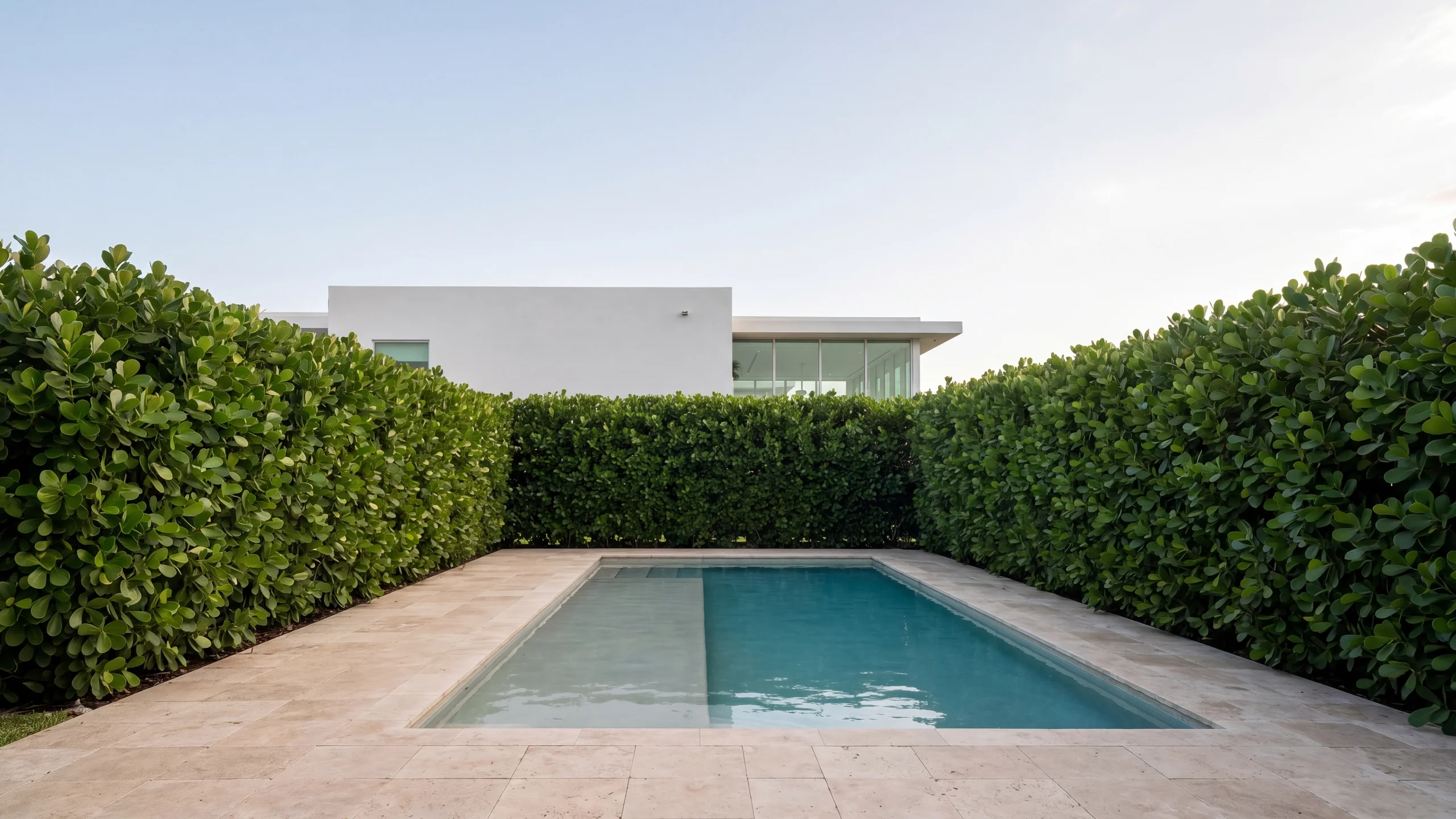
A mature Clusia hedge along a luxury South Florida home, illustrating the kind of established planting that holds shape through hurricane wind and recovers quickly after storms.

The short answer.

Mature Clusia and Podocarpus handle hurricane wind well. Newly installed hedges do not, but the gap closes in the first growing season.

South Florida hurricane season runs from June 1 through November 30, with peak storm activity from August through early October. For homeowners planting or maintaining a privacy hedge, the season changes how we install, when we install, and how we recommend caring for the hedge through the next year.

Mature Clusia and Podocarpus hedges hold up well in hurricane wind. Both species have flexible branches, dense canopies, and root systems that anchor cleanly into South Florida sandy soil. Most hedges that have been in the ground for two or more years come through named storms with minor leaf loss and superficial branch damage rather than structural failure.

Newly installed hedges are different. Plants in their first ninety days have not yet rooted into native soil. Heavy wind during that window can lean, shift, or pull a fresh hedge that would handle the same storm easily a year later. The rest of this page covers when to plant, how to protect new installs, and what to do when a storm has already affected an existing hedge.

Why Clusia and Podocarpus handle storms well.

The structural traits that let mature South Florida hedges absorb wind without falling apart.

Flexible branching, not brittle

Both Clusia and Podocarpus have flexible woody branches that bend in wind rather than snapping. Brittle species like ficus benjamina shed branches in storms. Clusia and Podocarpus take the wind, flex with it, and shake off leaves before they shed structural wood.

Dense lateral fill spreads load

A mature hedge with continuous lateral fill distributes wind load across the whole run rather than concentrating it on individual plants. Tightly spaced hedges are structurally stronger in storms than rows of separate shrubs spaced widely apart.

Anchor roots adapted to South Florida soil

Both species root readily into sandy native soil and develop strong anchor systems within the first growing season. After roughly twelve months of root development, the plant has enough soil grip to hold position through hurricane-force wind.

Salt and wind tolerance

Coastal exposure is part of the South Florida operating environment. Both Clusia and Podocarpus tolerate salt spray and persistent wind better than most ornamental hedge alternatives, which means they recover faster after the salt wash that follows a tropical system.

Fast leaf flush after storms

Healthy Clusia and Podocarpus push new leaf growth quickly after a defoliating storm. Most mature hedges that lose significant leaf cover in a hurricane have visibly recovered within four to eight weeks, with full canopy density returning over the following growing season.

Less debris than alternatives

Compared to palms, ficus, or large flowering shrubs, Clusia and Podocarpus shed relatively little debris in storms. The cleanup after a named storm is usually leaf raking and minor branch pickup rather than chainsaw work.

When to plant relative to hurricane season.

Four practical install windows and how each one interacts with storm risk.

1

1. Cool dry season (December to March): lowest risk

The calmest install window. New plants establish in mild weather without storm pressure. By the time hurricane season opens in June, the hedge has had three to six months of root development and is in much better shape to handle wind. Most premium installs we schedule land here for exactly this reason.

2

2. Early rainy season (late May to June): natural watering, manageable risk

Daily afternoon storms keep soil moisture high, which accelerates rooting. Heavy named storms are statistically rare in early June. Installs in this window typically have six to eight weeks of root development before peak storm activity begins, which is enough to weather most non-major systems.

3

3. Peak hurricane season (July to October): we install carefully

Installs during peak season are still common. We watch the National Hurricane Center forecast closely and avoid breaking ground in the seventy-two hours before a forecasted named system. New plants get extra irrigation, light staking on exposed sites, and a check-in walk seven to ten days after install to confirm they have settled cleanly.

4

4. Late season (November): low risk again

By November, hurricane risk drops sharply. Installs in this window have the rest of the cool dry season to root before the next storm cycle. This is the second-calmest install window of the year and a good fallback when summer scheduling did not work for the homeowner.

New hedge or mature hedge in a storm?

What to expect from each, and what we do differently for newly planted runs during hurricane season.

Mature hedge (12+ months in the ground)

  • Flexible branching absorbs wind without breaking
  • Anchor roots developed enough to hold position
  • Typically loses leaves but recovers within weeks
  • Major branch loss is uncommon in named storms
  • No staking or special storm prep usually required
  • Cleanup is leaf raking, not structural repair

Newly installed hedge (first 90 days)

  • Roots have not yet anchored into native soil
  • Plants can lean or shift in heavy wind
  • Light staking on exposed sites until rooted
  • Daily watering to support recovery from any wind stress
  • Avoid breaking ground in the days before a forecasted storm
  • Vulnerability window closes after first growing season

Project Highlight

A mature Clusia hedge along a coastal South Florida home, of the kind that absorbs hurricane wind without structural failure and recovers leaf cover within weeks of a major storm.

A Key Biscayne Clusia hedge that came through Hurricane Ian.

How a mature install absorbed sustained winds and recovered without replacement.

The Challenge

A Key Biscayne homeowner had installed a 90-foot Clusia hedge along the south side of their property in early 2021. By late September 2022, the hedge was just over eighteen months old and had reached a clean six-foot finished height. Hurricane Ian tracked west of the island but produced sustained winds and salt spray on Key Biscayne over a thirty-six-hour stretch. The owner was concerned the relatively young hedge might not survive.

Our Solution

We had set the install with the standard hurricane-aware approach: tight starter spacing for structural strength, irrigation tap-in to support healthy root development, and a check-in walk at sixty days. By the time Ian arrived, the hedge had a settled root system and dense lateral fill across the full run. No additional pre-storm preparation was needed. The owner did not stake or wrap any portion of the hedge.

The Outcome

The hedge lost a significant portion of its leaves during the storm and looked rough in the days afterward. Within four weeks, new leaf growth had visibly returned. By the following spring, the canopy was fully restored and the hedge has continued to thrive in the years since. No plants required replacement, no structural damage occurred, and the owner did not call us for storm-related work.

Hurricane-season hedges, in detail

Hurricane-season hedges in South Florida, properly explained

South Florida sits in one of the most active hurricane corridors in the United States. Most homeowners considering a privacy hedge are aware of the storm risk, and the question of how a hedge will hold up through a named system is one of the most common we get during quote walks. The honest answer is that hedge species, install age, install quality, and site exposure all interact, and the right plan looks different for a beachfront Key Biscayne property than for an inland Pinecrest yard. This section walks through the real performance pattern in detail.

Why most South Florida ficus hedges did not handle storms well

Older homeowners who remember pre-2000 South Florida landscapes will recall ficus hedges as the dominant privacy plant. Storms taught the region that ficus has a couple of structural weaknesses: large brittle branches that snap rather than flex, shallow lateral root systems that lift in wind, and a strong host relationship with whitefly and other pests that compromise plant health independent of storm damage. The combination is why ficus has fallen out of favor across the region.

Clusia and Podocarpus emerged as replacements partly because they handle storms more gracefully. The structural traits that make them better hedges in normal weather also make them better hedges in hurricanes.

How wind interacts with a hedge canopy

A privacy hedge in steady wind acts like a vertical wing. Air pushes against the canopy, and the resulting force has to be absorbed by branches, anchored by roots, or shed by leaves dropping. Healthy mature hedges shed leaves first, flex branches second, and only fail at the root level under truly extreme wind. The leaf-shed step is the safety valve that protects the rest of the structure.

Newly installed hedges have not yet developed the dense canopy or the deep root system that lets that safety valve work cleanly. They tend to take wind as a whole-plant force, which is why they can lean or shift in storms that a mature hedge would shrug off.

Salt spray and the post-storm wash

Tropical systems moving over warm Atlantic water carry a heavy salt load. After the storm passes, leaves on coastal South Florida properties can show salt burn within a few days as the salt dries on the foliage. Both Clusia and Podocarpus tolerate this better than most ornamentals, but they still benefit from a freshwater wash within a week of the storm if rainfall has not done it naturally.

For coastal homeowners on Key Biscayne, the Beaches, parts of Fort Lauderdale, and Palm Beach proper, post-storm freshwater rinsing is a small piece of seasonal hedge care that meaningfully extends canopy density between storms.

What we do differently for storm-exposed installs

For yards that sit directly in the wind path, oceanfront, intracoastal, or canal-facing, our install approach changes in a few specific ways:

  • Tighter starter spacing than we would use on an inland yard, to build structural strength faster.
  • Larger starter sizes when the homeowner wants storm resilience inside the first year. Larger plants have more developed root balls and reach anchored maturity faster.
  • Irrigation tap-in to support consistent rooting through the first ninety days. A water-stressed hedge is structurally weaker than a well-watered one.
  • Light staking on truly exposed sites for the first few months only, removed once rooting confirms.
  • Site-specific recovery plan for what to do if a named system arrives in the first year of the hedge.

None of these are exotic. They are practical adjustments that turn a generic install into a storm-aware install.

Pre-storm preparation for an existing hedge

For a mature Clusia or Podocarpus hedge that has been in the ground at least one full growing season, pre-storm preparation is generally minimal:

  • Light shaping is fine before a forecasted storm but is not required. Avoid heavy pruning that exposes interior branches to wind.
  • Clear loose objects from the area near the hedge. Wind-borne projectiles do more damage to hedge canopies than wind itself.
  • Leave irrigation on a normal schedule until the storm arrives. Soft soil is not the threat to anchored hedges that is sometimes assumed.
  • Do not wrap or tie a mature hedge. The flexibility that lets it absorb wind is a feature, not a problem.

Mature hedges fare better when they are left alone before a storm than when they are shaped or restrained in ways that change how they interact with the wind.

Pre-storm preparation for a newly installed hedge

If a hedge is in its first ninety days when a named storm is forecasted, the playbook is different:

  • Confirm or install light stakes if the site is wind-exposed. Stakes should support, not constrain.
  • Water deeply forty-eight hours before the storm to firm the root zone.
  • Avoid any pruning. New plants need every leaf they have.
  • If a major storm is forecasted within seventy-two hours of a planned install, push the install date.
  • Plan a post-storm walk to assess any leaning, shifting, or root exposure.

The first growing season is the only meaningfully vulnerable window for a healthy Clusia or Podocarpus install. After that, normal mature-hedge rules apply.

Post-storm recovery and what is normal

After a major storm, even healthy hedges can look rough. What we tell homeowners to expect:

  • Leaf loss across some or all of the hedge is normal and not a sign of plant failure.
  • Brown leaf edges from salt spray are normal in coastal yards and resolve as new leaves push out.
  • Minor branch breakage is normal and can be cleanly trimmed within a few weeks.
  • New leaf flush within four to six weeks is the strongest signal of healthy recovery.
  • No new growth after eight weeks is a flag worth investigating, especially on younger hedges.

Most South Florida hedges recover from a major storm without intervention beyond cleanup and ordinary watering. Hedges that do not recover usually have an underlying issue that the storm exposed rather than caused.

When a hedge needs replacement after a storm

Total replacement after a hurricane is uncommon for mature Clusia and Podocarpus runs. The cases where replacement is the right call:

  • Plants pulled out of the ground with significant root exposure that cannot be reseated cleanly.
  • Leaning that does not correct within thirty days even with reseating.
  • Persistent leaf loss with no new growth beyond the eight-week recovery window.
  • Structural damage that compromises the canopy line in a way light shaping cannot fix.

For partial damage, we usually recommend partial replacement matched to the existing hedge size rather than full replacement, since blending in matched plants is faster and far less disruptive than redoing the run.

How hurricane risk should affect your hedge plan

For most South Florida homeowners, hurricane risk is a real factor but not a reason to delay a privacy hedge. The plants we install are the species that have proven over decades to handle the regional storm pattern best. The install timing, starter size, and site planning we use are designed to bring new hedges through their first vulnerable window safely. And the long-term performance of a mature Clusia or Podocarpus hedge in storms is better than nearly every alternative privacy solution available to a South Florida homeowner.

A privacy hedge planned with hurricane season in mind is more reliable than a fence that the next storm bends, blows over, or ages prematurely. It is also more reliable than no hedge at all, since the privacy benefit only starts after install. The right move for most homeowners is to plant cleanly during a calm window, plan for a careful first year, and then trust the species and the install to do their work for the next decade.

Hurricane-season hedge questions, answered.

The questions South Florida homeowners ask most about privacy hedges and storm risk.

Mature Clusia hedges handle hurricane wind well. Flexible branches, dense lateral fill, and anchor roots adapted to South Florida sandy soil let the canopy absorb wind without structural failure. Most mature Clusia runs lose leaves in major storms but recover full density within four to eight weeks of the storm passing.

Plan a hurricane-aware privacy hedge.

Tell us where the hedge needs to go and we will plan the install to perform well in normal weather and through the storms South Florida actually gets.