HOA-approved privacy hedges in South Florida, explained
South Florida has more HOA communities per capita than nearly anywhere else in the United States. Gated golf-course developments, master-planned subdivisions, country clubs, and condo associations all run their own architectural review processes, and homeowners who want to add privacy to their yard usually have to get the plan signed off before any work begins. The good news is that privacy hedges are one of the few additions that pass review consistently across Miami-Dade, Broward, and Palm Beach communities.
What HOA architectural review actually checks
Most HOA landscape covenants apply the same handful of checks to a privacy hedge proposal: species, finished height, location on the property, setback from sidewalks and roads, and whether the hedge will be visible from common areas or street frontage. Some communities also have rules about side-yard versus rear-yard hedges, corner lots, and shared boundaries between adjacent owners.
Reviewers are generally not trying to block privacy. They are trying to maintain visual consistency, protect long sight lines on streets, and avoid setting precedents that future requests can stretch. A hedge plan that names a species the HOA already approves, fits within the height limits, and stays clear of setbacks is rarely controversial.
Why Clusia and Podocarpus dominate approved-species lists
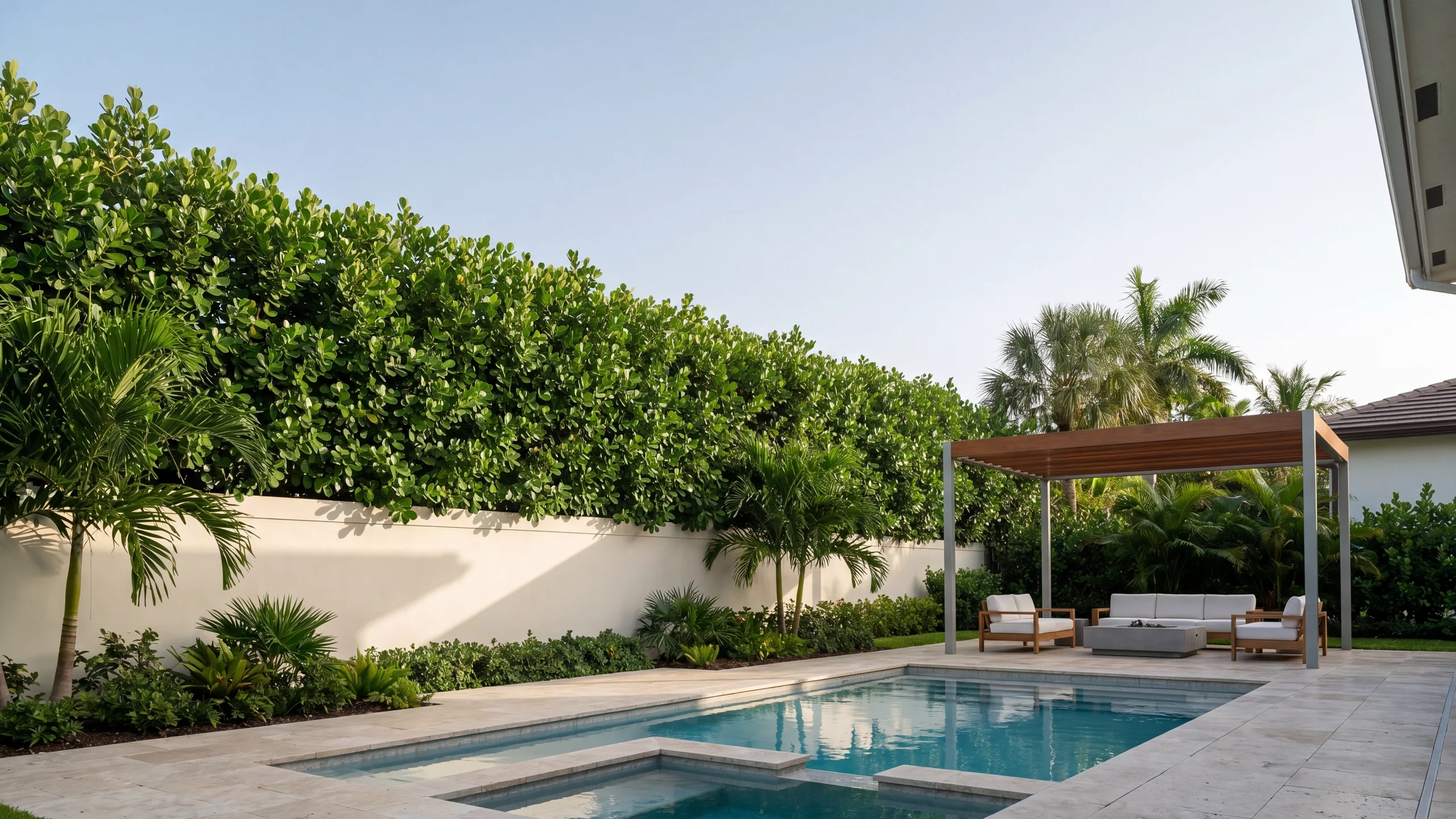
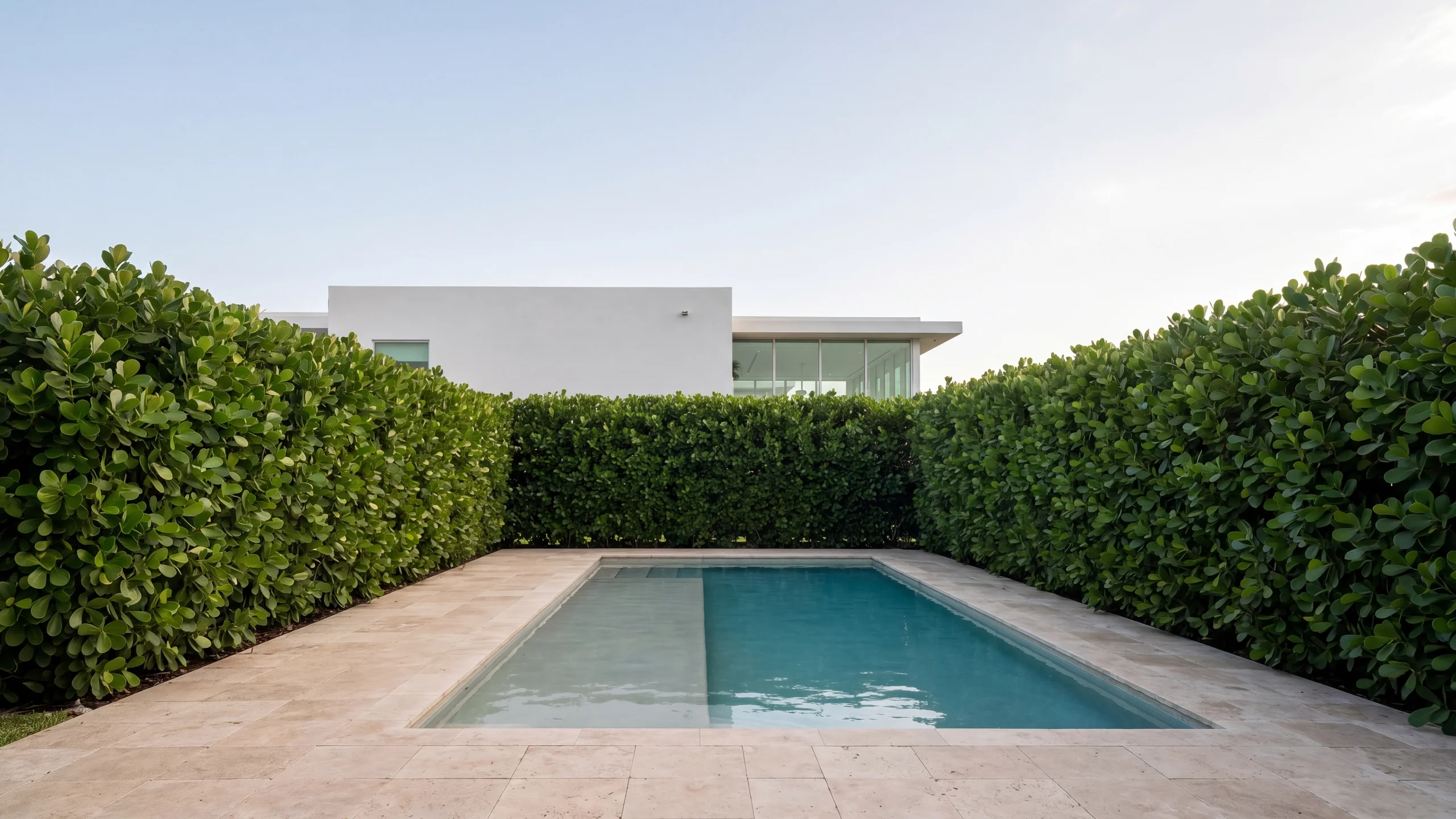
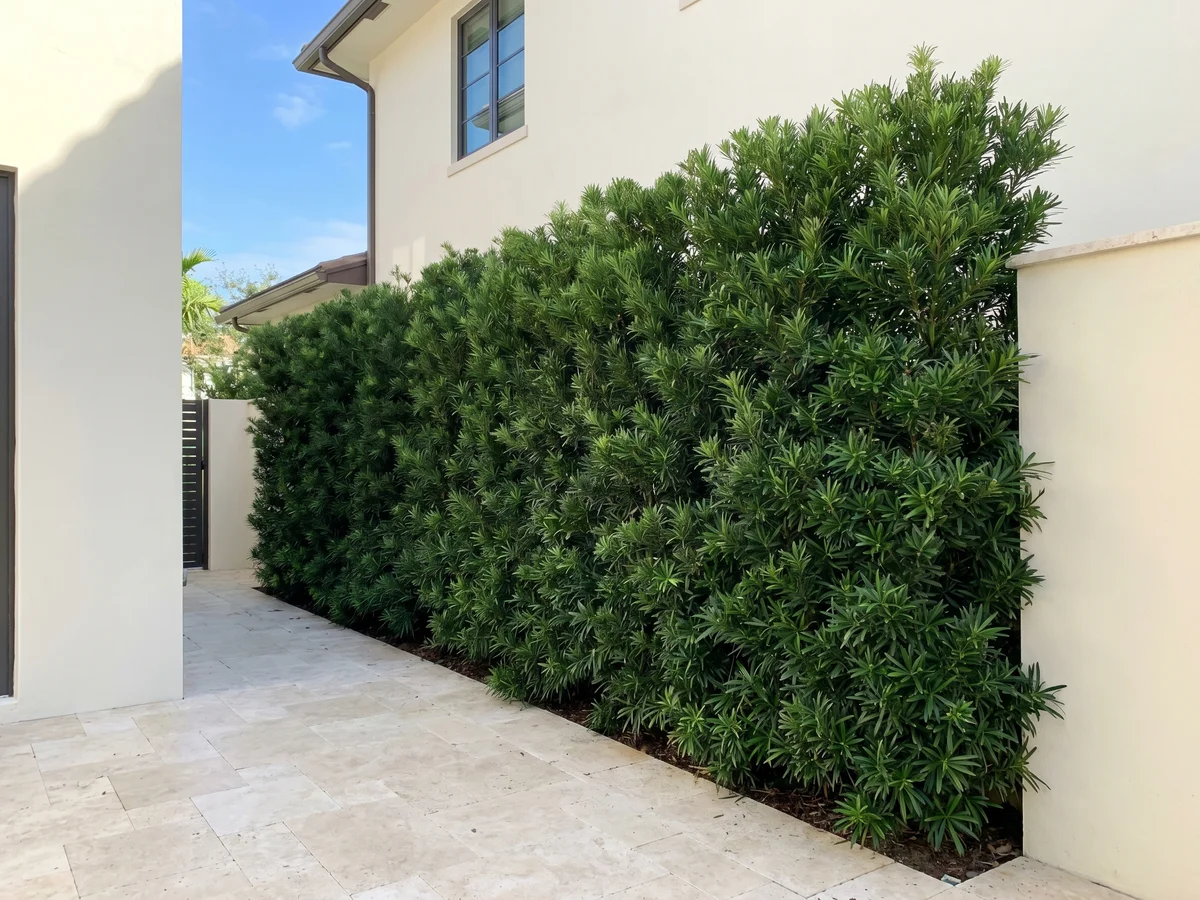
Approved-species lists in South Florida HOA communities tend to include the same handful of plants that the HOA's own landscape contractors already use. Clusia guttifera and Clusia rosea are common picks for residential hedges because they handle South Florida sun, salt, and storm conditions, they are pest-resistant compared to ficus, and they read tropical rather than agricultural. Podocarpus macrophyllus is the common formal pick, especially for Mediterranean-style communities where the architecture calls for vertical, fine-textured hedge lines.
If your HOA has a published approved-species list, it almost certainly includes one or both. If your HOA does not have a published list and reviews each request on its own, Clusia and Podocarpus are still the safest plants to propose because they are the species the rest of the community is already planted with.
The species HOAs typically reject or restrict
For balance, the species that HOA architectural review committees most often reject or limit:
- Bamboo, especially running varieties, because of the spread risk to neighboring properties.
- Areca palm clusters when proposed as a privacy screen, because they tend to thin out at the base and look unkempt over time.
- Fast-growing invasive species like Australian pine or Brazilian pepper, which are restricted by Florida environmental rules independent of HOA preferences.
- Ficus benjamina hedges, which were once standard but are increasingly restricted because of the ficus whitefly damage that has become endemic to South Florida.
Coming in with a Clusia or Podocarpus plan instead of any of these gives the application a head start.
Height limits in HOA hedge approvals
Most South Florida HOA covenants cap privacy hedges at one of three common heights, depending on location on the property:
- Street-facing hedges are often capped at four to six feet to protect sight lines and the visual openness of the streetscape.
- Side-yard hedges between adjacent properties are commonly capped at six to eight feet, sometimes higher.
- Rear-yard hedges, especially on lots backing up to canals or golf-course rough, are often capped at eight to ten feet or sometimes left uncapped within reason.
Knowing the cap before the plan is submitted is half the battle. Both Clusia and Podocarpus can be installed at finished heights that fit any of these caps, and we plan starter size and spacing accordingly so the hedge stops at the approved height rather than fighting the rule for years.
Setback rules that often surprise homeowners
HOA covenants frequently require hedges to sit back from the property line, sidewalk, or road edge. Common setbacks are eighteen inches to three feet, depending on the community. The reasoning is partly visual continuity and partly practical: hedges that hang over a sidewalk become a nuisance the HOA has to address, and hedges planted on the property line can become a dispute between neighbors as they mature.
A homeowner who plants tight against the property line because they want the hedge as far from the house as possible can run into a polite removal-or-relocate letter from the HOA later. We follow the setback during install so this never becomes an issue.
Corner lots and double-frontage rules
Corner lots and lots with frontage on two streets are usually subject to extra rules. Most HOAs treat a corner lot as having two front yards rather than one front and one side, which means street-facing hedge rules apply to both. This often means a maximum height closer to four feet on the second street side, even if the homeowner thinks of it as a side yard.
Corner-lot homeowners are the ones most likely to get caught by HOA enforcement after the fact, because they planted the hedge to side-yard rules and the HOA enforces front-yard rules. We flag this on every site walk so the install matches the actual rule from the start.
How to submit a plan that gets approved fast
The fastest-approving plans share a few traits:
- Species named, with botanical name (Clusia guttifera, Podocarpus macrophyllus).
- Finished height stated, in feet, matching the relevant guideline.
- Location described clearly, with a labeled diagram if possible.
- Install timeline included.
- Installer named, with phone and license information.
If the community has a standard architectural review form, we follow it exactly. If they do not, we put together a clean one-page summary the committee can read in five minutes. Our experience is that committees approve plans they can quickly evaluate. Plans that require interpretation or follow-up emails sit in committee for weeks.
Common HOA-related questions before a Clusia or Podocarpus install
Most homeowners ask the same questions when planning a hedge in an HOA community. The FAQ section below covers the ones we answer most often during quote walks. The honest answer to nearly all of them is: yes, the hedge will be approved, and the path is shorter than the homeowner usually expects.
What we do for HOA-community installs
For homeowners in HOA communities, we add a few extra steps that we do not need on non-HOA properties. We read the community's landscape and architectural review rules before the quote walk. We plan species, height, and location to match those rules without asking the homeowner to push for exceptions. We can put together the architectural review submission package on request. And we hold the install schedule until written approval is in hand. This is what HOA-aware install means in practice, and it is the difference between a smooth project and a dispute.
If you sit on the board rather than own a single lot, the common-area side is a different conversation. We work directly with associations on perimeter screening, amenity privacy, and uniform community-wide installs on our privacy hedges for HOA boards page.