A plain-English guide to native hedges in South Florida
Florida-native privacy hedges have shifted from a niche eco-program preference to a mainstream design choice across Miami-Dade, Broward, and Palm Beach. Three forces are doing it: water restrictions, FFL-aligned HOAs and municipalities, and a generation of homeowners who specifically want their yard to support wildlife. This page covers the species we plant most often, where each one fits, and what to expect.
The four Florida natives that actually work as privacy hedges
Plant lists are long. The species that actually function as privacy hedges in residential South Florida settings are shorter:
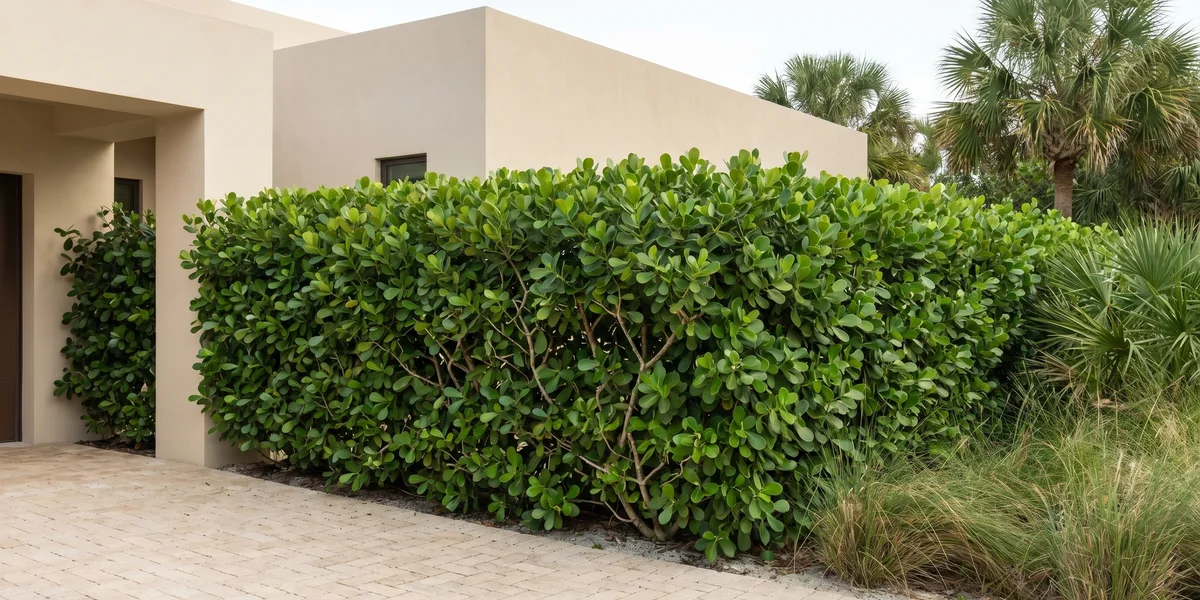
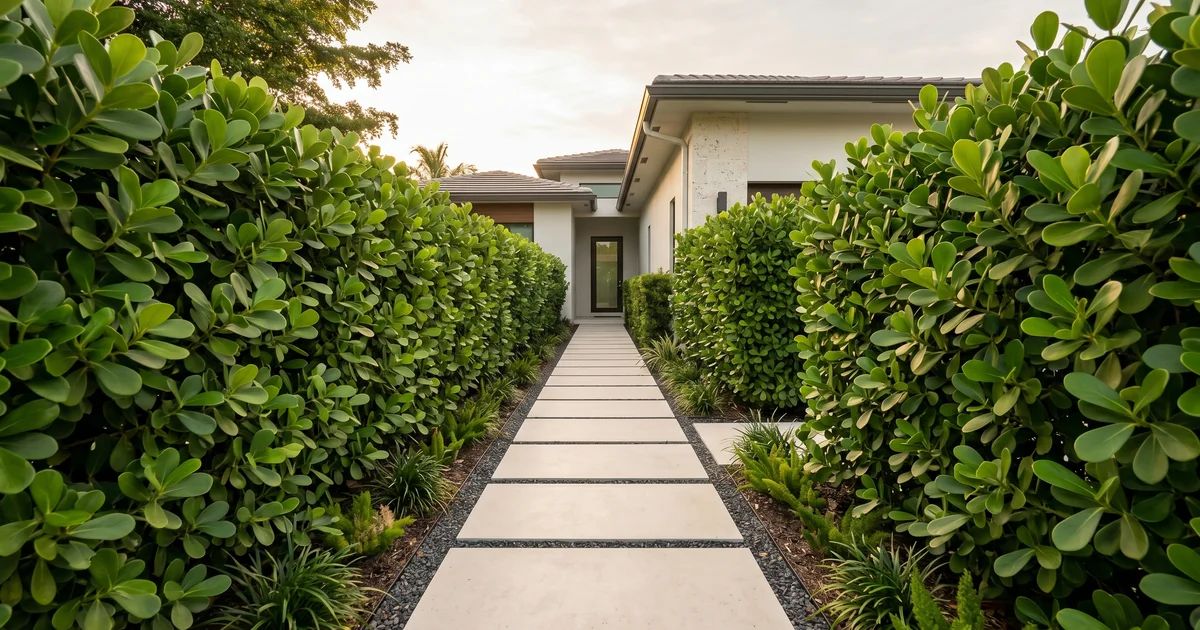
- Cocoplum (Chrysobalanus icaco). The strongest Florida-native privacy hedge for most yards. Salt-immune, drought-hardy, dense, and comfortable at 6 to 10 feet of maintained height. Three varieties (red-tip, green-tip, horizontal), the first two for hedges, horizontal for low borders.
- Simpson's stopper (Myrcianthes fragrans). Fine-textured, narrow, and naturally upright. Best for narrow side yards, modern naturalistic homes, and wildlife-prioritized properties. Comfortable at 6 to 12 feet. White spring flowers and red berries feed birds and pollinators heavily.
- Walter's viburnum (Viburnum obovatum). The native pick for shaded side yards. Tolerates part shade better than cocoplum or Simpson's stopper. Comfortable at 6 to 12 feet, with the 'Densa' cultivar being the residential default.
- Yaupon holly (Ilex vomitoria). The native option for tall formal screens, comfortably reaching 12 to 20 feet. Takes a clipped architectural line. Best on inland and interior South Florida lots; less ideal for direct coastal spray.
Beyond these four, the native hedge list thins out fast. Wild coffee and marlberry have niche shaded-yard roles. Seagrape (Coccoloba uvifera) is worth a note for coastal owners: it is a Florida native and about as salt-tolerant as any plant on the shoreline, but it grows as a large, coarse, big-leaf shrub or small tree, so it works as a loose natural coastal screen rather than a tidy clipped hedge. On a true beachfront or canal lot where you want a finished hedge line, cocoplum is still the better pick; seagrape fits when the look you want is relaxed and shoreline-native. Most other named natives are better understood as wildlife plantings than continuous privacy walls. Our blog on the best native privacy hedges for South Florida covers the full picture.
Where natives outperform Clusia and Podocarpus
Five situations where we will steer a homeowner toward a native instead of the standard imported pick:
- Direct coastal exposure. Cocoplum is more bulletproof than even Clusia on true beachfront and canal-front lots.
- Drought-prone sandy lots without reliable irrigation. Native hedges generally need less water once established. On lots that cannot be reliably irrigated, the long-term survival math favors natives.
- FFL-certified or eco-aligned HOA communities. Native species are the path of least resistance through architectural review in these communities.
- Wildlife-priority properties. If you want a hedge that also functions as habitat, the native list is the only honest answer. Clusia and Podocarpus are essentially wildlife-neutral.
- Long-term maintenance budgets. Lower water, lower fertilizer, and fewer chemical inputs over a decade shifts the maintenance economics in favor of natives.
Where Clusia and Podocarpus still win
We install both natives and imported standards. We are not anti-native and not pro-native; we pick the right plant for the yard. Honest cases where the imported standards are the better call:
- Speed of fill: Clusia closes laterally about a season faster than the fastest native.
- Predictable nursery supply at any starter size, natives at 15- and 25-gallon hedge-grade sizes sometimes require lead time.
- Maximum density per linear foot, at install age, a clipped Clusia or Podocarpus is slightly more visually solid than most natives at equivalent maturity.
- Estate-style formal architectural lines: Podocarpus clips crisper than yaupon holly at equivalent shaping schedules.
Are native hedges actually lower maintenance?
Once established, yes. Most South Florida native hedges need less water, less fertilizer, and fewer pest interventions than Clusia or Podocarpus. The "lower maintenance" claim is real but more nuanced than marketing usually makes it sound. The honest breakdown:
- Water: 20 to 35 percent less supplemental irrigation after the first establishment year. The gap widens in drought years.
- Fertilizer: Most natives thrive on one application of slow-release fertilizer per year. Clusia and Podocarpus typically prefer two to three.
- Pruning: Roughly equal, pruning frequency is driven by how formal the hedge is, not by species. A formal native hedge needs similar shaping to a formal imported one.
- Pests: Native hedges and Clusia/Podocarpus are roughly equal here, and all four are dramatically lower-maintenance than ficus.
- First year: Establishment care is essentially equal across all hedges. The maintenance gap opens up after the first 60 to 90 days.
The full breakdown lives in our blog on whether native hedges are actually lower maintenance.
A mixed approach is often the right plan
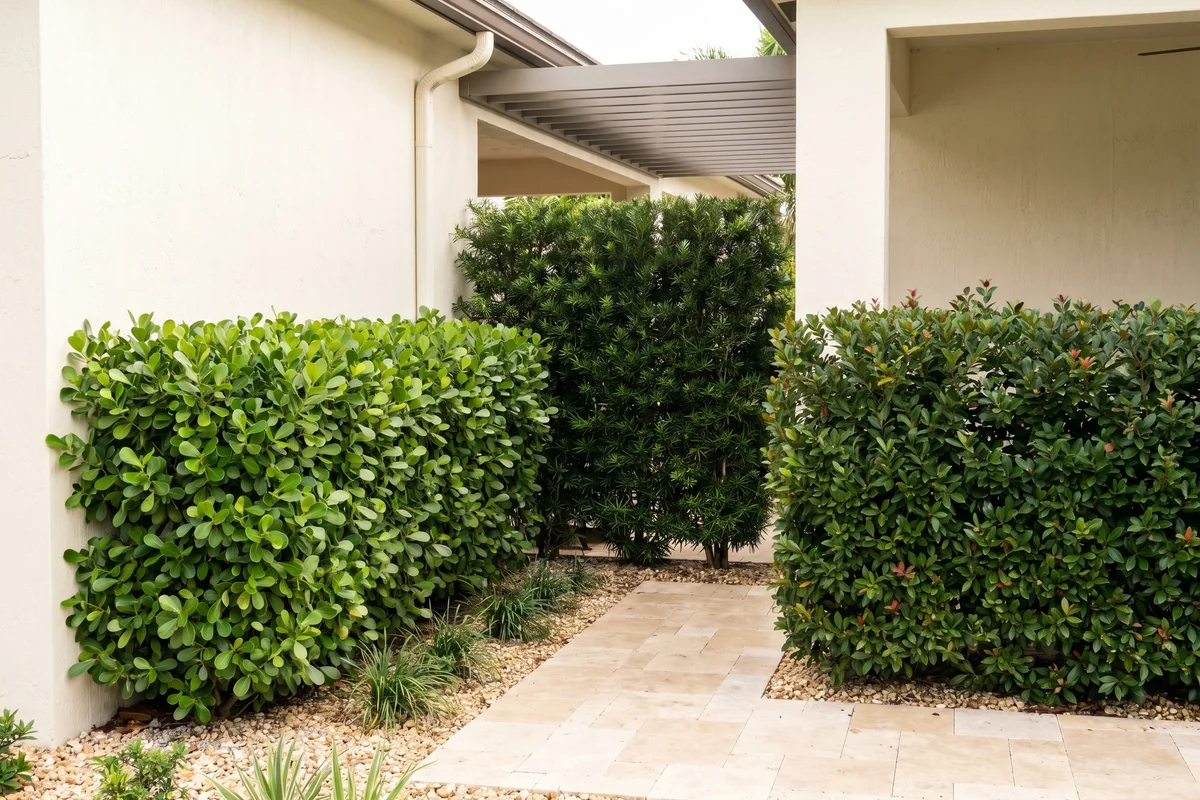
On larger properties with multiple exposures, the strongest install is often a mixed plan. Cocoplum on the coastal-facing line. Walter's viburnum on the shaded side yard. Clusia along the sunny pool yard. Each species picked for its actual conditions rather than forced to be a universal answer.
We avoid mixing different species along the same continuous hedge line because the textures and growth rates do not blend cleanly. Across the property is different, multiple species on different runs is often the most resilient long-term landscape, FFL-aligned or not.