Buying Guide
Best Native Privacy Hedges for South Florida
An honest ranking of the native privacy hedge options that actually work in Miami, Fort Lauderdale, and West Palm Beach yards, plus where they outperform imported standards and where they fall short.
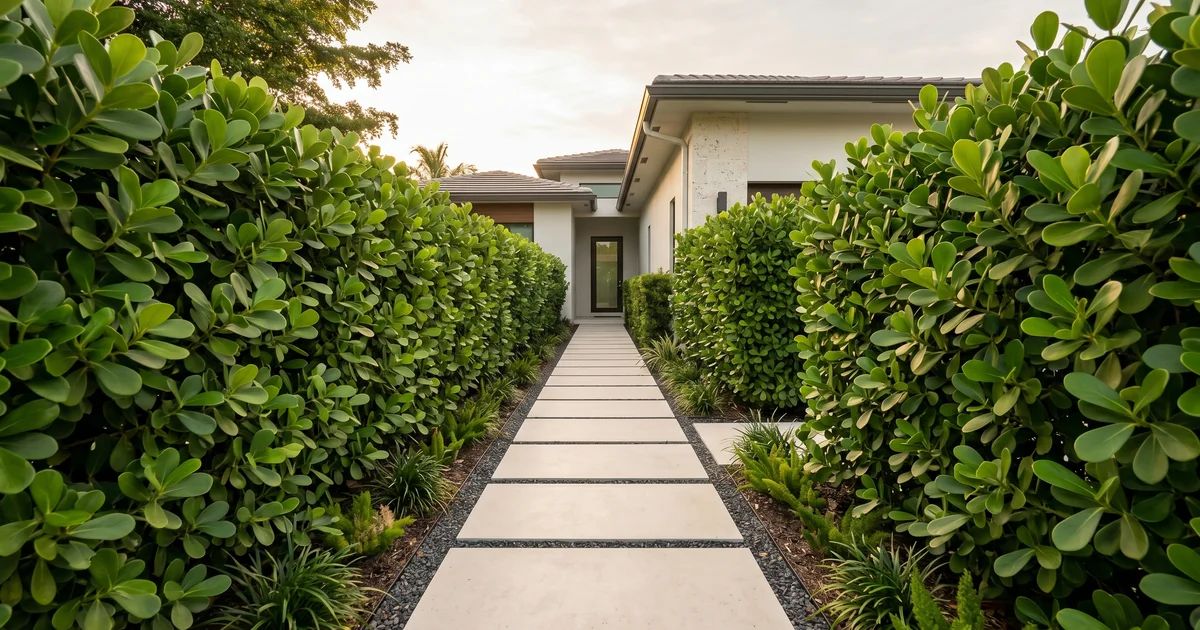
Most South Florida privacy hedges in the ground today are not Florida natives. Clusia, Podocarpus, areca palm, and ficus dominate residential installs because they fill in fast, take a clipped line, and look the way most homeowners picture a finished hedge. But native species can also do the job, and a growing share of homeowners want to know which ones actually work before they commit a 100-foot run to plants they have not seen up close.
This is an honest ranking from a South Florida installer who plants both. We are not anti-native, and we are not pro-native. We pick the right plant for the yard. This guide tells you which native hedges hold up on real Miami, Fort Lauderdale, and West Palm Beach properties and where they still cannot match what Clusia or Podocarpus deliver.
Picking a Florida-native hedge for your yard? This post ranks the species. For pricing, install, FFL alignment, and HOA review, see our pillar on Native Hedges for South Florida.
The Short Answer
The strongest native privacy hedge for most South Florida yards is cocoplum. It is salt-immune, drought-hardy once established, and the only Florida native we plant in volume as a true privacy hedge. Simpson’s stopper is the second pick, especially for narrower runs and modern homes. Walter’s viburnum is the right call for shaded side yards. Yaupon holly is the option for tall formal hedges on inland or northern South Florida lots. Beyond those four, the native list thins out fast.
If you want one species and want it to look finished without long surprises, cocoplum is the default native answer.
Why Native Matters In South Florida Right Now
Native plants are not just an environmental preference anymore. Three forces are pushing native hedges into more yards every year.
Florida-Friendly Landscaping (FFL) credit. Some HOAs and a handful of municipalities now favor or require FFL-aligned plant choices. Florida natives are the easiest path to compliance. Our guide to FFL-certified hedges breaks down what that certification actually means for an install.
Water restrictions. Once established, native hedges generally need less supplemental irrigation than Clusia or Podocarpus. In a drought year with mandatory watering days, that gap matters.
Wildlife and pollinator interest. Native hedges feed native birds, butterflies, and pollinators. Imported standards do not. Homeowners who are otherwise happy with Clusia often add a native section near a pool or patio specifically because they want to see more wildlife.
None of this means natives are automatically the right choice. It does mean the conversation has changed. Five years ago, almost no homeowner asked us about native hedges. Now we get the question on roughly one in four site visits.
What “Native” Actually Means
Native, as we use it on this page and as the Florida Native Plant Society defines it, means a species that occurred naturally in Florida before European contact. A plant grown by a Florida nursery is not necessarily a Florida native. Clusia is grown statewide but is not native. Areca palm is not native. Podocarpus is not native.
This matters because the plants below are all true Florida natives. They evolved with the local soil, salt, sun, rain, and wildlife. That history shows up on real installs as resilience and self-sufficiency once they are rooted in.
The Honest Ranking
We have ranked these by how well they actually function as a privacy hedge on South Florida residential lots. Function means three things: visual coverage, density per linear foot, and reliability over time.
1. Cocoplum (Chrysobalanus icaco)
Cocoplum is the Florida native we plant most often for true privacy hedges. It produces a dense, glossy, evergreen wall in the 6 to 10 foot range, takes shaping cleanly, and tolerates almost everything South Florida throws at it.
Three forms show up in nurseries: red-tip cocoplum, with new growth that flushes coppery red, green-tip cocoplum, with all-green new growth, and the lower-growing horizontal cocoplum, which works for shorter privacy borders rather than full screens. Red-tip is the most common privacy hedge variety for residential yards. It produces the most hedge-like form and the most visible seasonal color.
What cocoplum is exceptional at:
- True salt immunity, including direct ocean spray exposure
- Drought tolerance once established
- Tolerance of poor, sandy, alkaline soils
- Wildlife value, including small fruit eaten by birds
- A naturally dense form that does not need heavy training
Where cocoplum is weaker than Clusia: it grows more slowly. A 7-gallon cocoplum hedge typically takes one and a half to two seasons to read as a continuous wall. A 7-gallon Clusia hedge usually closes up within six to twelve months. That is the most honest single-line comparison you will hear from us.
For the full side-by-side, see our Clusia vs Podocarpus comparison. The same trade-off framework applies when weighing cocoplum against the imported standards.
2. Simpson’s Stopper (Myrcianthes fragrans)
Simpson’s stopper is the second strongest native privacy hedge for South Florida. It produces a fine-textured, evergreen screen with small, glossy leaves, white spring flowers, and red berries that birds eat through summer. It runs naturally narrow, which makes it useful in side yards and along property lines where width is limited.
Mature height runs 8 to 15 feet without aggressive pruning, though most residential hedges sit comfortably at 6 to 10 feet. The form is upright and slightly rounded. It clips cleanly into a formal hedge or grows into a softer naturalized screen, depending on what the yard wants.
Simpson’s stopper does best in full sun to part sun on inland and near-coastal lots. It is salt-tolerant but not as bulletproof on direct shoreline as cocoplum. It is also slower to fill than cocoplum, so plant size and starter spacing matter more on day one.
The most common reason homeowners pick Simpson’s stopper over cocoplum: the look. The fine leaf and the seasonal flowers and berries fit modern, contemporary, and naturalized landscapes in ways that a denser, plainer hedge does not.
3. Walter’s Viburnum (Viburnum obovatum)
Walter’s viburnum is the right native for shaded side yards and for homeowners who want a smaller-leaf, more controlled-looking hedge than cocoplum. It is a true Florida native with a compact, dense growth habit, small dark green leaves, and clusters of white flowers in spring.
Walter’s viburnum tolerates partial shade better than cocoplum or Simpson’s stopper, which makes it the native choice for the shaded north-facing side of a two-story home. Mature height ranges from 6 to 12 feet depending on cultivar. The dwarf and compact varieties stop closer to 6 feet, which is ideal for residential privacy.
It is less salt-tolerant than cocoplum. Direct shoreline lots are not where Walter’s viburnum belongs. Inland and lightly coastal yards work fine.
Maintenance is moderate. Walter’s viburnum responds well to two to three light shapings a year and otherwise asks very little.
4. Yaupon Holly (Ilex vomitoria)
Yaupon holly is the tall formal native option. It is the species we recommend when a homeowner wants a Podocarpus-style architectural screen but in a true Florida native. Mature height comfortably reaches 12 to 20 feet, and the dense small-leaf form takes a sharp clipped line.
Yaupon holly is well-suited to northern South Florida and inland lots. It tolerates a wider range of soil and is one of the most drought-tolerant evergreens on this list. It is not the right pick for direct coastal exposure.
The common cultivars vary in form. Standard yaupon grows tall and upright. Weeping yaupon has a softer architectural form that some homeowners prefer for entryway screens. Dwarf yaupon stops well short of privacy hedge height and belongs in lower borders rather than tall hedges.
For tall yaupon hedges to perform well, plant size at install matters. Smaller starters take a long time to read as a finished tall screen. Larger yaupon plants are scarcer in the nursery trade than Clusia or Podocarpus, which is the most common reason a homeowner ends up with one of those imported species instead.
5. Wild Coffee (Psychotria nervosa)
Wild coffee is a Florida native understory plant that works as a lower hedge or screen, usually 4 to 8 feet at maturity. The leaves are large, deeply veined, glossy, and tropical-looking. It produces small white flowers and bright red berries that birds use heavily.
Wild coffee belongs in shaded or partially shaded sites. It struggles in full direct sun, especially on bright sandy lots. For the shaded side of a yard, under a tree canopy, or as a transition layer between a tall imported hedge and a patio, wild coffee is one of the most useful Florida natives.
It is not a tall privacy hedge. Homeowners who try to use it as one are usually disappointed. Used in the right place at the right height, it is one of the strongest native hedges in the state.
6. Marlberry (Ardisia escallonioides)
Marlberry is a hammock-edge native that works as a medium-height privacy hedge in shaded and partially shaded sites. It tops out around 8 to 12 feet, produces glossy dark green leaves, fragrant white flowers in late spring, and dark purple berries that birds eat.
Marlberry is most useful on yards that already have a canopy. It does not perform on bright open lots. It is also less common in the nursery trade, which means hedge-grade quantities sometimes take time to source. For a homeowner who is willing to wait, it produces one of the most visually distinctive native hedges available in South Florida.
What We Did Not Include
Several plants come up in native hedge conversations that we usually steer homeowners away from for true privacy purposes.
Firebush (Hamelia patens) is a great native shrub but does not produce a clean hedge form. It fits as a wildlife planting, not a privacy wall.
Beautyberry (Callicarpa americana) is loose and seasonal. The fall berries are spectacular and the wildlife value is high, but it is not a year-round privacy screen.
Saw palmetto (Serenoa repens) reads as architectural ground cover or a low border, not a tall hedge.
Coontie (Zamia integrifolia) is a slow-growing native cycad that does not exceed about 3 feet. It belongs in foundation beds and ground layers, not privacy lines.
If you want one of these in your yard, that is a separate landscape conversation from a privacy hedge. Treat them as partners to the hedge, not the hedge itself.
Where Natives Outperform Clusia And Podocarpus
There are real situations where a Florida native is the better hedge, and we will tell you so on a site walk.
Direct coastal exposure. On true beachfront and canal-front lots, cocoplum is more bulletproof than even Clusia. Salt spray, sand, and wind do not slow it.
Drought-prone sandy lots without irrigation. Once established, native hedges need less supplemental water. If a homeowner cannot reliably irrigate, a native hedge has a better long-term survival rate than an imported one.
Wildlife-prioritized properties. If the goal is to attract birds, butterflies, and pollinators, natives are the only honest answer. Clusia and Podocarpus are essentially neutral on wildlife. Cocoplum, Simpson’s stopper, Walter’s viburnum, and yaupon holly are not.
Strict FFL or eco-restricted HOA communities. A small but growing list of South Florida HOAs require or strongly prefer Florida-Friendly plant lists. In those communities, natives are the path of least resistance through architectural review.
Low-fertilizer landscape budgets. Natives generally need fewer inputs than Clusia or Podocarpus once established. Over a decade, the maintenance economics shift.
Where Clusia And Podocarpus Still Win
We are not going to oversell the native list. There are equally clear situations where a non-native is still the right answer.
Speed of fill. Clusia closes up faster laterally than any native on this list. If a homeowner needs a finished hedge inside one season, Clusia is hard to beat. Cocoplum will get there, but on a longer runway.
Predictable nursery supply. Clusia and Podocarpus are grown statewide in nearly any starter size you might want. Native hedge plants in hedge-grade sizes are not always available on demand. Cocoplum is the easiest. Simpson’s stopper, yaupon, and Walter’s viburnum can require a lead time, especially in larger sizes.
Density per linear foot. A clipped Clusia or Podocarpus hedge is more visually solid than most natives at the same height. Cocoplum gets close. Walter’s viburnum and Simpson’s stopper are good but not equal. For a sharp, perfectly opaque privacy wall, the imported species still set the standard.
Estate-style architectural lines. Tall formal estate hedges trim crisper on Podocarpus than on yaupon holly in our experience. Yaupon performs well, but Podocarpus is more forgiving of imperfect shaping.
A Mixed Approach Often Wins
A pattern we recommend more than people expect: use a native hedge on one part of the property and an imported hedge on another. The two species do different things well. Mixing them on the same continuous hedge line is not a good idea, because the textures and forms do not blend cleanly. Mixing them across the yard is usually fine and often the most resilient long-term plan.
A typical example: cocoplum along the coastal-facing property line, Clusia along the pool yard, Walter’s viburnum on the shaded side yard. Three hedges, three species, each chosen for its specific exposure and use.
If you want to weigh that kind of mixed plan against a single-species install, we cover the design framework in our best privacy hedge for South Florida guide.
Cost And Maintenance Reality
Native is not the same as cheap. Hedge-grade native plants in the sizes we install are sometimes more expensive per plant than equivalent Clusia, mainly because nursery production is less concentrated.
A real cost picture for a native hedge looks like:
- Plant cost: roughly comparable to Clusia for cocoplum, slightly higher for Simpson’s stopper and Walter’s viburnum at hedge-grade sizes
- Spacing: same as Clusia, matched to starter size (roughly 1 to 1.5 feet on center for 3-gallon, up to 3 to 3.5 feet for 25-gallon)
- Site prep: identical
- Install labor: identical
- First-year watering plan: identical
- Ongoing maintenance: lower over a decade for natives, especially water and fertilizer
Long-term, a native hedge is usually slightly cheaper to keep alive once established. Up front, it can be flat or slightly more expensive. The full breakdown of what drives a real privacy hedge quote lives in our hedge installation cost guide.
How To Choose A Native Hedge For Your Yard
Use four questions:
- Where is the hedge going? Coastal, inland, sun, or shade? That alone narrows the list to one or two species.
- How fast do you need finished privacy? If the answer is “this season,” cocoplum is the only realistic native answer. The rest take longer.
- What is the maintenance budget over the next ten years? Lower long-term inputs favor natives.
- Are HOA, FFL, or eco-considerations driving the decision? If yes, lean native. If no, the choice opens up to the full hedge list including Clusia and Podocarpus.
The fastest way to settle the question on your specific property is a site walk. We can usually tell within a few minutes which species belongs on which side of a yard.
Frequently Asked Questions
Are native hedges actually easier to maintain? Once established, yes. Native hedges generally need less supplemental water, less fertilizer, and fewer pest interventions over a decade. The first six to twelve months are similar to any hedge, with consistent watering and light shaping. After that, the maintenance gap widens in favor of natives.
Is cocoplum the same as Clusia? No. Cocoplum (Chrysobalanus icaco) is a Florida native. Clusia (mostly Clusia guttifera) is not native to Florida. Both produce dense, glossy, evergreen privacy hedges. Cocoplum is more drought and salt tolerant. Clusia fills in faster and produces a slightly more solid clipped wall.
What is the fastest-growing native privacy hedge? Cocoplum is the fastest native to a finished privacy hedge in our installs, especially in full sun. Simpson’s stopper and yaupon holly are slower. Walter’s viburnum sits in the middle. None of the natives are quite as fast as Clusia for lateral fill.
Are native hedges salt tolerant? Cocoplum is exceptionally salt tolerant, including direct ocean spray. Simpson’s stopper handles near-coastal salt well. Yaupon holly tolerates moderate coastal exposure. Walter’s viburnum and wild coffee are not salt-tolerant choices and should be planted inland or in protected positions.
Can I plant a native hedge on a beachfront lot? Yes. Cocoplum is one of the strongest hedge choices for beachfront and canal-front South Florida lots. It tolerates direct salt spray, sand, and high wind. We use it regularly on shoreline-adjacent installs across Miami-Dade, Broward, and Palm Beach.
Are native hedges HOA approved in South Florida? Cocoplum is on most South Florida HOA approved-species lists. Simpson’s stopper, Walter’s viburnum, and yaupon holly are typically approved on a case-by-case basis. A growing number of communities favor native species. See our HOA-approved privacy hedges guide for the architectural review process.
Do native hedges attract more wildlife than Clusia? Yes. Cocoplum, Simpson’s stopper, Walter’s viburnum, and yaupon holly all produce flowers and fruit that South Florida birds, butterflies, and pollinators use. Clusia and Podocarpus are essentially neutral for wildlife. If wildlife value is a goal, the native list is the only honest answer.
Will a native hedge save me money on watering? Once established, yes. Native hedges generally need less supplemental irrigation than Clusia or Podocarpus, especially in drought years. The first six to twelve months still need consistent watering for any hedge. After year one, the savings start to show.
Can I mix native and non-native hedges on the same property? Yes, and it is often the smartest plan. Use cocoplum along coastal lines, Clusia for fast pool-yard privacy, and Walter’s viburnum for shaded side yards. We avoid mixing different species along the same continuous hedge line because the textures do not blend.
Are native privacy hedges more expensive than Clusia? Roughly comparable for cocoplum at hedge-grade sizes. Slightly more expensive for Simpson’s stopper, Walter’s viburnum, and yaupon holly because nursery production is less concentrated. Long-term maintenance costs are usually lower for natives once they are established.
How tall do native privacy hedges grow? Cocoplum runs 6 to 10 feet. Simpson’s stopper grows 8 to 15 feet. Walter’s viburnum sits 6 to 12 feet depending on cultivar. Yaupon holly reaches 12 to 20 feet. Wild coffee and marlberry are smaller, more in the 4 to 12 foot range and best for shaded sites.
Is a native hedge always the right choice? No. Native hedges are the right choice when coastal exposure, drought tolerance, wildlife value, FFL credit, or low-input maintenance are priorities. Clusia and Podocarpus are still the right choice when speed of fill, supply, density per linear foot, or formal architectural lines matter more.
How far apart should a native privacy hedge be planted? Native privacy hedges use the same size-based spacing as Clusia: smaller starters on tighter centers, larger starters on wider centers. A 3-gallon goes on about 1 to 1.5 foot centers, a 15-gallon on 2 to 2.5 feet, and a 25-gallon on 3 to 3.5 feet. Slower natives like Simpson’s stopper and Walter’s viburnum use the same spacing but take longer to close up. The mistake to avoid is spacing small plants too far apart, which leaves gaps. The same logic in our hedge spacing guide applies to native runs.
Is seagrape a good privacy hedge? Seagrape (Coccoloba uvifera) is a Florida native and one of the most salt-tolerant plants on the coast, so it holds up on direct beachfront and canal lots where most plants burn. But it grows as a large, coarse, big-leaf shrub or small tree, not a fine clipped hedge, so it reads more like a screen than a tidy privacy wall and needs room. For a true finished hedge on a coastal lot, cocoplum is the better native pick; seagrape fits when you want a looser, natural coastal screen. We cover where each native belongs on our native hedges in Florida pillar.
See also: Native Hedges for South Florida, our installer-side pillar covering species selection, install practices, and HOA review.
Plan Your Native Privacy Hedge
If you are weighing a native hedge for your South Florida property, the most useful next step is a site walk. We will tell you honestly which species fits which exposure and whether a native is actually the right call for the result you want. We install both Florida natives and the standard imported hedges, so the recommendation comes from what works on the yard, not what is in stock.
Request a free quote or call us at 305-222-7171. We serve Miami, Fort Lauderdale, West Palm Beach, Boca Raton, and Delray Beach.
Tagged
- native privacy hedges
- Florida native hedges
- cocoplum hedge
- Simpson's stopper
- Walter's viburnum
- Florida-Friendly Landscaping
- South Florida hedges
Ready for a privacy hedge that looks finished from day one?
Get a free estimate from a South Florida specialist who handles delivery, installation, and the result you actually want.