Buying Guide
Clusia Shrub vs Clusia Hedge
Same plant, different use cases. When to buy Clusia as a single shrub vs as a continuous hedge, explained by a South Florida installer who plants both.
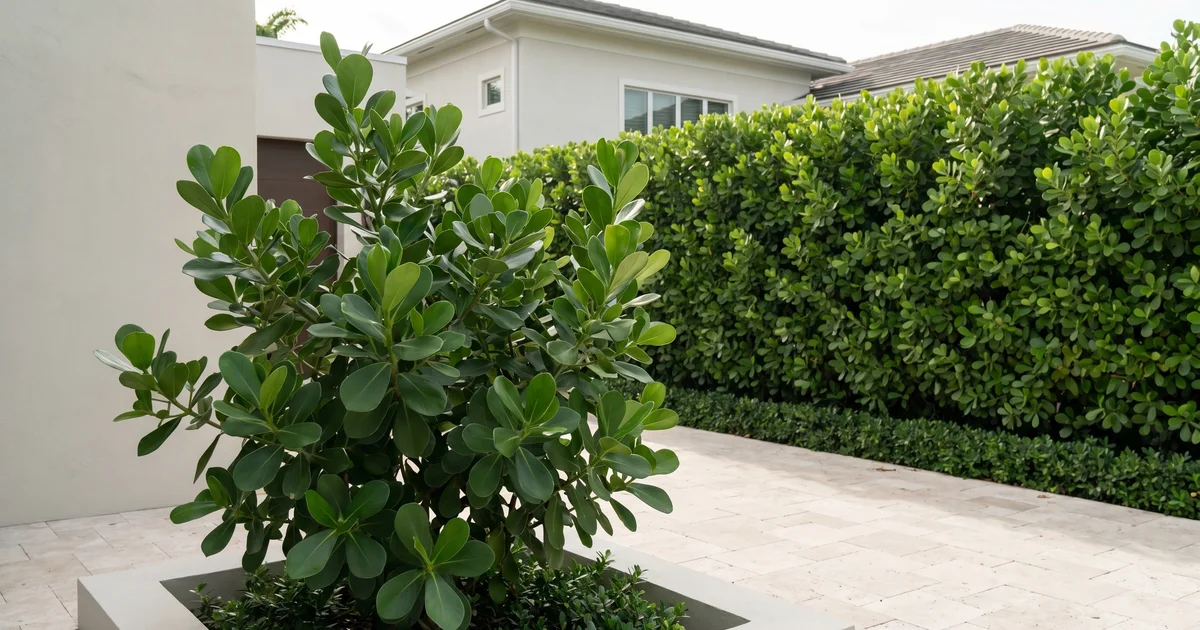
A lot of South Florida homeowners search “clusia shrub” and “clusia hedge” interchangeably. They’re the same plant, Clusia guttifera or Clusia rosea, but the way you buy, plant, and care for it differs depending on whether you’re installing one shrub or a continuous hedge line. This post explains when each approach is the right call.
Sorting out Clusia for your yard? For full install pricing and planning, see our pillar on Clusia Hedges in South Florida. Buying delivery-only? Try Clusia Plants for Sale.
The Short Answer
- Clusia shrub = a single Clusia plant grown as a standalone or in a small grouping. Used for feature plantings, accent corners, or small privacy buffers at specific windows or doors.
- Clusia hedge = a continuous line of Clusia plants installed at tight spacing to read as one solid green wall. Used for property-line privacy, full perimeter screening, and pool-yard enclosures.
- Same plant. The botanical species is identical. What differs is layout, spacing, and what the plant is asked to do.
If you only need to block one window or anchor one corner of the yard, a single Clusia shrub (or a small group of three to five) is enough. If you want to screen a long property line, a hedge is the only realistic answer.
What “Shrub” Means When We’re Talking About Clusia
In the nursery and landscape trade, “shrub” describes a Clusia planted as an individual specimen, it stands on its own as a feature in the landscape. It still has all the genus characteristics: dense, glossy, evergreen, full sun-loving. But it’s not part of a continuous hedge line.
A single Clusia shrub in a residential setting typically reaches 6 to 10 feet at maturity if left to grow naturally, or can be held shorter with light shaping. The visual effect is rounded and full, the plant fills out in all directions because adjacent plants aren’t pressing in on either side.
Common single-shrub use cases:
- A corner accent at the end of a driveway or walkway.
- A window-blocker screening one specific sightline.
- A buffer between a patio and the property line when a full hedge would be overkill.
- A small grouping (three to five plants in an informal cluster) for a more naturalistic look than a clipped hedge.
The plant performs well in any of these configurations.
What “Hedge” Means
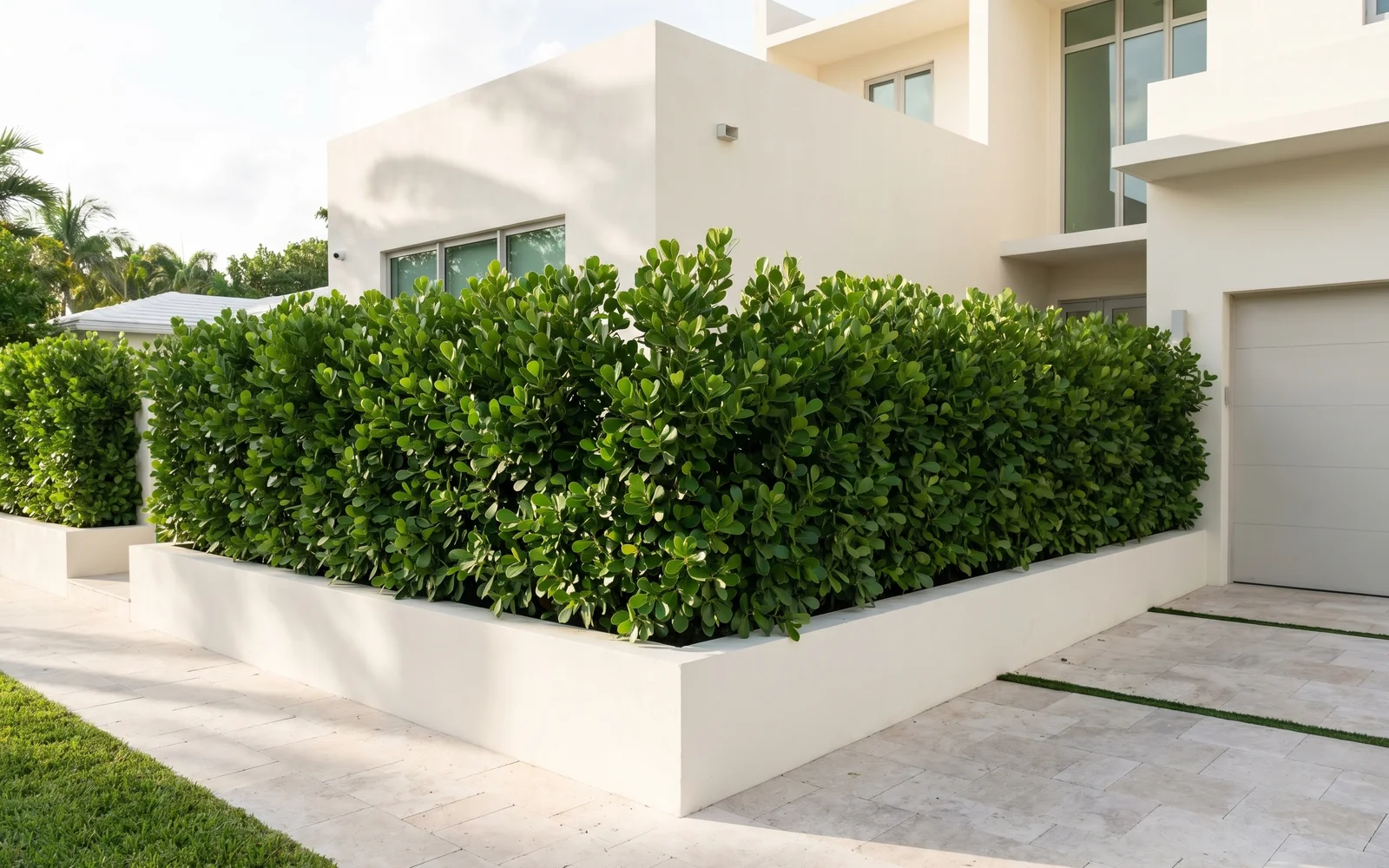
A Clusia hedge is a continuous line of Clusia plants installed at tight, consistent on-center spacing so adjacent plants close laterally and read as one solid green wall. This is what most people picture when they think of “the Mr. Clusia install”, a 50-foot or 100-foot run along a property line.
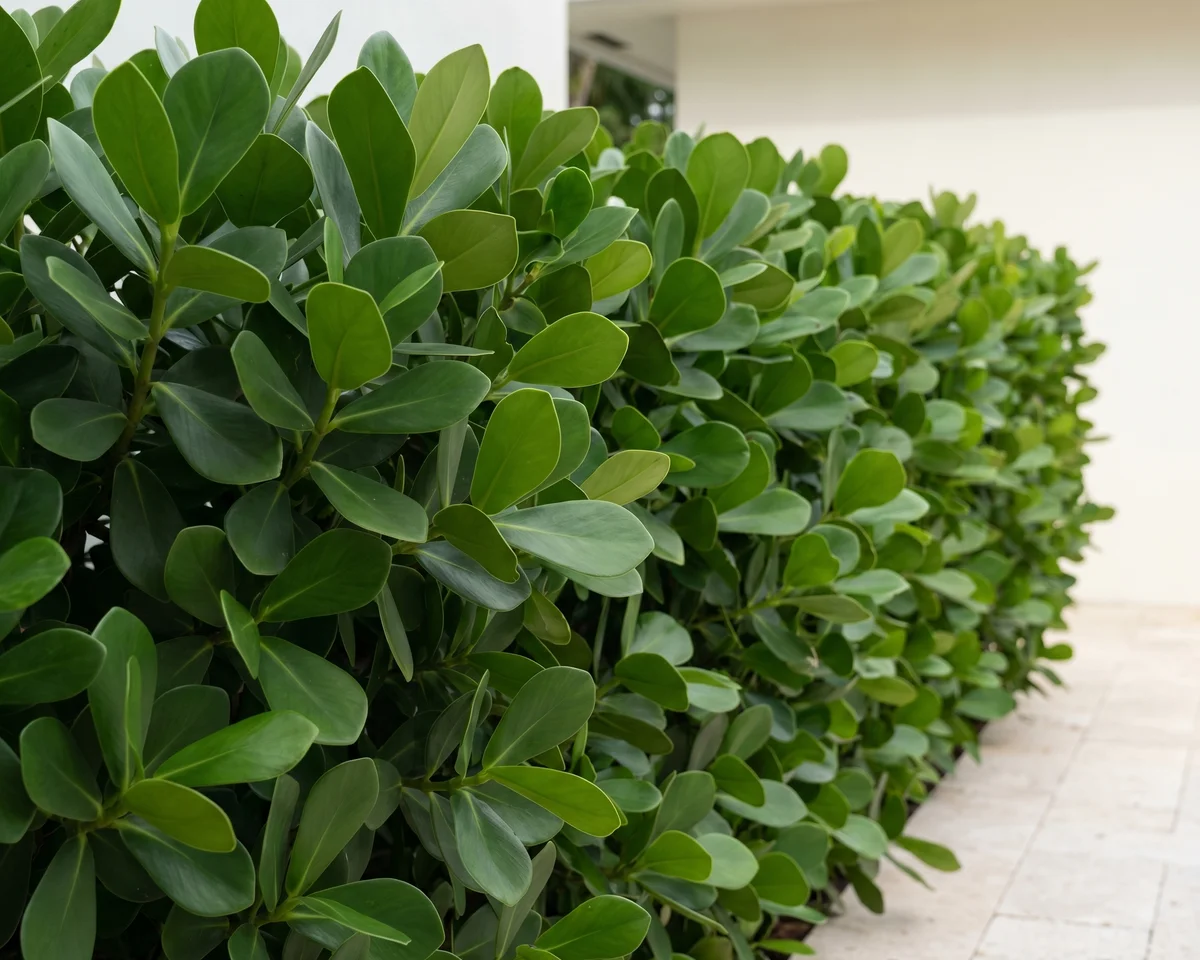
The key visual difference is the result. A single Clusia shrub looks like an individual plant. A Clusia hedge looks like a single architectural element, a wall, a screen, a boundary, that happens to be alive.
The technical difference is spacing and intent. Hedge plants are sized to match each other across the run and planted on tight enough centers, matched to the plant size (roughly 1 to 1.5 feet apart for 3-gallon up to 3 to 3.5 feet for 25-gallon), that they grow into each other rather than around each other.
Use Cases for a Single Clusia Shrub
Single shrubs are the right pick when:
- The buffer you need is narrow, one window, one corner, one specific sightline.
- The yard doesn’t have room for a full hedge, a tight side yard, a small condo terrace, a courtyard.
- You want the naturalistic look of an individual plant in the landscape rather than a clipped continuous wall.
- You’re starting small with the option to expand, install one shrub now, see how the species performs in your yard, decide if a full hedge is worth it in a year.
- You’re combining Clusia with other plants as part of a layered mixed bed rather than a monospecies wall.
For these use cases, a 15-gallon or 25-gallon Clusia gives you visual mass on day one. Smaller starter sizes (3-gallon and 7-gallon) work too if you have patience.
Use Cases for a Clusia Hedge (a Continuous Line)
A hedge is the right pick when:
- You’re screening a full property line of 30 feet or more.
- You want one continuous architectural element instead of separate plants reading as separate plants.
- The privacy concern is sustained, neighbors, road noise, sightlines across the yard.
- The yard’s aesthetic leans formal or contemporary, where a clipped hedge fits better than a naturalistic mixed bed.
- You want the highest visual density per linear foot that South Florida hedge plants offer.
Hedge installs are the bulk of our work for a reason: most residential privacy concerns are about long runs, not single points.
How the Buying Decision Changes
The container size, plant count, and spacing all shift between single-shrub and hedge orders:
Single shrub order:
- Quantity: 1 to 5 plants.
- Sizing: Mix or match, a single 25-gallon for instant impact, or a small group of 7-gallon plants for a more naturalistic clump.
- Spacing: Less critical. Plant where you want the visual feature; the plant fills out in all directions.
- Care: Standard Clusia care, no special hedge-line considerations.
- Cost: Scales with container size, from a smaller 3-gallon starter up to a 25-gallon specimen. We put exact per-plant pricing in the quote.
Hedge order:
- Quantity: Depends on run length and container size. A 50-foot run takes roughly 15 plants in large 25-gallon stock up to about 50 in small 3-gallon. A 100-foot run takes roughly 30 to 100 plants, since smaller plants need tighter spacing and more of them.
- Sizing: All plants matched by height across the order.
- Spacing: Critical. Tight, consistent on-center spacing matched to the plant size, tighter for small plants and wider for large, so adjacent plants grow into each other.
- Care: Same per-plant care, but synchronized, water and shape the whole line at once.
- Cost: Scales with quantity. The math is in the Clusia plants for sale page’s container-size guide.
Spacing Math When You’re NOT Building a Hedge
For single shrubs and small clusters, the spacing rules from hedge work don’t apply. The plant doesn’t need to close laterally with a neighbor, so you have more flexibility.
General guidelines for single Clusia or small groupings:
- Single specimen: No spacing math, just plant where it makes visual sense. Leave 4 to 5 feet of clearance from buildings, walls, and other plants so the shrub can fill out without crowding.
- Cluster of 2 to 5: Space 3 to 5 feet apart on center. Tight enough to read as a group, loose enough that each plant retains some individual character.
- Mixed bed with other species: Treat Clusia as one element in the bed. Don’t crowd it next to plants that will compete for the same root zone, a foot or two of breathing room around the dripline is plenty.
When People Get This Wrong
Two recurring mistakes we see:
Treating a hedge as a series of shrubs. Someone orders five 15-gallon Clusia and spaces them six feet apart across a 30-foot run, expecting them to grow together into a hedge over a few seasons. They don’t. The spacing is too wide for the plants to lateral-fill into each other. After two years, the result is five separate plants with three feet of empty space between each, not a hedge.
Treating a single shrub as a hedge. Someone orders one 7-gallon Clusia to “screen” a 12-foot section of property line. The plant fills out to its natural width (3 to 5 feet) but never extends to cover the full run. It’s a feature shrub in the middle of an otherwise exposed line.
The fix in both cases is matching the buying decision to the intended use. If you want continuous screening, you want a hedge, meaning enough plants at tight enough spacing to actually close laterally. If you want a feature plant, you want a shrub, and you don’t need many.
Frequently Asked Questions
Is a Clusia shrub the same plant as a Clusia hedge? Yes. The botanical species is identical, Clusia guttifera or Clusia rosea. The difference is how the plant is laid out and what role it plays in the landscape: a single specimen (shrub) versus a continuous tight-spaced line (hedge).
How many Clusia do I need for a privacy hedge? Depends on run length and starter size. A 50-foot hedge takes roughly 21 to 25 plants in 15-gallon at 2 to 2.5-foot spacing, or about 33 to 50 in 3-gallon at 1 to 1.5-foot spacing, since smaller plants go tighter and need more of them. A 100-foot run takes roughly 40 to 100 plants depending on container size. The spacing math is in our Clusia plants for sale container-size guide.
Can I buy just one Clusia plant? Yes. We sell single shrubs for feature plantings and small clusters. There’s no formal minimum order, though for orders below five plants the delivery fee starts to dominate the per-plant cost, we’ll let you know if it’s more economical to pick up.
How wide does a single Clusia shrub get? Mature single Clusia guttifera (the most common residential cultivar) typically reaches 3 to 5 feet wide if left to grow naturally. With light shaping, you can hold it narrower. Clusia rosea gets wider, up to 8 feet at maturity if unmaintained.
Will a single Clusia shrub block a window? Yes, if sized correctly. A 15-gallon or 25-gallon Clusia placed in front of a typical residential window provides a visual block on day one and continues to fill out over the first two seasons. For multiple windows or a wider section, a small cluster or short hedge is more effective.
Should I plant Clusia as a hedge or as separate shrubs? The answer depends on what you’re trying to achieve. Continuous privacy along a long run = hedge. A feature plant or a buffer at a specific point = shrub or small cluster. Both work; the decision is about layout intent, not plant suitability.
Does Clusia look different planted as a shrub vs as a hedge? The plant itself is identical, but the visual effect differs. A single Clusia shrub reads as a full, rounded individual plant. A Clusia hedge reads as a continuous wall, you don’t see individual plants in a well-installed hedge.
Can I convert a row of Clusia shrubs into a hedge later? Sometimes. If the original spacing was 3 to 4 feet on center, the plants can eventually close laterally and read as a hedge after several years of mature growth. If the spacing was 5+ feet, the gaps usually never close cleanly, you’d need to interplant additional Clusia to fill them.
See also: Clusia Hedges in South Florida for the full install service, or Clusia Plants for Sale for delivery-only plant orders.
Get the Right Clusia for Your Yard
Whether you need one shrub or a 100-foot hedge, the conversation starts the same way: a quick walk of the yard to confirm what you’re actually trying to achieve. We’ll tell you honestly whether a single shrub or a full hedge fits your needs.
Request a free quote or call us at 305-222-7171. We serve Miami, Fort Lauderdale, West Palm Beach, Boca Raton, and Delray Beach.
Tagged
- clusia shrub
- clusia hedge
- clusia plant
- buying clusia
- South Florida hedges
Ready for a privacy hedge that looks finished from day one?
Get a free estimate from a South Florida specialist who handles delivery, installation, and the result you actually want.