Buying Guide
Florida-Friendly Landscaping Certified Hedges
What FFL certification actually means for South Florida privacy hedges, which species qualify, how the program affects HOA approval, and how to plan a hedge that meets it.
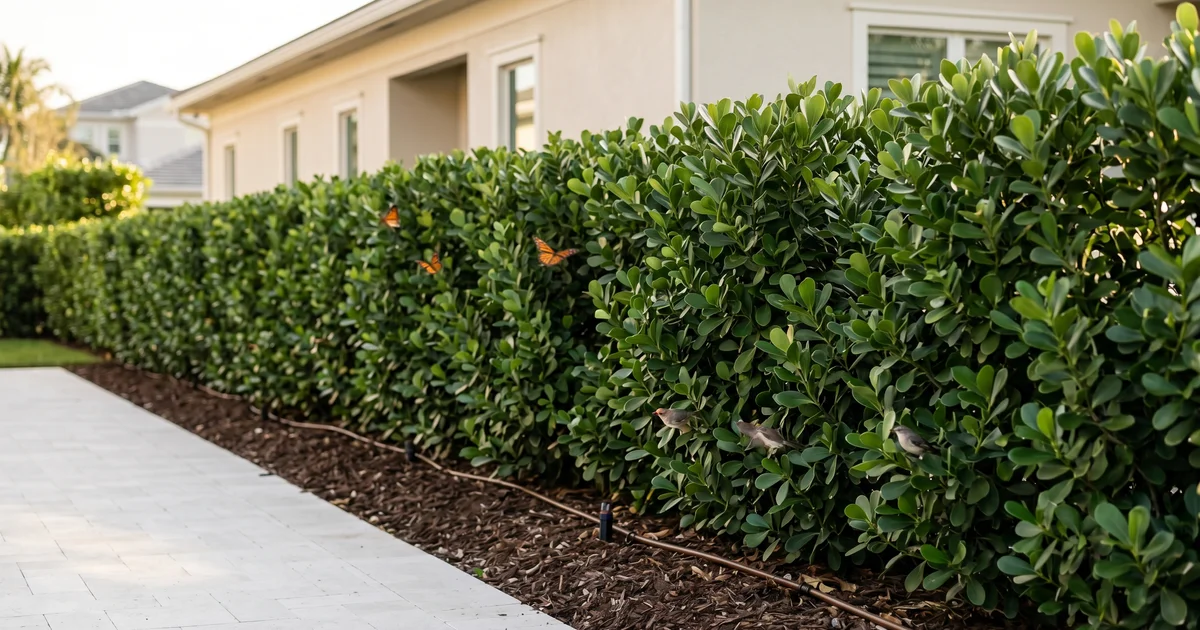
Florida-Friendly Landscaping certification has gone from niche eco-program to a genuine factor in South Florida hedge decisions over the last several years. Some HOAs now favor FFL-aligned plantings. A handful of municipalities offer water-restriction breaks for certified yards. And a growing share of homeowners simply want a privacy hedge that fits the program because it lines up with their values.
This post explains what FFL actually means for hedge installs, which species qualify, what changes when you go FFL on your privacy line, and where the program quietly stops short of being prescriptive.
Planning an FFL-aligned hedge install? This post covers the framework. For the installer-side plan, species selection, drip irrigation, mulch standard, and HOA-review prep, see our pillar on Florida-Friendly Landscaping Hedges.
The Short Answer
A “Florida-Friendly Landscaping certified hedge” is not a separate species. It is any privacy hedge installed using the right plant in the right place under the nine FFL principles, with a strong preference for Florida native species that match the site conditions.
Privacy hedges that align cleanly with FFL include cocoplum, Simpson’s stopper, Walter’s viburnum, yaupon holly, wild coffee, and marlberry. Clusia and Podocarpus are not on FFL native plant lists, but can still appear in FFL-aligned landscapes when site conditions and water-saving practices justify them. Pure native hedges produce the strongest FFL alignment for South Florida residential lots.
If FFL credit, water-restriction breaks, or eco-aligned HOA approval matter to you, the cleanest path is a native species hedge installed with proper spacing, mulch, and a real watering plan.
What Florida-Friendly Landscaping Is
Florida-Friendly Landscaping is a University of Florida IFAS Extension program that promotes sustainable residential landscape practices across the state. The program is built around nine principles:
- Right plant, right place
- Water efficiently
- Fertilize appropriately
- Mulch
- Attract wildlife
- Manage yard pests responsibly
- Recycle yard waste
- Reduce stormwater runoff
- Protect the waterfront
The program is voluntary. There is no statewide mandate that homes must be FFL-aligned. But the program has real legal force in two specific ways:
- Florida Statute 720.3075 prevents HOAs from prohibiting FFL practices. An HOA cannot legally tell a homeowner they must use turf instead of FFL-aligned plantings.
- Local water management districts sometimes provide stricter watering allowances or rebates for FFL-aligned yards.
Inside that framework, “FFL certified” usually means a homeowner has formally enrolled in a local IFAS Extension program and had their yard reviewed against the nine principles. Some counties offer recognition signs and certificates. The certification itself is not a prerequisite for using FFL principles, but it is the formal credential.
What “FFL Compliant Hedge” Actually Means
There is no single FFL-approved hedge species list at the state level. The closest thing is the Florida-Friendly Plant List, a database of plants suitable for Florida landscapes that prioritizes native and well-adapted species.
A privacy hedge is “FFL compliant” or “FFL aligned” when it meets these conditions:
- The species is appropriate for the site (sun, soil, salt, drainage)
- The species is Florida native or well-adapted, with native preferred
- The install includes proper mulch and irrigation design
- The fertilization schedule fits FFL standards
- The hedge does not require pesticide-heavy maintenance
Native species check the largest number of boxes most easily. Non-native species like Clusia and Podocarpus can still appear in an FFL-aligned landscape when the site genuinely calls for them and other FFL principles are followed, but they do not earn the strongest alignment by themselves.
Privacy Hedge Species That Cleanly Fit FFL
Six native species form the strong-alignment FFL hedge list for South Florida.
Cocoplum (Chrysobalanus icaco)
Cocoplum is the highest-volume FFL-aligned privacy hedge we plant. It is a true Florida native, exceptionally salt-tolerant, drought-hardy once established, low fertilizer requirement, and on every FFL plant list we have seen. Three varieties exist (red-tip, green-tip, horizontal). For privacy hedges in the 6 to 10 foot range, red-tip or green-tip is the choice. Our cocoplum varieties guide breaks down the differences.
Use cases:
- Coastal lots with direct salt exposure
- Drought-prone interior lots without consistent irrigation
- FFL-certified yards where Florida-native is a priority
Simpson’s Stopper (Myrcianthes fragrans)
Simpson’s stopper is the second-most-common FFL-aligned privacy hedge in our installs. Native, fine-textured, fits narrow runs, supports pollinators and birds, low input requirements. We covered the species in detail in our Simpson’s stopper post.
Use cases:
- Narrow side yards
- Modern and naturalistic homes
- Sun to part-sun runs
- Wildlife-priority FFL yards
Walter’s Viburnum (Viburnum obovatum)
Walter’s viburnum is the FFL-aligned option for shaded side yards. Native, dense fine texture, low maintenance once established. We compare it directly to Podocarpus in our shade hedge comparison.
Use cases:
- Shaded side yards
- Mid-height privacy hedges (6 to 12 feet)
- Wildlife-priority shaded sites
Yaupon Holly (Ilex vomitoria)
Yaupon holly is the FFL-aligned tall formal hedge option. Native, drought-tolerant, takes a clean clipped line, works on inland and northern South Florida lots. Less common than the other three because the supply chain for hedge-grade starters is narrower.
Use cases:
- Tall formal native screens (12 to 20 feet)
- Inland and interior South Florida lots
- Estate-style FFL landscapes
Wild Coffee (Psychotria nervosa)
Wild coffee is the FFL-aligned shade understory hedge. Native, glossy tropical-looking foliage, supports birds with bright red berries, requires consistent moisture. Tops out at 4 to 8 feet. Not a tall privacy hedge.
Use cases:
- Lower hedges or screens under tree canopy
- Transition zones between tall hedges and patios
- Wildlife-priority shaded sites
Marlberry (Ardisia escallonioides)
Marlberry is the hammock-edge FFL-aligned hedge. Native, glossy dark green leaves, fragrant white flowers, dark purple berries. Less common in nursery production. Useful on shaded lots with existing tree canopy.
Use cases:
- Shaded hammock-style yards
- Wildlife-priority shaded sites
- Designer landscapes wanting a less common native
Species That Do Not Fit FFL As Cleanly
Several common South Florida hedge species do not align with FFL strongly, even though they are widely planted. We are honest about this on every site walk.
Clusia
Clusia is a non-native species widely planted in South Florida. It is well-adapted, drought-tolerant once established, and salt-tolerant. It is not on most native FFL plant lists, and FFL-certifying programs do not credit it for the wildlife principles. It can still appear in FFL-aligned yards when site conditions justify it and other principles are met, but the FFL-strict homeowner usually picks cocoplum instead.
Podocarpus
Podocarpus is a non-native conifer-relative widely planted as a tall formal hedge. It is well-adapted to South Florida and tolerates sun, part shade, and a range of soils. It is not on FFL native plant lists, does not contribute to FFL wildlife principles, and is the formal-tall hedge species most commonly replaced by yaupon holly in FFL-strict installs.
Areca Palm
Areca palm is non-native and produces a privacy screen rather than a hedge. It is widely planted in South Florida but does not align cleanly with the FFL native preference and produces relatively little wildlife value. Our Clusia vs areca palm comparison covers the use-case differences.
Ficus
Ficus is non-native, pest-prone (rugose spiraling whitefly), and high-maintenance under FFL principle 6 (manage yard pests responsibly). FFL-aligned yards typically replace ficus rather than plant it. Our whitefly treatment guide and ficus removal guide cover the transition.
What Changes When You Go FFL On The Hedge
The species choice is the most visible change, but the install and maintenance practices also shift.
Install
- Mulch is essential. A 2 to 3 inch layer of natural mulch within the hedge dripline, kept off the trunk, is FFL standard.
- Irrigation is designed for efficiency. Drip lines and zone-based scheduling are preferred over overhead spray.
- Soil amendment is light. Native species generally do not need rich loam. Compost incorporation at install is fine. Heavy amendment is unnecessary.
- Spacing follows the same logic as any hedge. Native species do not need wider or tighter spacing because they are native.
Maintenance
- Fertilizer applications are reduced. Most native hedges thrive on one application of slow-release fertilizer per year. We covered the maintenance contrast in our native hedges maintenance post.
- Watering schedules are tapered aggressively after establishment. Native hedges hold up on weekly or biweekly irrigation in normal South Florida conditions.
- Pest management is responsive rather than preventive. FFL principle 6 favors fixing problems when they appear over routine pesticide application.
- Yard waste is recycled. Pruned material gets composted or chipped on site rather than hauled away.
These practices are not exclusive to FFL. Most well-installed hedges already follow them. The FFL framework just formalizes the approach.
How FFL Affects HOA Approval
Florida law prevents HOAs from prohibiting FFL principles. In practice, this matters in three ways for hedge installs.
Plant species selection. An HOA cannot legally tell a homeowner they must plant a specific non-native species when an FFL-aligned native species would serve the same function. If the architectural review committee insists on Podocarpus and the homeowner wants yaupon holly, the homeowner has the legal high ground.
Turf reduction. Some HOAs require lawn coverage along property lines. FFL practices allow native plant beds, including hedge runs, to replace turf in those areas under the right plant in the right place principle.
Watering restrictions. HOAs typically defer to local water management districts on watering schedules. FFL-certified yards sometimes have stricter watering allowances, which can affect what the HOA can require for irrigation.
That said, most South Florida HOAs are not adversarial about hedges. Both native and well-adapted non-native hedges typically clear architectural review without conflict. Our HOA-approved privacy hedges guide covers the standard review process.
The conflict cases are rare and usually involve homeowners trying to remove existing turf in favor of a native plant bed, not just installing a hedge.
How To Plan An FFL-Aligned Privacy Hedge
A practical sequence for homeowners who want their privacy hedge to be FFL-aligned:
- Confirm the goal. Are you formally certifying with your county IFAS Extension office, or do you just want the hedge to align with FFL principles? Both are valid. Formal certification adds paperwork and a yard review.
- Walk the run with the FFL species list in mind. Match exposure to species. Sun coastal, cocoplum. Sun inland tall, yaupon holly. Part-shade narrow, Walter’s viburnum or Simpson’s stopper. Deep shade, wild coffee or marlberry.
- Confirm starter size and spacing. FFL does not change the math. Plant size and spacing decide how finished the hedge looks on day one.
- Plan irrigation around drip and zoning. Skip overhead spray on hedge runs.
- Plan mulch placement and depth. A clean 2 to 3 inch layer holds soil moisture and reduces weed pressure.
- Set fertilizer schedule conservatively. One application per year is usually enough.
- Get the install done. A site walk and quote tell you whether the species, the spacing, and the surrounding conditions add up to a real hedge that will perform.
Our hedge installation cost guide covers what should be on a real quote, FFL-aligned or not.
When FFL Is Not The Right Constraint
A short list of cases where the FFL framework is not the right priority for a hedge install:
- Tight privacy timeline. If the hedge needs to read finished within one growing season, Clusia is faster than any FFL-aligned native. Some homeowners pick Clusia even in FFL-leaning yards because of timeline.
- Specific aesthetic requirements. Modern tropical homes sometimes specifically want the bold Clusia look that no FFL-aligned native fully replicates.
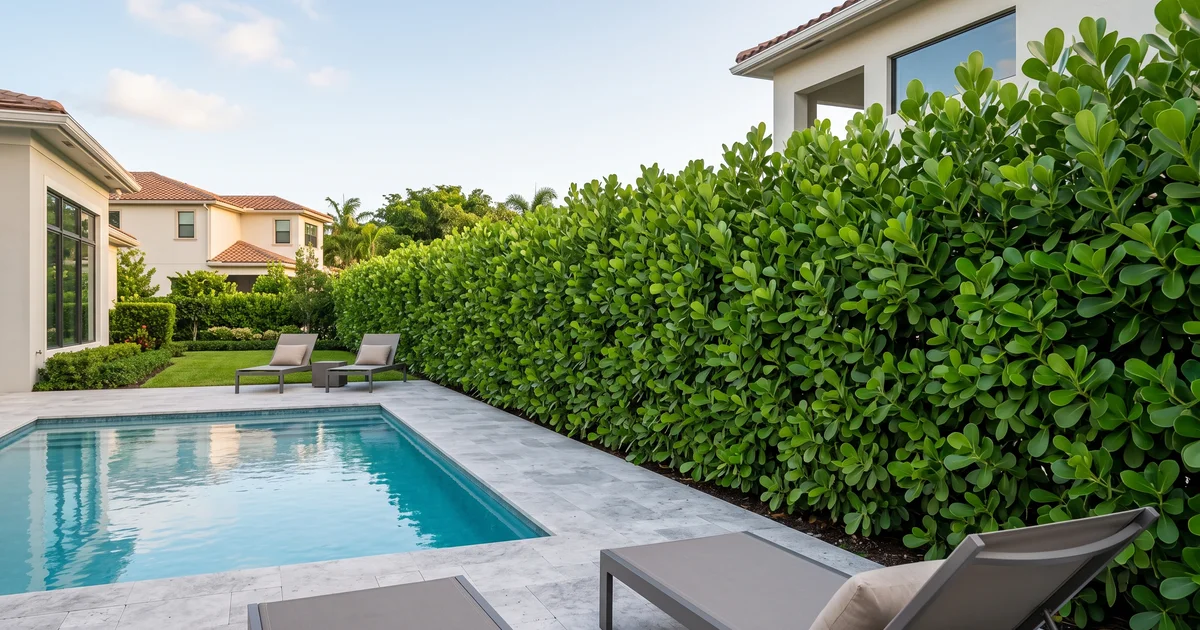
- Pool-yard density. Clusia and Podocarpus produce a slightly more visually solid clipped wall right at a pool deck than most natives. On strict-pool-edge runs, the imported species sometimes wins.
- Estate scale where supply matters. On very long estate runs, FFL-aligned native supply can run thin in 15-gallon hedge-grade sizes. Larger jobs sometimes default to Clusia or Podocarpus simply because the volume is available.
In all of these cases, the homeowner can still apply FFL principles to mulch, irrigation, fertilizer, and pest management even when the species choice is non-native. FFL alignment is a spectrum, not a binary.
Frequently Asked Questions
What is a Florida-Friendly Landscaping certified hedge? There is no single “FFL certified hedge” species list. A hedge is FFL-aligned when the species is appropriate for the site, preferably Florida native, and the install and maintenance practices follow the nine FFL principles around water, fertilizer, mulch, pest management, and stormwater.
Are Clusia hedges FFL approved? Clusia is not a Florida native and is not on most FFL native plant lists. It can still appear in FFL-aligned yards when site conditions justify it and other FFL practices are followed, but it does not earn the strongest alignment. For strict FFL hedges, cocoplum, Simpson’s stopper, or Walter’s viburnum are better matches.
Are Podocarpus hedges FFL approved? Podocarpus is a non-native and not on FFL native plant lists. It is well-adapted to South Florida and widely planted, but it does not contribute to FFL wildlife principles. For FFL-aligned tall formal hedges, yaupon holly is the native alternative.
Which native hedges are FFL aligned in South Florida? Cocoplum, Simpson’s stopper, Walter’s viburnum, yaupon holly, wild coffee, and marlberry are all native species suitable for South Florida privacy hedges and align cleanly with FFL principles. Each fits different conditions: sun coastal, narrow side yards, shaded runs, tall formal screens, and shade understory.
Do I need to be FFL certified to plant FFL-aligned plants? No. FFL principles can be applied to any landscape without formal certification. Formal certification through county IFAS Extension offices adds paperwork and a yard review, and provides recognition. The hedge species and practices are the same in either case.
Can my HOA prohibit FFL-aligned hedges? No. Florida Statute 720.3075 prevents HOAs from prohibiting FFL practices. An HOA cannot legally require you to plant a specific non-native species when an FFL-aligned alternative would serve the same function. Most South Florida HOAs accept FFL-aligned hedges without conflict.
Will FFL certification reduce my water bill? Sometimes. Local water management districts sometimes provide stricter watering allowances, rebates, or restriction-day exemptions for FFL-certified yards. The savings vary by district. Even without certification, FFL practices like drip irrigation and mulching reduce water use on hedge runs by 20 to 35 percent.
Is cocoplum FFL approved? Yes. Cocoplum, Chrysobalanus icaco, is a Florida native and is on every FFL plant list we have seen. All three cocoplum varieties (red-tip, green-tip, horizontal) qualify. Cocoplum is the highest-volume FFL-aligned privacy hedge species we plant.
Are FFL-aligned hedges more expensive? Roughly comparable for cocoplum at hedge-grade sizes. Slightly more expensive for Simpson’s stopper, Walter’s viburnum, and yaupon holly because nursery production volumes are smaller. Total install cost depends much more on starter size, run length, and site conditions than on FFL alignment specifically.
Can I mix native and non-native hedges in an FFL yard? Yes, on different lines. The FFL framework prefers native species but allows well-adapted non-natives where conditions justify them. A common pattern is cocoplum on the coastal-facing line, Walter’s viburnum on the shaded side yard, and Clusia on the pool yard. Mixing native and non-native within a single continuous hedge line is not recommended for visual reasons.
Does FFL require a specific mulch type or depth? FFL recommends 2 to 3 inches of natural mulch within the hedge dripline, kept off the trunks. Acceptable mulches include pine bark, melaleuca, eucalyptus, and pine straw. Cypress mulch is generally discouraged due to ecosystem concerns. Rubber mulch is not FFL-aligned.
Where can I get my yard FFL certified? Through your county University of Florida IFAS Extension office. Each Florida county has an extension office that handles FFL certification, recognition signs, and yard reviews. The process involves submitting a yard description, sometimes a site visit, and confirming alignment with the nine FFL principles.
See also: Florida-Friendly Landscaping Hedges, our installer-side pillar covering FFL species, drip irrigation, mulch, fertilization, and HOA review.
Plan An FFL-Aligned Hedge
The fastest way to settle whether an FFL-aligned hedge fits your yard is a site walk. We will tell you honestly which native species fits the run, how it compares to a non-native alternative, and how the install and maintenance practices translate to FFL alignment.
Request a free quote or call us at 305-222-7171. We serve Miami, Fort Lauderdale, West Palm Beach, Boca Raton, and Delray Beach, and we install Florida-native and well-adapted non-native privacy hedges across the region.
Tagged
- Florida-Friendly Landscaping
- FFL certified hedges
- Florida native plants
- HOA hedge approval
- South Florida hedges
- sustainable landscape
Ready for a privacy hedge that looks finished from day one?
Get a free estimate from a South Florida specialist who handles delivery, installation, and the result you actually want.