Buying Guide
Walter's Viburnum vs Podocarpus for Shaded Yards
Side-by-side comparison of Walter's viburnum and Podocarpus for shaded South Florida side yards. Real performance data on shade tolerance, height, density, and maintenance.
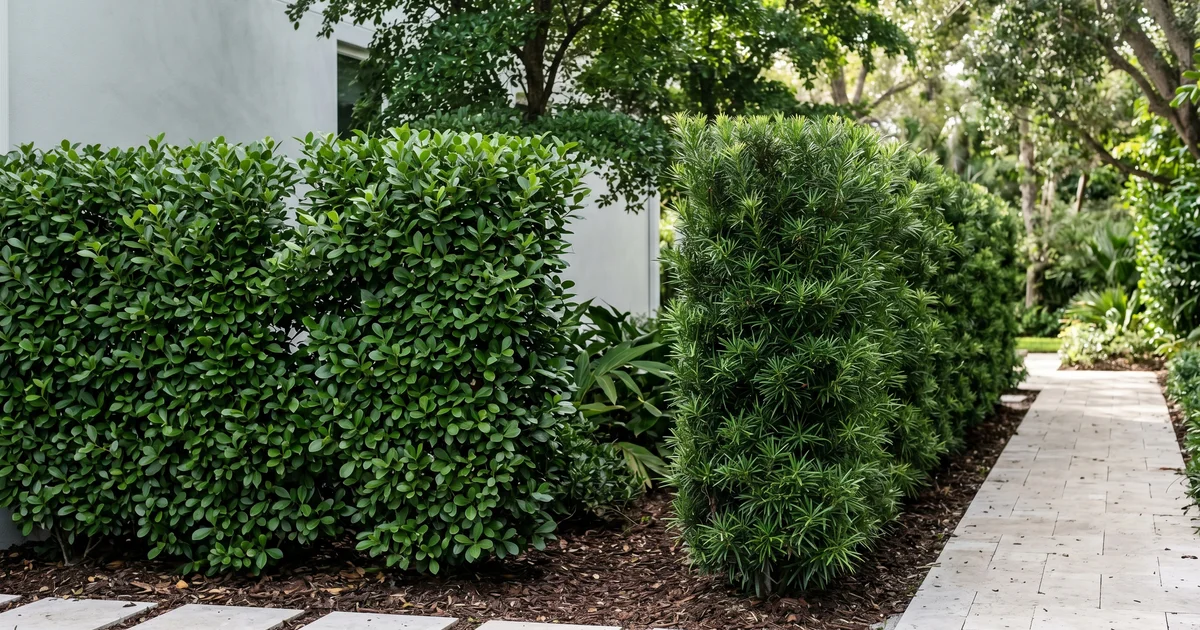
Shaded side yards are the trickiest hedge runs in South Florida. The north side of a two-story home, the strip between two close-set lots, the run under a mature live oak canopy, all of these reduce light below what most privacy hedge species need to fill in cleanly. Clusia and cocoplum start thinning. Simpson’s stopper opens up. Areca palm gets leggy. The two species that consistently work in real shade are Walter’s viburnum and Podocarpus.
This is the honest comparison from a South Florida installer who plants both species across Miami-Dade, Broward, and Palm Beach. Walter’s viburnum and Podocarpus solve the shaded-yard hedge problem in different ways. The right pick depends on the look you want, the height the run needs, and whether Florida-native status matters to you.
The Short Answer
For most shaded residential side yards, Walter’s viburnum is the easier match. It is a true Florida native, holds 6 to 12 feet comfortably, fits narrow runs, takes part shade well, and produces a clean dense hedge with minimal maintenance.
For tall formal architectural screens in shaded conditions, especially anywhere over 12 feet, Podocarpus is the stronger pick. It clips into the cleanest formal line of any shade-tolerant hedge species in South Florida.
Pick Walter’s viburnum for naturalistic mid-height shade hedges and Florida-native priority. Pick Podocarpus for tall formal screens, estate-style runs, and shaded yards where the look has to read architectural.
Quick Scorecard
| Feature | Walter’s Viburnum | Podocarpus |
|---|---|---|
| Florida native | Yes | No |
| Mature hedge height | 6 to 12 feet | 8 to 20 feet |
| Mature hedge width | 3 to 5 feet | 4 to 6 feet |
| Shade tolerance | Excellent (part shade) | Excellent (part shade) |
| Deep shade tolerance | Moderate | Moderate to good |
| Density per linear foot | Very high | Highest |
| Speed of fill | Moderate | Moderate to slow |
| Formal architectural look | Soft, slightly fuzzy | Crisp, sharp lines |
| Cost (large starter sizes) | Comparable to Podocarpus | Comparable to Walter’s |
| HOA acceptance | Standard | Standard |
| Wildlife value | High | Neutral |
What Walter’s Viburnum Is
Walter’s viburnum, Viburnum obovatum, is a Florida native evergreen shrub native to floodplains, swamps, and hammock edges across the southeastern US. It produces small dark green leaves under an inch long, dense compact branching, clusters of small white flowers in spring, and small dark berries that birds eat.
Several cultivars exist. The most common in South Florida residential installs:
- ‘Densa’ stays compact, around 6 to 10 feet, with extra-tight branching.
- ‘Mrs. Schiller’s Delight’ is a dwarf form, 3 to 5 feet, used as a low border, not a privacy hedge.
- ‘Whorled Class’ runs taller, up to 12 to 15 feet, with cleaner upright form.
For privacy hedge purposes, ‘Densa’ is the workhorse. It produces the right height for most residential side yards and clips cleanly.
What Podocarpus Is
Podocarpus, usually Podocarpus macrophyllus, is a non-native conifer-relative widely planted across South Florida for tall formal hedges. It produces narrow needle-like leaves about two inches long, very dense upright branching, and a naturally tall growth habit reaching 20 to 30 feet unmaintained.
Common cultivars in residential installs:
- ‘Maki’ is the standard hedge cultivar with a tighter compact form.
- ‘Pringles’ is a slower-growing variety with finer texture.
For shaded yards specifically, the standard ‘Maki’ is the most common pick because of its dense fill in lower-light conditions.
Where Walter’s Viburnum Wins
Florida Native Status
Walter’s viburnum is a true Florida native. Podocarpus is not. For homeowners who specifically want a native plant for their hedge, this is the only direct match between the two species.
Narrow Side Yards
Walter’s viburnum’s mature hedge width is typically 3 to 5 feet. Podocarpus mature hedge width is 4 to 6 feet. On lots where the side yard is 6 to 8 feet wide and the hedge needs to leave room for a walkway or grass strip, Walter’s viburnum fits better.
Mid-Height Hedges
For target heights between 6 and 12 feet, Walter’s viburnum hits the range easily and holds it without aggressive shaping. Podocarpus can be held at this height too, but it wants to grow taller and asks for more frequent shaping to stay short.
Wildlife Value
Walter’s viburnum produces flowers that feed pollinators and berries that feed native birds. Podocarpus is wildlife-neutral. For homeowners who want the shaded side yard to feel alive with birdsong, Walter’s viburnum delivers what Podocarpus does not.
FFL And Eco-Aligned Communities
Walter’s viburnum is on Florida-Friendly Landscaping plant lists. Podocarpus is not on most native-aligned FFL recommendations. In communities where FFL or eco priorities drive architectural review, Walter’s viburnum is the smoother path.
Lower Long-Term Inputs
Walter’s viburnum once established needs less water and less fertilizer than Podocarpus. The species evolved on Florida wetland edges and tolerates inconsistent moisture and lean soils. Podocarpus is a low-maintenance hedge by general standards but is not as truly self-sufficient as a native after year one.
Where Podocarpus Wins
Tall Formal Screens
This is the cleanest case for Podocarpus. Anywhere the hedge needs to reach 12 to 20 feet for a tall privacy screen, second-story window block, or estate boundary, Podocarpus is the only realistic shade-tolerant choice. Walter’s viburnum tops out around 12 feet and is uncomfortable above that height even on the tall cultivars.
Architectural Crisp Lines
A clipped Podocarpus hedge produces sharper architectural lines than a clipped Walter’s viburnum hedge. The needle-like leaf and the dense upright form take a tight clipped wall and hold it cleanly between trims. Walter’s viburnum clips well but reads slightly softer at the same trim level.
Maximum Density Per Linear Foot
A mature Podocarpus hedge is the most visually solid shade-tolerant privacy wall available in South Florida. The density per linear foot is extraordinary. Walter’s viburnum is also very dense, but Podocarpus wins this category.
Deeper Shade Performance
Both species handle part shade well. In deeper shade, especially under heavy canopy, Podocarpus generally holds form slightly better than Walter’s viburnum. Neither species thrives in true continuous deep shade. Both belong in part-shade conditions rather than under full dense canopy.
Predictable Nursery Supply
Podocarpus is grown in massive volume across Florida nurseries in any starter size. Walter’s viburnum hedge-grade plants are widely available but in narrower volumes, and large 15-gallon starters can require lead time when several jobs are pulling stock at once.
Side-By-Side, In Detail
Shade Tolerance
Both species tolerate part shade better than Clusia, cocoplum, or Simpson’s stopper. In our installs, both produce a fully filled-in hedge in part shade conditions. In deeper shade with less than 4 hours of dappled or filtered light per day, both species thin somewhat. Podocarpus thins less than Walter’s viburnum in those conditions, but neither is the right pick for true continuous deep shade.
Growth Speed
Walter’s viburnum at 7-gallon starters and 1.5 to 2 foot centers reads as a continuous wall within 12 to 24 months. Podocarpus at 7-gallon, set a little tighter at 1 to 1.5 foot centers, reads as a continuous wall within 18 to 30 months. Walter’s viburnum fills slightly faster in part shade. Both are slower than Clusia in full sun but faster than most shade alternatives.
Mature Size
Walter’s viburnum ‘Densa’ is comfortable at 6 to 10 feet. The taller cultivars push to 12 to 15 feet. Podocarpus is comfortable at 8 to 20 feet and can be pushed higher with shaping. For target heights above 12 feet, Podocarpus is the safer pick.
Density And Texture
Walter’s viburnum produces a dense fine-textured wall with small dark green leaves. The hedge reads as a soft, naturalistic privacy line. Podocarpus produces an extremely dense fine-textured wall with narrow needle-like leaves. The hedge reads as a sharp formal screen. Both are excellent. They are different aesthetics.
Formality
Walter’s viburnum can be clipped formal but reads slightly softer at any trim level. It is more comfortable in a relaxed naturalistic form. Podocarpus is the most clip-friendly shade-tolerant species available and reads its best as a sharp formal hedge.
Watering And Fertilizer
Walter’s viburnum once established needs less water and less fertilizer than Podocarpus. Both are low-maintenance, but Walter’s viburnum sits closer to truly self-sufficient on lean soils.
Pruning Schedule
Both species need similar pruning schedules at equivalent formality. A formal Podocarpus hedge needs three to four light shapings per year. A formal Walter’s viburnum hedge needs two to three. A naturalistic version of either needs one to two per year.
Cost
For comparable starter sizes, plant cost is in a similar range. Walter’s viburnum at 15-gallon hedge-grade sizes can run slightly more expensive due to narrower nursery production. Total install cost depends much more on starter size, run length, spacing, and existing hedge removal than on species. Our hedge installation cost guide covers what drives a real quote.
When To Mix Both On The Same Property
On larger properties with multiple shaded runs, mixing both species on different lines is sometimes the smartest plan. A typical example:
- Walter’s viburnum on the shaded side yard, sized for mid-height privacy
- Podocarpus on the front entry walk, clipped formal as an architectural screen
- Clusia on the sunny pool yard
- Cocoplum on the coastal-facing line
Four species across the property, each picked for its specific exposure and design role. We avoid mixing different species along the same continuous hedge line. The textures and forms do not blend cleanly.
For a broader framework on this kind of mixed approach, see our native privacy hedges guide.
How To Choose For Your Yard
Three questions usually settle the call:
- What height does the run need to hit? Up to 12 feet, Walter’s viburnum is in play. Above 12 feet, Podocarpus.
- What look are you after? Soft and naturalistic favors Walter’s viburnum. Crisp and architectural favors Podocarpus.
- Does Florida-native status matter to you? If yes, Walter’s viburnum is the only choice. If no, both species are on the table.
A site walk usually settles all three within a few minutes.
Frequently Asked Questions
Which is better for a shaded side yard, Walter’s viburnum or Podocarpus? For most shaded residential side yards under 12 feet, Walter’s viburnum is the easier match. It fits narrower runs, is a true Florida native, and asks for less water and fertilizer once established. For tall formal screens or runs over 12 feet, Podocarpus is the stronger pick.
Will Walter’s viburnum grow in shade? Yes, in part shade. It tolerates the kind of dappled, filtered, or partial-day shade common on the north side of a two-story home or under high canopy. In deep continuous shade with less than 4 hours of light, it thins. For deep shade conditions, neither Walter’s viburnum nor Podocarpus is ideal.
Will Podocarpus grow in shade? Yes. Podocarpus is one of the most shade-tolerant tall hedge species in South Florida. It performs well in part shade and holds its form even in moderately deep shade. For runs that need 12 feet or more in shaded conditions, Podocarpus is usually the right pick.
How tall does Walter’s viburnum get? Walter’s viburnum ‘Densa’ is comfortable as a hedge at 6 to 10 feet. Taller cultivars like ‘Whorled Class’ push to 12 to 15 feet. For target heights above 12 feet, Podocarpus is the safer choice.
Is Walter’s viburnum a Florida native? Yes. Walter’s viburnum, Viburnum obovatum, is native to Florida and the broader southeastern US. It occurs naturally in floodplains, swamps, and hammock edges. Podocarpus is not native to Florida or the US.
How wide is a Walter’s viburnum hedge? A maintained Walter’s viburnum hedge is typically 3 to 5 feet wide. Podocarpus runs 4 to 6 feet at maturity. On narrow side yards, Walter’s viburnum’s tighter form fits where Podocarpus would crowd a walkway or grass strip.
Is Walter’s viburnum HOA approved? Yes, in nearly every South Florida HOA we have worked with. It is on most approved-species lists, and FFL-aligned communities specifically favor it. Architectural review is generally straightforward. Podocarpus is also widely approved. Both species pass review on standard residential lots.
How fast does Walter’s viburnum grow? About one to one and a half feet per year in healthy conditions. A 7-gallon hedge typically reads as a continuous wall within 12 to 24 months at proper spacing. The first two to three years carry the strongest growth. After that, the hedge holds its target height with light shaping.
Does Walter’s viburnum attract wildlife? Yes. Spring flowers feed pollinators including bees and butterflies. Small berries feed native birds in summer and fall. The dense canopy provides nesting cover. Podocarpus produces neither flowers nor fruit that wildlife uses, so Walter’s viburnum is the clear wildlife winner between the two.
Is Podocarpus more pest-resistant than Walter’s viburnum? Both species have very few sustained pest issues. Occasional scale on stressed Podocarpus and occasional minor problems on stressed Walter’s viburnum. Neither is particularly pest-prone. Both are dramatically lower-maintenance than ficus on pest pressure.
Can I plant Walter’s viburnum and Podocarpus on the same property? Yes, on different lines. Use Walter’s viburnum on the shaded side yard at mid-height and Podocarpus on a separate line where the formal tall look is needed. We avoid mixing different species along the same continuous hedge line because the textures do not blend cleanly.
Which is more expensive, Walter’s viburnum or Podocarpus? For comparable starter sizes, the two species are in a similar price range. Walter’s viburnum at 15-gallon hedge-grade sizes can run slightly more due to narrower nursery production. Total installed price depends much more on plant size, run length, and site conditions than on species choice.
Get A Real Recommendation On Your Shaded Run
The fastest way to settle Walter’s viburnum vs Podocarpus on your specific property is to have someone who plants both walk the run. We will tell you honestly which species fits the height, the width, and the formality you want, and how the hedge will perform under your specific shade conditions.
Request a free quote or call us at 305-222-7171. We serve Miami, Fort Lauderdale, West Palm Beach, Boca Raton, and Delray Beach.
Tagged
- Walter's viburnum
- Podocarpus hedge
- shade hedge
- Florida native hedge
- shaded yard hedge
- side yard privacy
Ready for a privacy hedge that looks finished from day one?
Get a free estimate from a South Florida specialist who handles delivery, installation, and the result you actually want.