Buying Guide
Simpson's Stopper as a Privacy Hedge
An honest look at Simpson's stopper as a South Florida privacy hedge: where it shines, where it falls short, real growth timelines, spacing, and how it compares to Clusia and cocoplum.
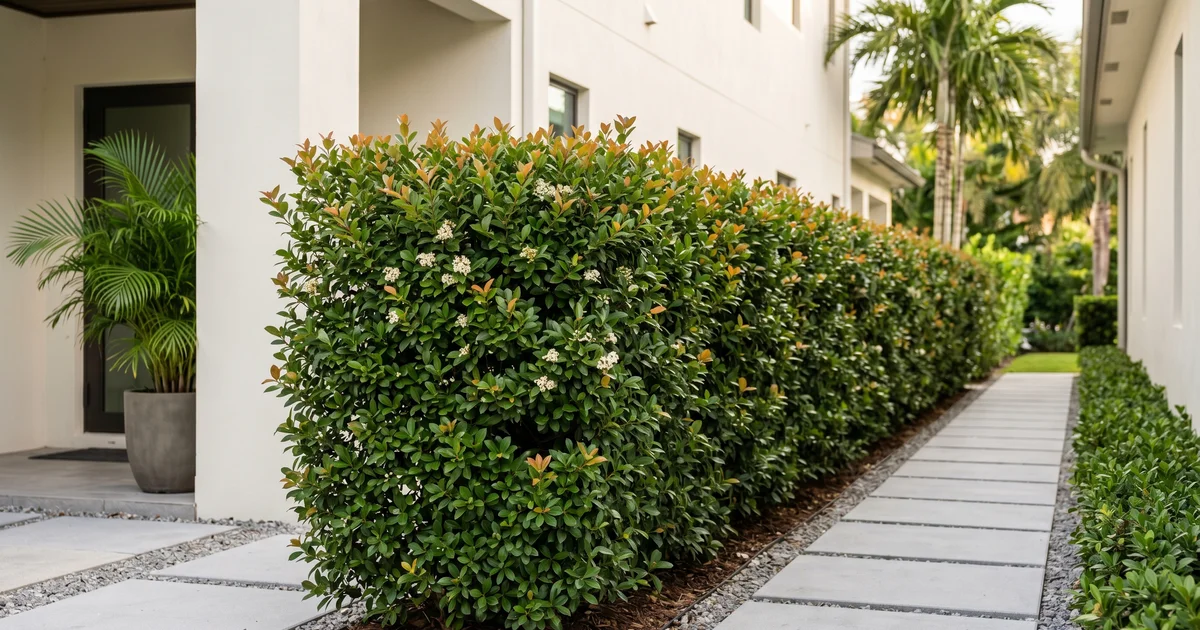
Simpson’s stopper has become the second most-asked-about Florida native privacy hedge on our site visits, after cocoplum. Homeowners read about it on Florida-Friendly Landscaping lists, see it at native plant nurseries, and want to know if it can actually do the job of a real privacy wall along a property line. The honest answer is yes, with conditions. This post is the long version of that yes.
We install both Simpson’s stopper and the standard Clusia and Podocarpus hedges across Miami, Fort Lauderdale, and West Palm Beach. Simpson’s stopper is not the right choice for every yard. It is the right choice for some, and on those yards it produces one of the most quietly beautiful hedges in South Florida.
The Short Answer
Simpson’s stopper, Myrcianthes fragrans, works well as a privacy hedge on narrow side yards, modern or naturalistic homes, full to part-sun lots, and properties where slow steady growth is acceptable. It is not the right pick for tight install timelines, deep shade, or pool-yard runs that need maximum density per linear foot.
For homeowners who want a Florida native, a fine-textured look, white spring flowers, red summer berries, and an aromatic hedge that rewards close-up attention, Simpson’s stopper is hard to beat.
What Simpson’s Stopper Is
Simpson’s stopper is a true Florida native evergreen shrub or small tree native to coastal hammocks of central and south Florida. Its scientific name, Myrcianthes fragrans, hints at the trait that distinguishes it from most other hedge plants: the leaves are aromatic when crushed, with a clean, slightly nutmeg-like scent.
The plant produces:
- Small, glossy, oval leaves about an inch long
- Coppery to reddish new growth that matures to deep green
- Clusters of small white flowers in late spring
- Bright red to dark red berries through summer that birds love
- A naturally upright, slightly columnar growth habit
Mature plants run 10 to 20 feet in the wild but are happily held at 6 to 12 feet as a residential privacy hedge. The form is denser and more upright than cocoplum, which makes it useful on narrow runs.
Where Simpson’s Stopper Belongs
We pick Simpson’s stopper over other hedge species in five specific situations.
Narrow Side Yards
Simpson’s stopper grows naturally upright. The mature width of a maintained hedge is typically 3 to 5 feet, less than a comparable Clusia or cocoplum hedge. On lots where the side yard is only 6 to 8 feet wide and the hedge needs to leave room for a walkway, irrigation, or grass strip, Simpson’s stopper fits where wider species struggle.
Modern And Naturalistic Landscapes
The fine leaf and the seasonal flower-and-berry display fit modern, contemporary, and naturalized residential landscapes. It does not read as overtly tropical the way Clusia does. Designers working on Florida-vernacular and modern coastal homes often specify it for exactly that reason.
Full Sun To Part Sun Lots
Simpson’s stopper performs best in full sun and tolerates part sun well. It is not a deep shade plant. For yards with bright open exposure on most of the run and mild shade in patches, it holds up evenly.
Properties Where Wildlife Value Matters
The flowers feed pollinators in spring, and the berries feed birds through summer and into fall. We see active wildlife on every mature Simpson’s stopper hedge we have planted. Homeowners who want the privacy hedge to also pull butterflies and birds get real value here.
FFL And Eco-Aligned Communities
Simpson’s stopper is on every Florida-Friendly Landscaping plant list we have seen. In HOAs that favor or require FFL-aligned choices, it sails through architectural review. We cover that process more fully in our HOA-approved privacy hedges guide.
Where It Does Not Belong
We turn homeowners away from Simpson’s stopper when one of these conditions applies.
The Privacy Timeline Is Tight
If the homeowner needs a finished hedge inside one growing season, Simpson’s stopper is the wrong species. It grows steadily but not quickly. Plan on one and a half to two seasons before a 7-gallon install reads as a continuous wall, longer for smaller starters. For comparison, Clusia at the same starter size and spacing usually closes up in six to twelve months. Our growth-timeline breakdown for Clusia explains the contrast in detail.
The Run Is In Deep Shade
Simpson’s stopper tolerates part shade but not deep continuous shade. On the north side of a two-story home with mature canopy overhead, leaves thin and gaps appear. Walter’s viburnum or wild coffee belong on those runs. We compare options for shade in the native privacy hedges guide.
Direct Coastal Spray
Simpson’s stopper handles near-coastal exposure well, but it is not as bulletproof as cocoplum on direct ocean-spray lots. For beachfront and direct-spray oceanfront yards, cocoplum is the safer native choice. The cocoplum vs Clusia comparison covers that exposure call in more detail.
Pool Edges That Need Maximum Density
A clipped Clusia or cocoplum hedge produces a more visually solid privacy wall per linear foot than Simpson’s stopper at equivalent age. For pool yards where the priority is maximum opacity right at the deck edge, the standard species win.
Realistic Growth Timeline
Here is what we actually see on installs across Miami, Fort Lauderdale, and West Palm Beach.
3-gallon starters at 1 to 1.5 foot centers: plants close up visually around 18 to 30 months. The hedge looks intentional within a season, but it does not read as a finished wall until the second year.
7-gallon starters at 1.5 to 2 foot centers: plants begin to touch within 12 to 18 months and read as a continuous hedge by 18 to 24 months. This is the most common starter size we use for Simpson’s stopper privacy hedges.
15-gallon starters at 2 to 2.5 foot centers: plants read as a finished hedge from install day. The first growing season fills any small gaps. This is the path for homeowners who want immediate privacy from a Simpson’s stopper run.
Annual vertical growth is roughly 1 to 1.5 feet per year in healthy conditions. The first two to three years carry the strongest growth. After year three, the hedge holds its target height with light shaping.
Spacing And Plant Count
For a finished privacy wall on day one or close to it, we typically install Simpson’s stopper at:
- 15-gallon at 2 to 2.5 foot centers for an immediately-finished run
- 7-gallon at 1.5 to 2 foot centers for a near-finished run that closes up in a season
- 3-gallon at 1 to 1.5 foot centers for a longer-runway DIY-friendly install
For a 100 foot hedge:
- 15-gallon at 2 to 2.5 foot centers: about 41 to 51 plants
- 7-gallon at 1.5 to 2 foot centers: about 51 to 68 plants
- 3-gallon at 1 to 1.5 foot centers: about 68 to 101 plants
Spacing logic mirrors what we cover in our Clusia spacing guide. The species changes, the math does not.
Soil, Sun, And Site Prep
Simpson’s stopper handles a wider range of soil than Clusia or Podocarpus. Lean, sandy, alkaline South Florida soils suit it fine, especially with light compost incorporation at install. It does not need rich loam.
Sun is the bigger variable. Plants in full sun produce the densest hedges with the most flowers and berries. Plants in part sun grow more open and flower less. Plants in deep shade thin out and never read as a privacy wall.
Site prep is the same as for any hedge install: clear the run, amend with compost where the existing soil is exhausted, set drip irrigation before planting, and plan a watering schedule for the first sixty to ninety days. We cover the install process in our privacy hedge installation guide.
Maintenance And Care
Simpson’s stopper is genuinely low-maintenance once established. The first year is the same as any new hedge: consistent watering, light shaping. After that, the maintenance load drops noticeably.
Watering: daily for the first two weeks, every other day for weeks three to four, two to three times a week through the first sixty to ninety days, then weekly to biweekly once established depending on rainfall.
Shaping: two to three light shapings a year holds the hedge in a clean form. Heavy shearing every few months is not necessary.
Fertilizing: a balanced slow-release fertilizer once a year supports steady growth. Heavy fertilization is not required and can push weak growth.
Pest pressure: low. Simpson’s stopper is not commonly affected by the pests that hammer ficus or scale-prone hedges. Occasional mites or thrips show up on stressed plants but rarely become a problem on healthy installs.
Drought tolerance: good once established. Plants will hold their leaves through normal South Florida dry stretches without supplemental water beyond weekly irrigation.
Cost Reality
Simpson’s stopper at hedge-grade sizes runs slightly more expensive per plant than Clusia at the same starter size, mainly because nursery production volumes are smaller. For a 100 foot hedge, the plant-cost difference against an equivalent Clusia install is modest, and starter size and site conditions move the total far more than the species choice does.
Total installed price depends much more on starter size, spacing, soil prep, and existing hedge removal than on species. Our hedge installation cost guide breaks down what should be on a real quote and which lines actually drive the number.
For homeowners considering DIY, delivery-only pricing on Simpson’s stopper is also available where supply allows.
How It Compares To Other Hedges
A condensed comparison against the species homeowners usually weigh:
- vs Clusia: Simpson’s stopper grows more slowly and reads as less assertively tropical. Clusia fills faster and produces a denser clipped wall. Pick Simpson’s stopper for narrow runs, modern looks, and FFL credit. Pick Clusia for fast finished privacy on standard residential lots.
- vs cocoplum: Both are Florida natives. Cocoplum fills faster, handles direct coastal spray better, and produces a denser hedge. Simpson’s stopper fits narrower runs, looks more refined, and offers more wildlife variety with flowers and berries. The two species are good neighbors on the same property, on different lines.
- vs Podocarpus: Podocarpus produces a tall formal architectural hedge. Simpson’s stopper produces a more naturalistic mid-height hedge. They serve different goals. We compare Walter’s viburnum vs Podocarpus for a closer same-purpose match in an upcoming post on shaded yards.
- vs Walter’s viburnum: Walter’s viburnum is the better shade pick. Simpson’s stopper is the better full-sun pick. On a property with both exposures, both species can earn a line.
When It Is The Right Pick
Use Simpson’s stopper when:
- The run is narrow and a wide hedge would crowd a walkway or grass strip.
- The home reads modern, naturalistic, or coastal-vernacular rather than overtly tropical.
- The exposure is full to part sun.
- The privacy timeline is one and a half to two seasons or longer.
- Wildlife value, FFL credit, or true Florida-native status matters.
If three or more of these apply, Simpson’s stopper is probably the right call. If none of them apply, a Clusia or cocoplum hedge will likely serve the yard better.
Frequently Asked Questions
Is Simpson’s stopper a good privacy hedge? Yes, on the right yard. It produces a dense, fine-textured, evergreen privacy wall in the 6 to 12 foot range with white flowers and red berries. It is a strong choice for narrow side yards, modern homes, and Florida-Friendly Landscaping communities. It is slower than Clusia and not the right pick when timelines are tight.
How fast does Simpson’s stopper grow? About one to one and a half feet per year in healthy South Florida conditions. The first two to three years carry the strongest growth. A 7-gallon hedge typically reads as a finished wall within 12 to 24 months at proper spacing. Larger starter sizes deliver finished privacy faster.
How tall does Simpson’s stopper get as a hedge? Most residential hedges sit comfortably at 6 to 12 feet. With shaping, plants can be held shorter for low borders or allowed to grow taller as a tall screen. Mature plants in the wild reach 15 to 20 feet but are not typically held at that height in residential privacy installs.
How wide does a Simpson’s stopper hedge get? A maintained Simpson’s stopper hedge is usually 3 to 5 feet wide, narrower than Clusia or cocoplum at equivalent maturity. This is the main reason it is our default native pick for tight side yards where width matters.
Is Simpson’s stopper salt tolerant? Yes, moderately. It handles near-coastal salt exposure well and grows naturally in coastal hammocks. For direct ocean-spray beachfront lots, cocoplum is more bulletproof. For inland and lightly coastal South Florida properties, Simpson’s stopper is reliable.
Does Simpson’s stopper attract wildlife? Yes. Spring flowers feed native pollinators including bees and butterflies. Summer berries feed mockingbirds, cardinals, blue jays, and other Florida birds. The dense canopy provides nesting cover. It is one of the most actively-used Florida native privacy hedges for wildlife.
How far apart should I plant Simpson’s stopper? Spacing follows the starter size. 15-gallon go on 2 to 2.5 foot centers, 7-gallon on 1.5 to 2 feet, and 3-gallon on 1 to 1.5 feet. Smaller plants go tighter so the row closes; larger plants sit wider and still touch. A 100 foot hedge needs roughly 41 plants in 15-gallon up to about 101 in 3-gallon, since tighter spacing means more plants.
Will Simpson’s stopper grow in shade? It tolerates part shade but does not thrive in deep shade. On north-facing or canopy-shaded runs, plants thin out and the hedge stops reading as solid. For shaded sites, Walter’s viburnum or wild coffee are better native choices.
Is Simpson’s stopper HOA approved in South Florida? Yes, in nearly every South Florida HOA we have worked with. It is a long-listed Florida Friendly species and is on most approved-species lists. Eco-aligned and FFL-certified communities specifically favor it. Architectural review is generally straightforward.
Is Simpson’s stopper the same as Stopper or red-stopper? No. Several Florida natives share the “stopper” name, including red stopper, white stopper, and Spanish stopper. Simpson’s stopper, Myrcianthes fragrans, is the species we use for privacy hedges. The other stoppers are smaller, more open, and not typically planted as continuous privacy walls.
Are Simpson’s stopper berries edible for humans? The berries are eaten by birds and are not toxic to humans, but they are not commonly consumed and the flavor is not appealing. We do not recommend eating them. We never plant Simpson’s stopper as a fruit-producing edible. The berries are part of the wildlife value, not the kitchen.
How much does a Simpson’s stopper hedge cost to install? For a similar starter size, plant cost is slightly higher than Clusia. Total installed price depends much more on size, run length, spacing, and site conditions than on species. A real quote comes from a site walk, not a phone estimate. Our installation cost guide covers what drives the number.
Plan Your Simpson’s Stopper Hedge
If you are weighing Simpson’s stopper for your South Florida yard, the most useful next step is a site walk. We will tell you honestly whether the species fits the run, what starter size makes sense for your timeline, and how the hedge compares to Clusia or cocoplum on your specific property.
Request a free quote or call us at 305-222-7171. We serve Miami, Fort Lauderdale, West Palm Beach, Boca Raton, and Delray Beach, and we install both Florida natives and the standard imported privacy hedges.
Tagged
- Simpson's stopper
- Florida native hedges
- native privacy hedges
- South Florida hedges
- Myrcianthes fragrans
- narrow privacy hedge
Ready for a privacy hedge that looks finished from day one?
Get a free estimate from a South Florida specialist who handles delivery, installation, and the result you actually want.