Tips & Guides
Are Native Hedges Actually Lower Maintenance?
Cutting through the marketing claim. Real water, fertilizer, pruning, and pest data on Florida native hedges vs Clusia and Podocarpus from a South Florida installer who plants both.
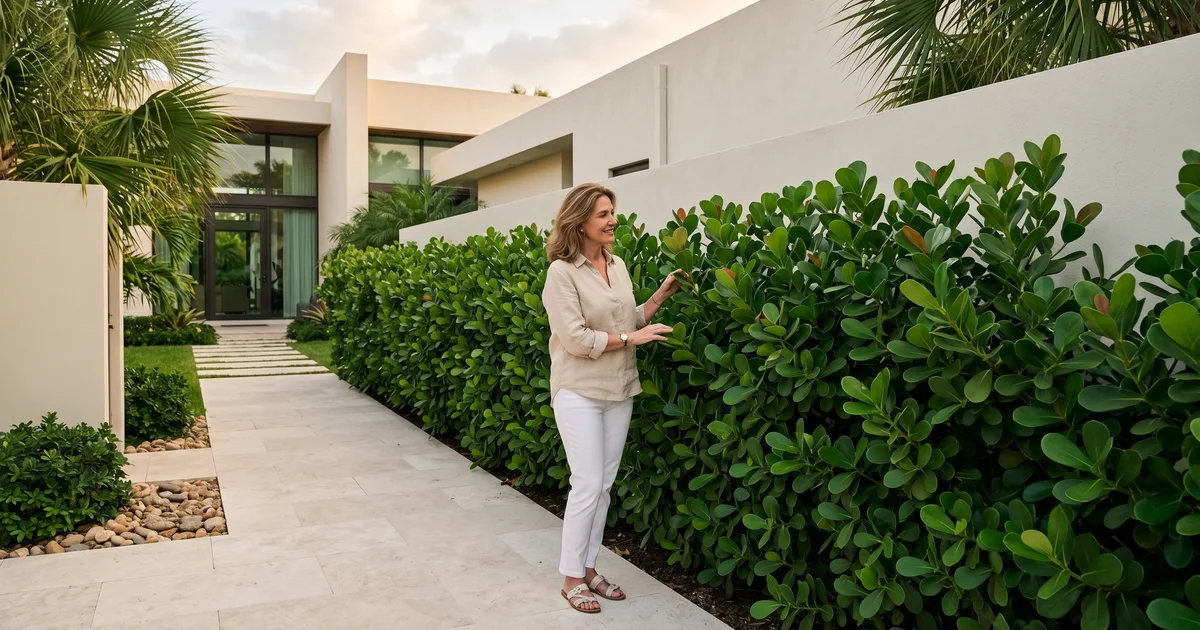
“Native hedges are lower maintenance” is a sentence we hear from homeowners almost every week. It is also a sentence we hear from native plant marketing materials, FFL brochures, eco-conscious landscape designers, and the occasional well-meaning but selective Reddit thread. The truth is more useful than the slogan. Sometimes natives genuinely are lower maintenance. Sometimes they are roughly equal. Sometimes they are actually more demanding than Clusia or Podocarpus, especially in the first year.
This post breaks down the maintenance reality across four categories that actually matter on a hedge: water, fertilizer, pruning, and pest pressure. We pull from real installs across Miami, Fort Lauderdale, and West Palm Beach where we plant both natives and the imported standards.
Considering a Florida-native hedge? This post is the maintenance breakdown. For the full installer-side picture, species selection, FFL alignment, install, and HOA review, see our pillar on Native Hedges for South Florida.
The Short Answer
Once established, most South Florida native hedges do need less water and less fertilizer than Clusia or Podocarpus, especially on lean sandy soils and on drought-prone interior lots. They are also generally less pest-prone than ficus and roughly equal to Clusia and Podocarpus on pest pressure.
But “lower maintenance” is not universal:
- The first year is roughly equal for native and non-native hedges. Establishment care does not change.
- Pruning effort is similar. Most native hedges need the same one to three light shapings per year that Clusia or Podocarpus need.
- Wildlife traffic is higher on natives. That brings benefits and a bit of cleanup.
- Some natives are actually fussier in specific conditions, like irrigation-heavy lawns where the soil stays too wet.
Below is the long version, with the trade-offs that matter.
What “Maintenance” Actually Means On A Hedge
Before comparing species, we have to define the term. On most South Florida residential hedges, maintenance breaks into:
- Water during establishment and through dry stretches.
- Fertilizer to keep growth steady and color clean.
- Pruning and shaping to hold the form.
- Pest and disease management when issues show up.
- Cleanup under and around the hedge from leaves, fruit, or storm debris.
A hedge can score “low” on water and “medium” on cleanup. Calling a species “low maintenance” without breaking down which axis matters most for the homeowner usually leads to mismatched expectations. Every homeowner cares about a different combination of these.
Water: Where Natives Earn Their Reputation
This is the category where natives clearly outperform once established.
After the first 60 to 90 days of establishment, a healthy cocoplum, Simpson’s stopper, Walter’s viburnum, or yaupon holly hedge can hold its color and density on roughly one to two waterings per week through normal South Florida dry stretches. In drought years with watering restrictions, that gap widens. Cocoplum in particular handles extended dry stretches with minimal stress.
Clusia is forgiving and not especially thirsty by hedge standards, but it does need more consistent moisture than most natives. Podocarpus is similar. Both species hold up fine in normal South Florida conditions on standard residential irrigation, but in drought years they ask for more help.
The math for a 100 foot hedge over a year: a native hedge typically needs 20 to 35 percent less supplemental irrigation than a Clusia hedge once established. On lots without irrigation at all, that gap can be the difference between survival and replacement.
Caveats:
- Year one is roughly equal across all hedges. Establishment is establishment.
- On heavily irrigated lawns where the hedge gets soaked daily, some natives like Walter’s viburnum can root-rot. Clusia and Podocarpus tolerate that condition better.
- On pure sand without compost amendment, natives outperform Clusia by a wider margin. On loamy soils, the gap narrows.
For homeowners on water-restricted properties or anyone planning around drought, our hurricane-season and weather guide is also useful for understanding stress windows.
Fertilizer: Real Difference, Real Limits
Native hedges generally need less fertilizer than Clusia or Podocarpus. The species evolved on lean Florida soils and do not require rich nutrient inputs to grow steadily.
Typical schedules we use:
- Cocoplum, Simpson’s stopper, Walter’s viburnum, yaupon holly: one application of slow-release balanced fertilizer per year, sometimes two on faster-growing runs.
- Clusia: two applications per year produces the cleanest growth and color.
- Podocarpus: two to three applications per year, especially on tall formal hedges where consistent vigor matters.
In dollar terms, the savings are not enormous on a residential hedge. Dropping an application or two per year on a typical run trims a little off the fertilizer line, and even across a decade it stays a minor number next to the cost of the hedge itself. The bigger savings come from the runoff and soil-health implications, not the line item.
Pruning: Surprisingly Similar
This is where the “low maintenance” claim gets oversold most often.
Most South Florida hedges, native or not, need one to three light shapings per year. The number depends more on how formal the hedge is than on the species. A formal clipped Podocarpus hedge needs more shaping than a relaxed cocoplum hedge because the formal look demands it. Switching the formal Podocarpus to a formal yaupon holly does not reduce the shaping schedule.
We see homeowners assume a native hedge will be a “set it and forget it” hedge. That is partly true if they accept a softer naturalized form. If they want the hedge clipped to a sharp line, the pruning schedule is roughly equal to Clusia.
The actual variation in pruning load is:
- Loose informal native hedge (Simpson’s stopper, marlberry, wild coffee): one to two shapings per year is fine.
- Lightly maintained cocoplum or Walter’s viburnum: two shapings per year.
- Lightly maintained Clusia: two to three shapings per year.
- Formal Podocarpus or yaupon holly architectural hedge: three to four shapings per year.
If pruning effort is the main maintenance concern, the variable to optimize is hedge formality, not species.
Pest And Disease Pressure
Native hedges have a real advantage here, but mostly compared to ficus, not to Clusia or Podocarpus.
The big-picture South Florida pest reality:
- Ficus is the high-maintenance hedge. Whitefly, especially the rugose spiraling whitefly, has been a sustained problem for over a decade. We cover the dynamics in our whitefly treatment guide and the ficus removal guide.
- Clusia has very few sustained pest issues. Occasional thrips or scale on stressed plants. Generally clean.
- Podocarpus has very few sustained pest issues. Occasional scale on stressed plants. Generally clean.
- Cocoplum, Simpson’s stopper, Walter’s viburnum, yaupon holly all have very few sustained pest issues. Occasional minor problems on stressed plants. Generally clean.
So the real comparison: native hedges and the imported standards (Clusia, Podocarpus) are roughly equal on pest pressure. Both are dramatically lower-maintenance than ficus.
For homeowners replacing a failing ficus hedge, the maintenance gap when switching to either Clusia or a Florida native is significant. The species choice within that healthy-hedge tier matters less for pest pressure than the choice to leave ficus behind.
Cleanup And The Wildlife Tradeoff
This is the maintenance category where natives sometimes ask for more, not less.
Native hedges that produce fruit (cocoplum, Simpson’s stopper, Walter’s viburnum, yaupon holly, marlberry, wild coffee) attract birds. Birds drop seeds. Some seeds germinate in nearby lawn or garden beds. Most homeowners we work with consider this a small price for the wildlife value, but it is honest to mention.
Cocoplum fruit and Simpson’s stopper berries also drop on the ground beneath the hedge. The drop is light and soft, not the kind of fruit fall that creates a mess, but on hardscape walkways and pool edges it is noticeable. Clusia and Podocarpus produce nothing comparable.
Pollinator activity on native hedges in spring is genuinely high. Most homeowners enjoy it, but a small subset prefer hedges that do not pull bees and butterflies up close to the patio. Those homeowners are usually better served by Clusia or Podocarpus.
When A Native Is Truly Lower Maintenance
Putting all four axes together, a native hedge is meaningfully lower maintenance than Clusia or Podocarpus on:
- Drought-prone lots without consistent irrigation.
- Lean sandy soils where Clusia would need more amendment.
- Properties prioritizing low chemical inputs, including FFL-certified yards.
- Coastal exposure where cocoplum specifically beats every other species on resilience.
- Yards with a relaxed naturalistic landscape style that does not demand a perfectly clipped wall.
When most or all of these apply, switching to a Florida native is not a marketing exercise. It is a real long-term maintenance reduction.
When A Native Is Not Lower Maintenance
The claim breaks down on:
- Heavily irrigated standard South Florida lawns where everything stays wet. Walter’s viburnum can root-rot, and other natives gain no water-savings advantage.
- Formal architectural hedges where pruning frequency is driven by the design, not the species.
- First-year installs, where every hedge needs the same establishment care.
- Tight pool yards where leaf drop and fruit drop matter more than water savings.
- Homeowners who do not want wildlife visiting the hedge.
On these yards, picking Clusia or Podocarpus is the maintenance-honest choice.
Honest Math For A 100 Foot Hedge
A rough ten-year maintenance comparison for a clean residential 100 foot hedge in South Florida, after the first establishment year:
| Item | Native (e.g., cocoplum) | Clusia | Podocarpus |
|---|---|---|---|
| Annual water cost | Lowest | Moderate | Moderate |
| Annual fertilizer cost | Lowest | Moderate | Moderate to high |
| Annual pruning labor | Low to moderate | Low to moderate | Moderate to high |
| Annual pest interventions | Very low | Very low | Very low |
| Cleanup (fruit drop, wildlife) | Light to moderate | Minimal | Minimal |
| Total annual maintenance | Lowest | Low to moderate | Moderate |
The takeaway is not “always pick native.” It is that natives consistently come in at the low end of the maintenance range when their other conditions are right.
How To Think About The Decision
Three questions to ask before assuming a native is the lower-maintenance pick:
- Will the hedge be clipped formal or grown naturalistically? Formal hedges level the pruning gap.
- Is the property irrigation-heavy or drought-prone? Irrigation-heavy lots erase the water advantage.
- Does the homeowner want wildlife on the hedge? If no, native value drops.
Layered onto the broader privacy hedge decision in our best privacy hedge for South Florida guide, these questions usually resolve the species call within a few minutes of a site walk.
Frequently Asked Questions
Are native hedges actually lower maintenance than Clusia? Once established, yes, generally. Most Florida native hedges need less water and less fertilizer than Clusia, especially on drought-prone or lean-soil sites. Pruning, pest pressure, and first-year care are roughly equal. The “lower maintenance” claim is real but narrower than marketing usually makes it sound.
Do native hedges need less water? Yes, after the first 60 to 90 days. Established cocoplum, Simpson’s stopper, Walter’s viburnum, and yaupon holly typically need 20 to 35 percent less supplemental irrigation than Clusia. In drought years with watering restrictions, the gap is even larger. The first year of establishment care is roughly the same for any hedge.
Do native hedges need less fertilizer? Yes, but the dollar savings are small. Most native hedges thrive on one application of balanced slow-release fertilizer per year. Clusia and Podocarpus do better with two to three. The runoff and soil-health benefits are usually more meaningful than the cost reduction.
Do native hedges need less pruning? No, not really. Pruning frequency is driven mostly by how formal the hedge is, not by species. A clipped formal Podocarpus and a clipped formal yaupon holly need similar shaping schedules. The real pruning savings come from accepting a softer, more naturalistic hedge form.
Are native hedges more pest resistant than ficus? Yes, by a wide margin. Ficus has sustained whitefly issues across South Florida and is the most pest-prone privacy hedge in the region. Native hedges and the imported Clusia and Podocarpus are all dramatically lower-maintenance on pest pressure than ficus.
Are native hedges more pest resistant than Clusia? Roughly equal. Clusia has very few sustained pest issues. Cocoplum, Simpson’s stopper, Walter’s viburnum, and yaupon holly also have very few sustained pest issues. There is no clear winner. Both options are far better than ficus.
Will a native hedge attract more bugs to my house? Native hedges attract more pollinators and birds than Clusia or Podocarpus. That includes bees and butterflies on flowers and birds on berries. Most homeowners welcome it. A smaller subset prefer hedges that do not pull wildlife up close to the patio, in which case Clusia or Podocarpus are the better fit.
Do native hedges grow slower than Clusia? Most do, yes. Cocoplum is the closest in speed but still slower laterally than Clusia. Simpson’s stopper, Walter’s viburnum, and yaupon holly take one to two seasons longer to read as a finished privacy wall at the same starter size and spacing. For tight timelines, Clusia is hard to beat.
Will a native hedge pass HOA architectural review? In nearly every South Florida HOA, yes. Cocoplum, Simpson’s stopper, Walter’s viburnum, and yaupon holly are on most approved-species lists. Eco-aligned and FFL-certified communities specifically favor them. Our HOA-approved privacy hedges guide covers the review process.
Will switching from ficus to a native really reduce maintenance? Yes, significantly. Ficus is the most pest-prone hedge species in South Florida. Switching to any of cocoplum, Simpson’s stopper, Walter’s viburnum, yaupon holly, Clusia, or Podocarpus produces a major drop in pest interventions and chemical applications. Our whitefly treatment guide and ficus removal guide cover the transition.
Are native hedges drought tolerant? Once established, yes. Cocoplum is the most drought-tolerant native hedge in our installs and can hold its color through extended dry stretches with minimal supplemental water. Simpson’s stopper and Walter’s viburnum are also drought-tolerant. Wild coffee is the exception and prefers consistent moisture.
Is a native hedge always cheaper to maintain over time? Usually, but not always. Native hedges save on water and fertilizer once established. They can cost slightly more on cleanup if fruit drop and wildlife traffic matter to the homeowner. Net annual maintenance is usually lower for natives, but the gap is narrower than the marketing implies.
See also: Native Hedges for South Florida, our installer-side pillar covering species selection, install practices, and HOA review.
Plan The Right Hedge For Your Maintenance Reality
The maintenance question is best answered with a site walk on your specific property. We will tell you honestly whether a native or a non-native hedge fits your soil, your irrigation, your timeline, and your tolerance for wildlife. Sometimes the answer is a native. Sometimes it is Clusia or Podocarpus. Sometimes it is a mix across the property.
Request a free quote or call us at 305-222-7171. We serve Miami, Fort Lauderdale, West Palm Beach, Boca Raton, and Delray Beach.
Tagged
- native hedges
- low maintenance hedge
- Florida native plants
- Florida-Friendly Landscaping
- hedge maintenance
- South Florida hedges
Ready for a privacy hedge that looks finished from day one?
Get a free estimate from a South Florida specialist who handles delivery, installation, and the result you actually want.