Podocarpus growth rate, properly explained
"How fast do Podocarpus hedges grow?" is one of the most common research questions for South Florida homeowners who want a formal privacy hedge, and the most common answer online is a single number with no context. The honest answer is a range, and that range depends on what kind of plant you started with, where you planted it, and how it was cared for in the first season. This section walks through the real growth pattern, the variables that move it, and what a finished Podocarpus hedge actually looks like at each stage.
Annual vertical growth in healthy conditions
In full sun, healthy soil, and consistent watering, Podocarpus in South Florida typically puts on six inches to one foot of vertical growth per year. Some sites and seasons will push slightly past a foot. Stressed sites, shaded sites, or under-watered sites may grow only three to six inches in a year. The middle of the range is what most well-installed runs deliver.
The first three to five years usually carry the strongest growth. Once a Podocarpus hedge reaches its target height and matures into a settled root system, vertical growth slows further and the plant puts more energy into density, foliage refinement, and lateral fill. That is the natural transition from "growing into a hedge" to "looking like a finished hedge."
Lateral fill and how a Podocarpus hedge closes up
A Podocarpus privacy hedge does not fill in only by getting taller. It fills in by spreading sideways until adjacent plants meet and merge visually. Lateral fill on Podocarpus is slower than on Clusia because Podocarpus has a more upright, columnar growth habit by default and pushes vertical growth before sideways expansion.
That is why starter spacing matters more for Podocarpus than for Clusia. Tighter spacing closes up the visual hedge much sooner because adjacent plants do not have to grow huge before they meet. Wider spacing gives each plant more room but extends the time before the hedge reads as one continuous wall. Our how far apart to plant Podocarpus guide has the exact centers and plant count by container size.
Why starter size compresses or stretches the timeline
The biggest practical lever a homeowner controls is starter size. A 3-gallon Podocarpus and a 25-gallon Podocarpus are the same plant, but the 25-gallon plant is several years ahead in development. Choosing a larger starter does not change how fast the plant grows from that point forward. It changes how much growth has already been done in the nursery before the plant reaches your yard.
For homeowners who want a finished hedge by a specific date, choosing a larger starter is almost always faster, more reliable, and less stressful than trying to push smaller plants to grow faster. The slower per-year growth rate of Podocarpus makes this even more true than it is for Clusia. You can see the starter sizes we install on our Podocarpus hedges page, and a free quote will tell you which one hits your date.
Seasonal growth patterns in South Florida
Podocarpus is an evergreen plant, but it still has a seasonal growth rhythm. The strongest growth pushes happen during the warm wet months, roughly late spring through early fall. The slower months are the cooler dry stretch from late November into March, when growth still happens but at a calmer pace.
Early rainy season installs often look like they fill in fast for this reason. The plant goes into the ground right as natural conditions are pushing it to grow. Cool-month installs grow more quietly through the first few months, then accelerate as warm weather returns.
How watering decides early growth speed
Water is the variable that separates a fast-growing Podocarpus hedge from a stalled one. Newly planted Podocarpus has to push roots out of the original root ball into surrounding soil before it can support strong top growth. That root work depends on consistent moisture in the first 60 to 90 days.
Our typical post-install plan is daily watering for the first two weeks, then every-other-day for the next two to four weeks, then tapered to two or three times a week as roots establish. A drip line or simple tap-in irrigation makes this almost effortless. Hand watering works, but it is more demanding and easier to skip on a busy week. Podocarpus is more drought-tolerant than Clusia once established, but the first 90 days do not benefit from that tolerance.
How fertilization fits in
Podocarpus in healthy South Florida soil rarely needs heavy feeding. A balanced slow-release fertilizer applied at install and then once or twice a year keeps the plant supported during peak growth seasons without pushing weak fast growth that gets brittle. Over-fertilizing is a more common mistake than under-fertilizing, and Podocarpus tends to show stress from overfeeding more visibly than Clusia does, with yellowed tip growth or thin foliage.
For sites where Podocarpus is planted into depleted or compacted soil, a one-time soil amendment at install does more for long-term growth than any fertilization schedule.
What slows Podocarpus growth
The most common reasons a Podocarpus hedge grows slower than expected are predictable:
- Inconsistent watering in the first 90 days, especially missing several days in a row during a hot stretch.
- Poor drainage, which Podocarpus tolerates less well than Clusia. Standing water at the root zone stalls growth and can kill plants outright.
- Deep shade under heavy oak or banyan canopy. Partial shade is fine; deep shade slows growth significantly.
- Wide starter spacing that asks individual plants to do too much lateral growth before the hedge reads as one wall.
- Heavy early shaping that removes growing tips before the hedge has reached target height.
- Podocarpus aphid infestations, which damage new growth and slow the hedge. The aphid is treatable but should not be ignored on a young hedge.
Most of these are correctable. The first one, watering, is the only one that cannot be undone after the fact. A Podocarpus hedge that goes through significant water stress in the first 90 days often spends the next year recovering instead of growing.
What accelerates Podocarpus growth
Hedges that grow at the high end of the typical range usually share a few traits:
- Full sun on most of the run.
- Reliable irrigation from day one, not hand-watered.
- Well-drained soil with no standing water after rain.
- Tight starter spacing so visual fill happens fast despite the slower per-plant lateral growth.
- Light, infrequent shaping for the first year or two while the hedge is still building toward target height.
- Active aphid monitoring in the first growing season, treating early if pressure shows up.
None of these are exotic. They are the conditions a careful install and a homeowner with a basic plan can produce together.
Time to a finished hedge by starter size
The clearest way to think about Podocarpus growth speed is as a function of starter size, since that is what most directly determines time to a finished look. The table below maps common Podocarpus starter sizes to typical timelines in healthy South Florida conditions.
| Starter size | Plant height at install | Visual fill (closes up) | Finished privacy hedge |
|---|---|---|---|
| 3-gallon | 2 to 3 ft | 12 to 18 months | 24 to 36 months |
| 7-gallon | 3 to 4 ft | 6 to 9 months | 12 to 18 months |
| 15-gallon | 4 to 6 ft | 1 to 3 months | 3 to 6 months (continues densifying) |
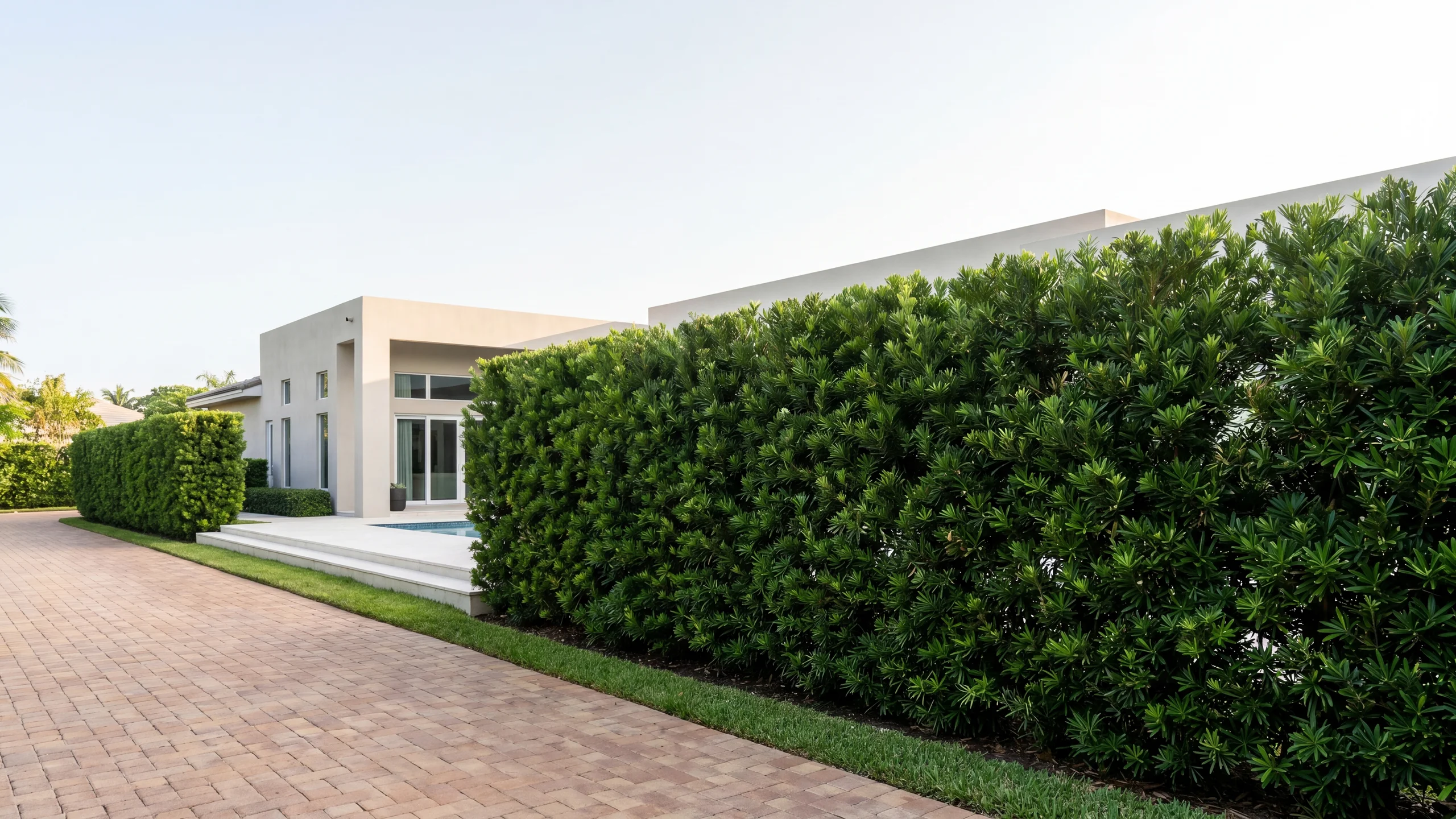
| 25-gallon | 6 to 8 ft | Day one | Day one, premium finish |
| 45-gallon and larger | 8 ft and up | Day one | Day one, tall premium estate |
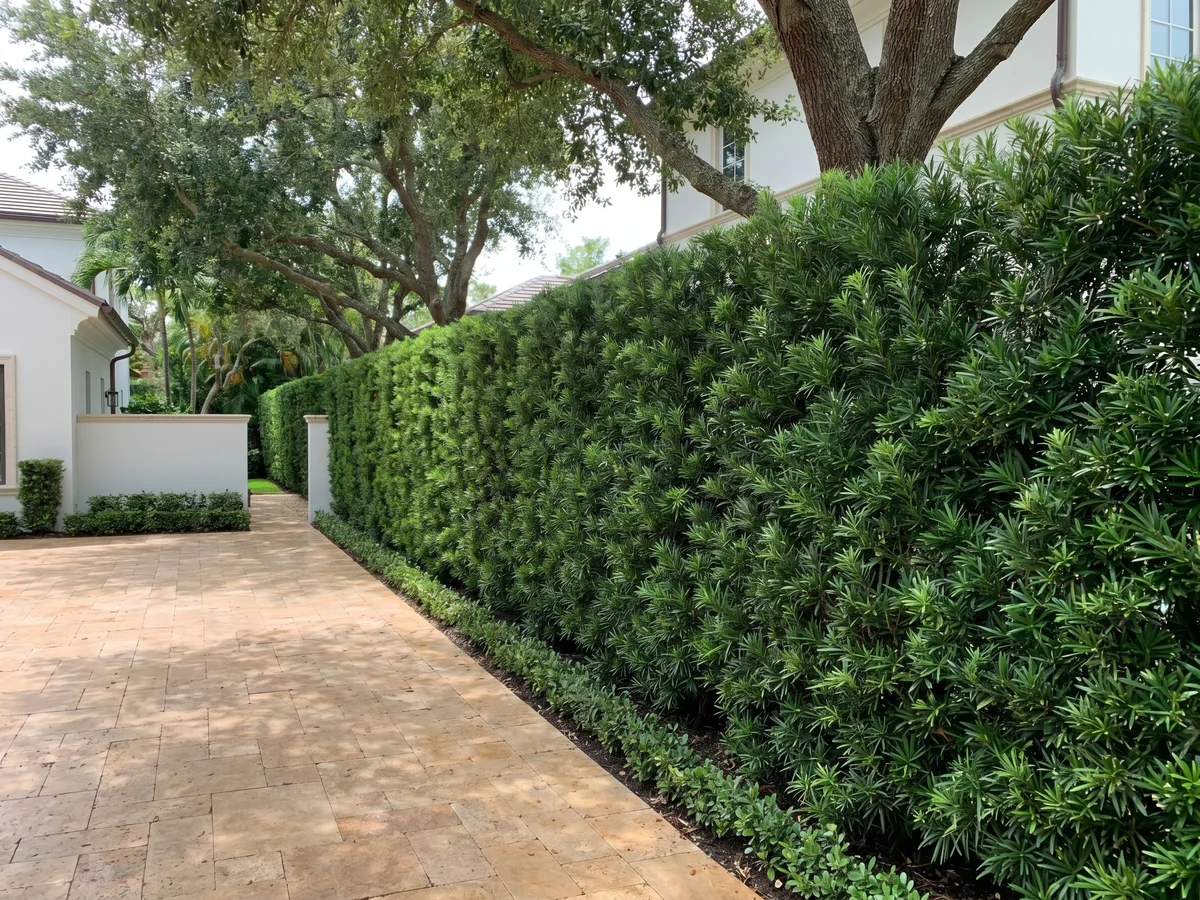
Two things to read into the table. First, "finished" is a homeowner-facing word, not a horticultural one. The plants keep growing and densifying for years. The timeline is when the hedge stops looking like a row of plants and starts reading as one continuous architectural wall. Second, every row assumes a clean install, well-drained soil, and consistent first-90-day watering. A neglected install at any starter size will lag the timelines shown.
Podocarpus macrophyllus vs gracilior, side by side
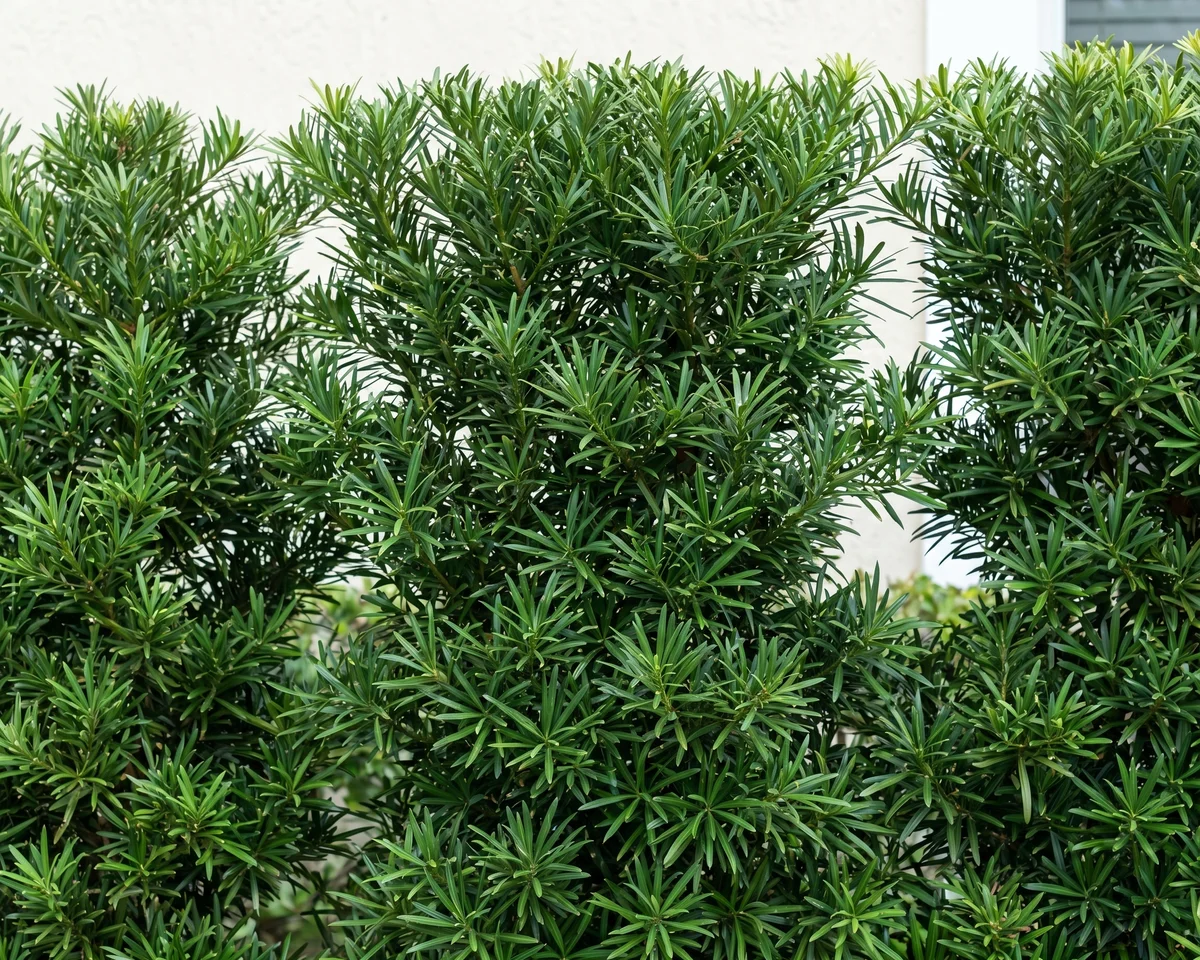
Two Podocarpus species show up in South Florida nurseries, and they are easy to mix up on a plant tag. Podocarpus macrophyllus is the yew pine. Podocarpus gracilior is the fern pine, and some newer plant lists file it under Afrocarpus. For a privacy hedge, macrophyllus is the better pick in most yards. Here is how they differ.
| Trait | Macrophyllus (yew pine) | Gracilior (fern pine) |
|---|---|---|
| Look | Stiff, flat, dark green leaves on upright branches. Reads as a solid, formal wall. | Shorter, softer, blue-green leaves on looser branches that arch. Reads feathery and light. |
| Yearly growth | About six inches to one foot. | A little more height per year in good sun. |
| How fast it closes up | Faster. Dense branching fills the gaps between plants sooner. | Slower. The open habit takes longer to block a view. |
| Hedge height it holds well | 6 to 15 feet with regular shaping. The compact 'Maki' form holds 6 to 12 feet easily. | Taller screens and small-tree forms. Wants more room to look its best. |
| Shaping | Takes frequent trims and holds crisp lines. | Takes trims, but its soft texture never looks as sharp. |
| Partial shade | Handles it well and stays dense. | Grows, but thins out more in low light. |
| Best use | Residential privacy hedges, formal entrances, narrow side yards. | Tall, soft backdrops, or a single specimen tree. |
The trade-off is simple. Gracilior wins a little on yearly height. Macrophyllus wins on how soon the hedge blocks a view, and that is the number most homeowners care about. It is the species we plant on almost every Podocarpus hedge, mostly in the compact 'Maki' form. Whichever you choose, keep one species along the whole run. The two look different enough that a mixed line never settles into one clean hedge.
How Podocarpus growth compares to other South Florida hedges
Podocarpus is generally slower than the other leading South Florida privacy hedges. Clusia typically puts on one to two feet of vertical growth per year and closes up laterally faster, which is why we recommend Clusia for most homeowners who want a finished hedge in the shortest time. A cocoplum hedge grows closer to Clusia's pace, sometimes a bit slower, and brings native-plant credentials and exceptional salt tolerance. Older ficus hedges grew very fast, but ficus has fallen out of favor across South Florida because of the ficus whitefly problem, which makes its speed advantage a liability rather than a benefit.
For homeowners weighing options, a Podocarpus hedge wins where formal architectural lines are the priority, where partial shade is in play, or where a tall, narrow hedge is needed for second-story screening or driveway formality. Clusia wins where lush tropical look and fast finish are the priority. The right call depends on the look, the timeline, and the site, not on growth speed alone.
Planning a Podocarpus install around a deadline
If you have a date the hedge needs to look finished by, planning backward from that date is the most useful exercise. With Podocarpus, the math tilts toward larger starter sizes faster than it does for Clusia because per-year growth is slower. A year out, a 7-gallon Podocarpus install can plausibly finish in time. Inside six months, the answer is almost always to step up to 15-gallon or 25-gallon plants and avoid relying on growth to do the work.
If the deadline is more than two years out, smaller starters are often a sensible budget choice, since the growth window has time to do its job. Inside two years, the math usually favors a larger starter size even at the higher price point. We help homeowners make this trade-off with eyes open on every Podocarpus hedge quote, and the full Podocarpus hedges page covers selection, sizing, and install in depth.