Tips & Guides
Height vs Maturity in Privacy Hedges
How some installers hit hedge height fast by letting plants shoot up thin, and why we trim ours for full, strong, climate-resistant plants instead, even if it takes longer.
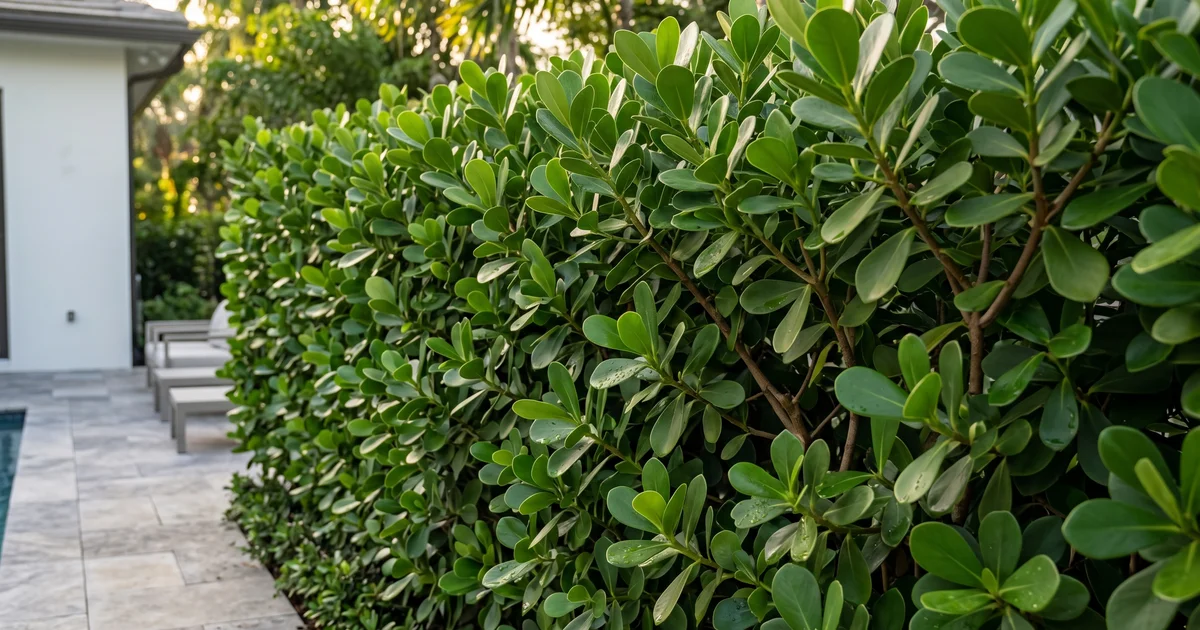
When South Florida homeowners shop for a privacy hedge, the first question is almost always the same: how tall, and how soon. It is a reasonable question. The hedge has a job to do. The yard needs privacy. The neighbors are right there.
But there is a quieter question that almost no one asks, and it is the one that decides whether the hedge you buy this season is still doing its job in five years, ten years, or twenty. Is it tall, or is it actually mature?
Those two words sound like the same thing. They are not. The difference between them is the difference between a hedge that looks the part on install day and falls apart the first time a real storm comes through, and a hedge that gets stronger every year and quietly outlives the fence it replaced.
This post is about that difference, why some installers race to height at the cost of maturity, why we don’t, and what that decision actually means for the hedge in your yard.
The Short Version
A hedge can hit a target height in two very different ways.
The first way is to let the plant shoot up. Don’t shape it. Don’t trim it. Let every branch race for the sky. In two growing cycles a 3-gallon Clusia can look six feet tall on a tape measure. From the curb, the height number looks correct. From the side yard, the plant is thin, leggy, and full of holes you can see through.
The second way is to build the plant as it grows. Trim the leader. Encourage lateral growth. Force the plant to fill out at the base before it gets tall. Repeat that for an extra growing cycle or two before delivering. The result is a hedge that hits the same height number but with three or four times the volume, dense from the ground to the top, and with the kind of structural strength that only comes from years of being shaped properly.
We do the second one. It is more work, it costs more, and the plants spend longer in our nursery before they are ready to go in your yard. We believe it is the right answer, and the rest of this post explains why.
What “Shooting Up” Actually Looks Like
A privacy hedge that has been allowed to race to height has a few tells. Once you know what to look for, you can spot them in your neighborhood without even trying.
The plant is taller than it is wide. A healthy Clusia or Podocarpus at six feet should also be at least three feet wide at the base, maybe more. If you can wrap your hands around a hedge and almost touch your fingers on the other side, the plant has been forced upward instead of allowed to fill out.
There are gaps you can see daylight through. Not the small dark spaces inside dense canopy. Actual gaps, sometimes a hand wide, between branches. When the sun is low in the morning or evening, you can see right into the yard.
The bottom looks bare. The lower branches have either been removed for the look of “tree shape,” or they never developed because all the growth energy went up. A privacy hedge with a bare lower third is not actually a privacy hedge. It is a screen at eye level only.
The leaves on each branch are sparse. You can see most of the wood. Every leaf has to do too much work, and the plant looks tired even when it is healthy.
Some of these things can be fixed with time and care, after install. Most of them cannot be undone without years of corrective trimming. The plant has learned a shape, and it will keep that shape unless you fight it.
Why Some Installers Choose the Shortcut
It is worth saying clearly: an installer who delivers tall-but-thin hedges is not necessarily a bad installer. They are usually working under different pressures than we are.
Cost. A plant that has spent two cycles in the nursery, getting shaped and topped and encouraged to fill out, is more expensive to produce than a plant that has just been left in a pot to grow upward. The labor adds up. The water and fertilizer add up. The space the plant occupies adds up. A nursery that ships tall-but-thin plants can charge less and still make their margin. Some homeowners shop on price. Those plants find homes.
Speed. Shoppers want the hedge done. A “six-foot Clusia in two months” is an easier sentence to sell than “six-foot Clusia in nine months, but built right.” A lot of installers compete on how fast they can get height into the yard, not how durable the hedge will be three years from now.
Bottom-line math. A nursery can put more plants in the same amount of space if those plants are tall and thin. The footprint per plant is smaller. Inventory turns faster. The business runs leaner.
None of those reasons are dishonest. They are real trade-offs that real businesses make. But the trade-off is paid for by the homeowner, in the form of a hedge that does not last.
What “Building the Plant” Looks Like
When we say we grow our plants differently, here is what that actually means in practice.
When a young Clusia comes into the nursery, we top it early. That means cutting the central leader so the plant has to push lateral branches instead of just running straight up. A plant that wants to shoot up vertically has to be told, over and over, that we want it to fill out instead. You teach it. It listens.
Through each growing cycle we shape the plant from the bottom. We hand-trim the lateral branches so the lower third of the plant gets light, gets air, and stays full. A hedge that fills out at the base on day one will stay full at the base for the next thirty years.
We wait. A plant that is ready to ship from our nursery at the volume we are willing to send has usually spent at least one extra growing cycle longer with us than the same size plant would spend at a typical operation. That extra time is not idle. It is the time the plant is being built.
We cull aggressively. Plants that do not respond well to shaping, plants that get pest issues, plants that develop bad structure, they do not make it onto our delivery trucks. The percentage of plants we start with that actually go out as finished installs is meaningfully lower than at a high-volume nursery. The plants that do go out are the ones we would put in our own yards.
The end product is a plant that costs more, takes longer to grow, and arrives at your property with a structure that will hold up.
Why It Matters: The Storm Test
South Florida tests every hedge on the property every year. Sometimes the test is gentle, a strong afternoon thunderstorm, gusts to thirty or forty miles per hour. Sometimes it is a tropical storm. Once in a while it is a real hurricane.
Here is what happens to a tall-but-thin hedge when the wind picks up.
The leverage is bad. A plant that is mostly height and almost no width acts like a flag pole. The wind catches the upper canopy, the trunk flexes hard at the base, and there is no breadth of lateral root structure to hold it down. The plant either snaps or pulls.
The canopy whips. With sparse foliage and long thin branches, individual branches whip back and forth instead of flexing together as a unit. Each whip is a small fracture. By the end of a major storm event, what looked like a hedge at the start of the day is a collection of broken stems by sunset.
The interior takes damage. The few interior branches that exist on a thin hedge are not protected by an outer canopy. Salt spray, wind-borne debris, and direct rain hit them straight on. After the storm, the recovery is slow because the plant has so little reserve.
A hedge that was built with volume and structural strength behaves completely differently. The wide base anchors. The dense foliage flexes as a single mass instead of fighting itself. The interior branches are protected by the outer canopy. After the same storm, a properly grown hedge usually looks ragged for a few weeks, then quietly recovers and looks the same as before by the next season. We covered the broader picture of hedges in storms in our piece on whether a privacy hedge survives a Florida hurricane. The summary version is that a strong hedge is a remarkably good storm investment. A thin hedge is not.
Why It Matters: Climate Resilience Beyond Storms
Hurricanes are the dramatic test, but most of the long-term wear on a South Florida hedge comes from the slow stuff.
Heat and sun load. A thin hedge gets baked from every side. Every leaf is exposed. There is no interior shade to give the plant a break in the middle of a July afternoon. A dense hedge has shaded interior leaves that act as a thermal reserve, and the plant runs cooler overall.
Salt and coastal air. The same logic applies to salt. A thin hedge gets every leaf and every twig hit with salt spray during a coastal wind. A full hedge has an outer shell that takes the brunt and protects the structure inside. On a beachfront property the difference between a thin Clusia and a full one is the difference between needing replacements every five years and not thinking about the hedge again.
Drought stretches. South Florida has dry months. A dense, properly built hedge holds soil moisture better, because the canopy shades the ground at the root zone. A thin hedge lets the sun cook the soil and dries out faster. We see this play out every year, the thin hedges struggle in the dry season, the full ones cruise through.
Pest pressure. A weak plant is a target. A strong plant is not. This is not just about the species choice. A thin Clusia is more vulnerable to scale and whitefly than a dense Clusia of the same age, even though they are the same plant, because the dense one has the energy reserves to push back. The plant’s own defense system runs on the same fuel that builds the canopy.
The cumulative effect of all of these is the difference between a hedge that gets better every year and a hedge that gets a little worse every year.
What Volume Actually Costs
We will not put dollar figures on a webpage because the right price for a job depends on the specific yard, but the cost math is worth understanding in shape.
A plant that has spent extra growing cycles in our nursery is more expensive than a plant that hasn’t. That cost shows up in your quote. It can be hard, in the moment, to look at two quotes side by side and pick the higher one when both are calling the plant a “six-foot Clusia.”
We think about it this way. The cheaper hedge is a real plant that will arrive at your house. It is not fake. It just is not what it looks like. In five years that hedge will likely have thinned, sagged, taken some storm damage, and started to need either heavy renovation or partial replacement. In ten years it may need to come out entirely.
The fuller hedge is also a real plant. It is the same species. It has just been built differently. In five years it is in the prime of its life. In ten years it is a feature of your yard that people compliment when they walk by. In twenty years it is the kind of hedge a buyer notices when they tour the house.
The price difference at the moment of install, spread across the actual usable life of the hedge, gets very small. The cheaper plant is not actually the cheaper plant.
What This Looks Like on Install Day
We want to be straightforward about what choosing the patient route means for the experience of buying a hedge from us.
Sometimes it means a slightly longer wait between quote and delivery. If the right starter size is not available right now at the volume we send, we will say so, and offer either a different size or a scheduled install when the right plants are ready.
Sometimes it means quoting a slightly larger starter size than another installer recommended, because the bigger plant we ship at the size we ship is the equivalent of the smaller plant they ship in actual canopy.
Sometimes it means walking the yard and recommending Podocarpus or Cocoplum instead of Clusia, because the conditions on that yard would not let a Clusia we are willing to send hit its potential. We covered the cross-species version of this in Best Privacy Hedges for South Florida, the right plant for the yard always beats the most popular plant for the wrong yard.
And sometimes it just means saying that the hedge will look its best at year five, not on install day, and asking the homeowner if that timeline works for them. Most do. Some don’t, and we point them toward another installer who can hit their timeline with the trade-off they are comfortable with.
A Quick Diagnostic for Existing Hedges
If you already have a privacy hedge and you are wondering whether it was built right, a few quick checks will tell you the answer.
Stand at the corner of the hedge run, at the base. Look down the length of the hedge along the trunk line. Can you see daylight between plants at the base? A built-right hedge will be solid at the base from end to end. A shot-up hedge will have a saw-tooth pattern of light and shadow because each plant is too narrow to meet its neighbor below knee height.
Press a hand gently into the side of the hedge at chest height. Does it flex like a foam mattress, or like a wall? A full hedge has enough density that you can feel resistance through several inches of foliage. A thin hedge gives almost immediately because there is nothing inside.
Look at the canopy from below. Do you see leaves overhead, or sky? A canopy that lets sky through has not been built to act as a privacy hedge. It is a row of plants.
These are also the things to look for during a quote walk-around at a neighbor’s property if you are trying to evaluate the hedge installer they used. The hedge in the yard tells you more than the website.
FAQ
Q: Doesn’t a tall hedge give better privacy than a shorter one? A: Up to a point, yes. But “tall and thin” gives almost no privacy because you can see through it. “Shorter but fully dense” gives better privacy than “taller but sparse” at most viewing angles, especially from the upstairs windows of neighboring homes. Volume matters more than raw height for actually feeling private in your yard.
Q: Can I trim my way out of a thin hedge? A: Sometimes, with patience. You can encourage a thin hedge to fill out by cutting back the upper canopy hard, forcing the plant to push lateral growth. It takes one to three growing cycles and the hedge will look worse before it looks better. Some plants respond well. Others have learned a shape they will not unlearn. We do this work on rescue projects when we can; it is not a guaranteed fix.
Q: How do I know if the plants in a quote are the “built” kind or the “shot up” kind? A: Ask. A reputable installer will be happy to send a photo of the actual stock or invite you to the nursery to walk through what they are about to deliver. If they can’t, or won’t, that itself is information. Also look at the price, significantly cheaper than other quotes for the same nominal size is almost always achieved by skipping the work of building the plant.
Q: Does this height-vs-maturity thing apply to Podocarpus too, or just Clusia? A: It applies to every privacy hedge species, but most strongly to fast-growing species like Clusia and Ficus where the temptation to let the plant race is the strongest. Podocarpus naturally grows slower, so the gap between “raced” and “built” is smaller, but it still exists. Cocoplum is somewhere in between. The general rule holds across all of them: volume and structure beat raw height for long-term hedge performance.
Q: Will choosing the patient hedge actually save money long-term? A: Almost always, yes. The cheaper hedge that has to be replaced or heavily renovated at year seven costs more across a twenty-year horizon than the more expensive hedge that lasts the full window. The math gets even more lopsided when you include the cost of redoing landscaping around a replaced hedge, which is rarely included in the original quote.
Q: If I want to come look at how the plants are grown, can I do that? A: Yes. We invite homeowners to come walk the nursery during business hours. The difference between a built plant and a raced plant is obvious in person, and seeing the work tends to answer most questions about the price difference faster than any explanation we can write down.
Closing
A privacy hedge is one of the longest-lived features you can put on a South Florida property. Most of the hedges we install will outlast the cars in the driveway, the roof above the garage, and the people who picked them. They should be built with that horizon in mind, not the install-day horizon.
That belief is the thing that decides everything else about how we run our nursery. It is why our plants spend an extra growing cycle with us. It is why the truck arriving at your property has fewer plants on it than a competing truck of the same supposed size. It is why our quotes are not always the lowest. And it is why the hedge we install on your property today should still be there, looking better than the day it went in, when your house changes hands a generation from now.
If that horizon matches your horizon, we should talk. You can request a quote and we will walk the yard with you, talk through which plant fits, and tell you honestly whether we think we are the right installer for your project. If we are not, we will say so and recommend someone else. The hedge is going to be there for a long time. It is worth getting right.
Tagged
- privacy hedges
- clusia hedge
- hedge care
- south florida
- hedge growing
- buying guide
Ready for a privacy hedge that looks finished from day one?
Get a free estimate from a South Florida specialist who handles delivery, installation, and the result you actually want.