Buying Guide
Best Pool-Yard Privacy Hedges in South Florida
Which privacy hedges actually work around a South Florida pool, leaf drop, salt resilience, root clearance from pool decks, and the species we install most for pool-adjacent runs.
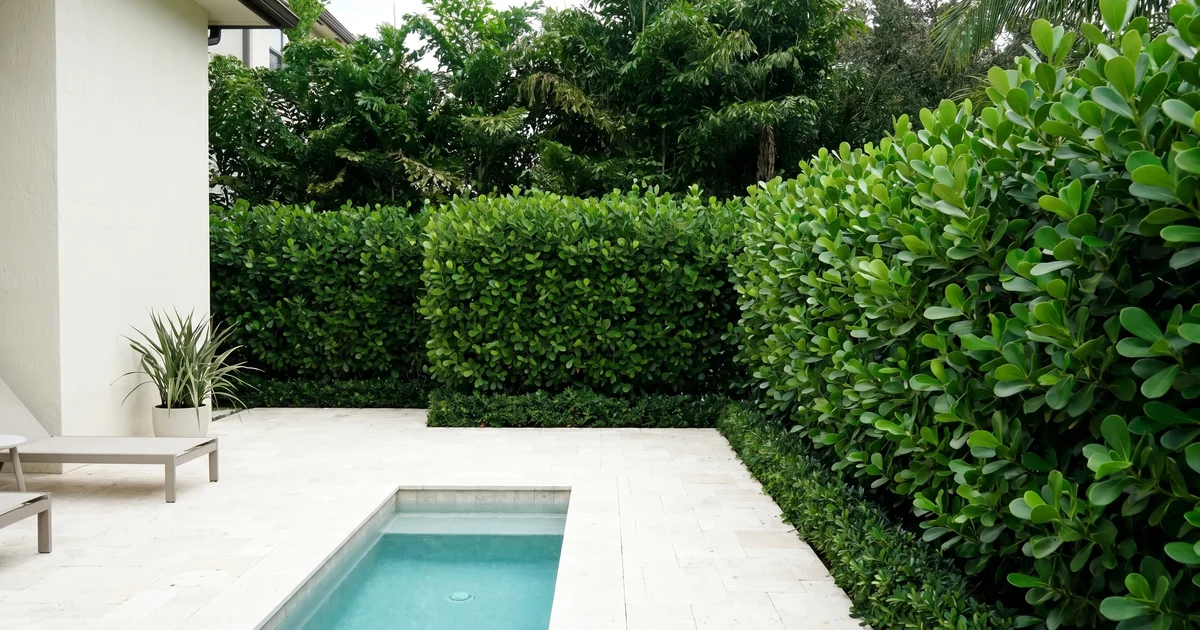
Pool yards are the toughest place to put a privacy hedge in South Florida. The plant has to screen the yard from neighbors and the street, look good year-round around water, not drop into the pool, not buckle the deck or pavers, tolerate chlorine spray and (for some pools) direct salt, and not attract bees or wasps to the swim area. Most hedge species fail at least one of those tests. A few pass them all. This is the installer-side ranking, from a crew that installs around pools every week across Miami-Dade, Broward, and Palm Beach.
Planning a hedge for a pool yard? This post is the deep dive. For full install pricing and planning on the species below, see our pillars on Clusia Hedges, Podocarpus Hedges, or Cocoplum Hedges.
The Short Answer
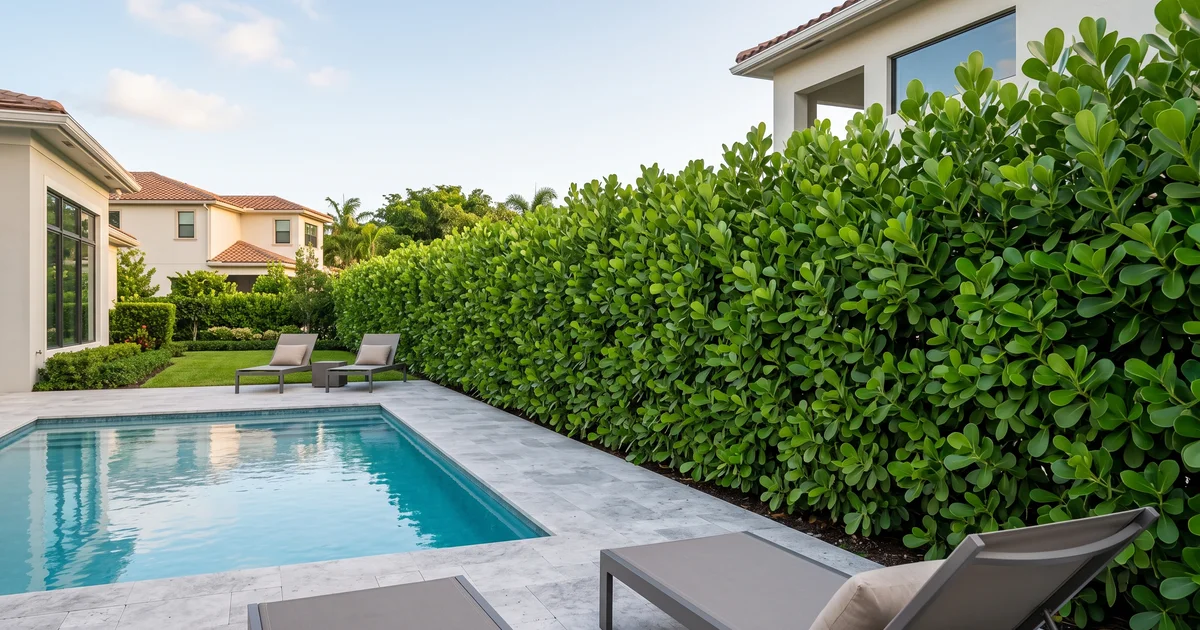
For most South Florida pool yards, Clusia is the best privacy hedge. It has the cleanest leaf-drop profile, tolerates chlorine and salt spray, has a non-invasive root system that doesn’t lift pool decks or pavers, and looks lush year-round.
For direct beachfront and canal-front pool yards with constant salt exposure, cocoplum is the stronger pick, it’s more salt-immune than Clusia and handles direct ocean spray with no leaf burn.
For tight side-yard pool runs where you need a tall narrow screen between the pool and a neighboring property, Podocarpus is the right call, it grows up rather than out, fits narrow planting beds, and has minimal leaf drop.
Species we typically recommend against for pool yards: areca palm (heavy frond drop after every storm), ficus (root system buckles pool decks), and most flowering shrubs (flower and pollen drop into the water).
The detail behind each ranking is below, plus what we look at on a site walk before we recommend any of them. For the broader ranking beyond pool yards, see our guide to the best privacy hedges in Florida.
What Makes a Pool-Yard Hedge Different
Five things matter more around a pool than around any other hedge run on a property:
1. Leaf drop into the pool. This is the single biggest pool-yard concern. Plants with large, soft, frequent-drop leaves (most flowering hedges, palms, ficus) put leaves and debris into the water constantly. Skim time becomes a daily chore. Plants with small, waxy, infrequent-drop leaves (Clusia, Podocarpus, cocoplum) keep the water clean.
2. Root clearance from hardscape. Pool decks, pavers, coping, and footing all sit on engineered substrate that doesn’t tolerate aggressive plant roots. Ficus is the famous offender, mature ficus root systems can crack pool decks, lift pavers, and (in extreme cases) damage pool shell integrity. Hedge species we install around pools have shallower, less aggressive root systems that share space with the hardscape.
3. Chlorine and salt tolerance. Pool water vapor carries chlorine; salt-water pools carry actual chloride. Plants close to the pool absorb some of this through leaves and root zones. Species that handle the chemistry stay green; species that don’t show leaf burn within months. Clusia, Podocarpus, and cocoplum all tolerate pool chemistry well. Many ornamental flowering shrubs don’t.
4. Year-round screen density. South Florida pools get year-round use, so the hedge needs to look full year-round. Deciduous or semi-deciduous species drop foliage seasonally, fine in a back-of-yard utility run, problematic around a pool where you want consistent privacy and consistent visual mass.
5. No bees, wasps, or pollinators near the swim area. This one’s species-specific. Flowering hedges attract pollinators. Most homeowners are fine with that around the perimeter of the property; many are not fine with it within 10 feet of where people swim. The hedge species below either don’t flower significantly or have flowers that don’t attract heavy pollinator activity.
These five filters take most hedge species off the table for pool-adjacent runs. The few that pass all five are the ranking below.
The Ranking
1. Clusia, best overall pool-yard hedge
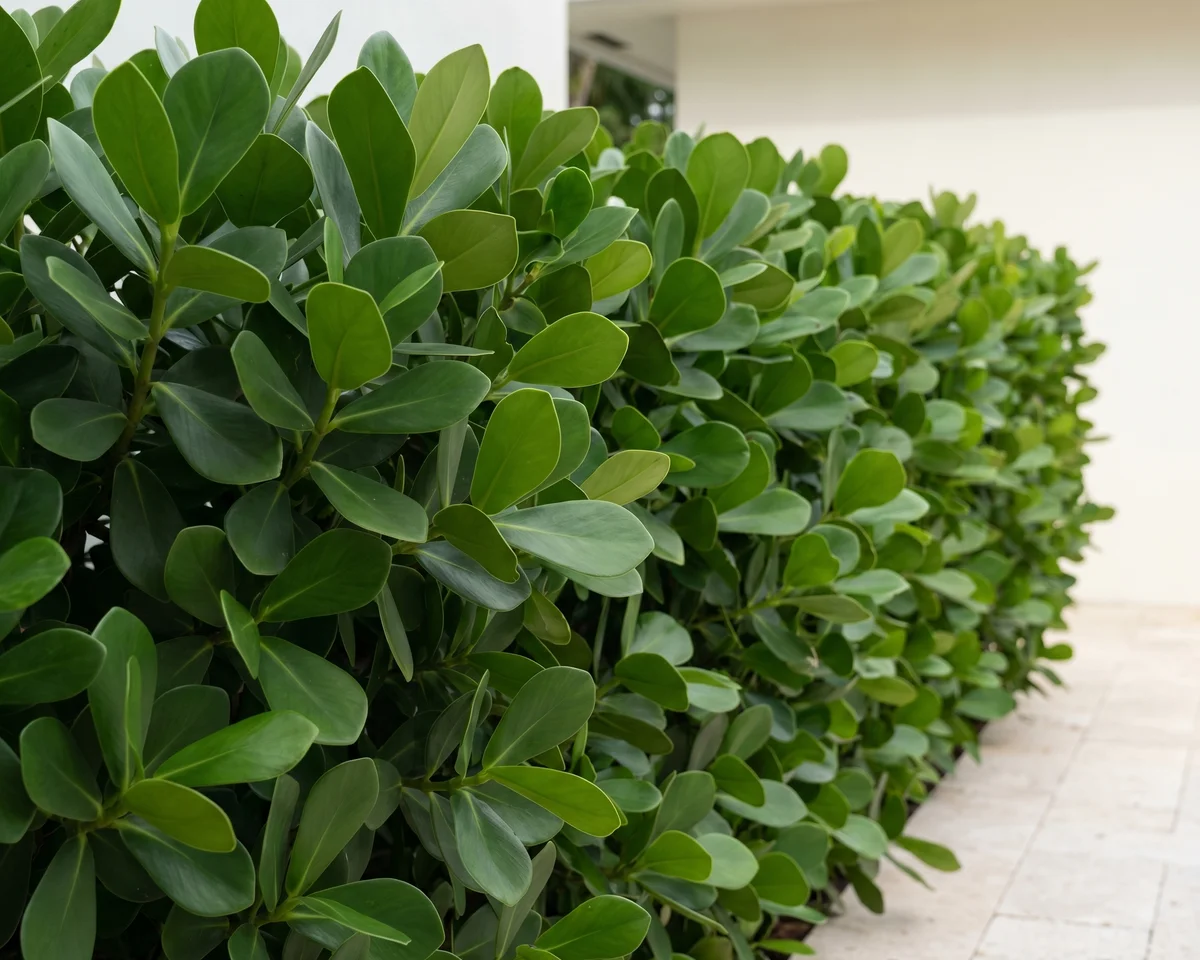
Clusia, the small-leaf ‘Princess’ or ‘Nana’ cultivars, is the species we install most often in pool yards across South Florida. It hits every pool-yard filter cleanly:
Leaf drop: Light. Clusia’s leaves are small, waxy, and shed infrequently. When they do drop, they’re large enough to skim easily off the surface rather than sinking through the filter system.
Root clearance: Non-invasive fibrous root system. We’ve never had a Clusia install create issues with a pool deck, pavers, or coping. Standard residential clearance (about 18 to 24 inches off hardscape) keeps the planting room open without putting the hedge or the deck at risk.
Chlorine/salt tolerance: Strong. Clusia handles pool chemistry well and tolerates near-coastal salt exposure cleanly. For direct beachfront with constant ocean spray, cocoplum is a step up, but for most residential pool yards (interior and near-coastal), Clusia is sufficient.
Year-round screen: Evergreen, dense, full-canopy through every month. The hedge reads the same in January as in July.
Pollinators: Clusia’s flowers are small and infrequent. Pollinator activity at the hedge is minimal and not concentrated near pool spaces.
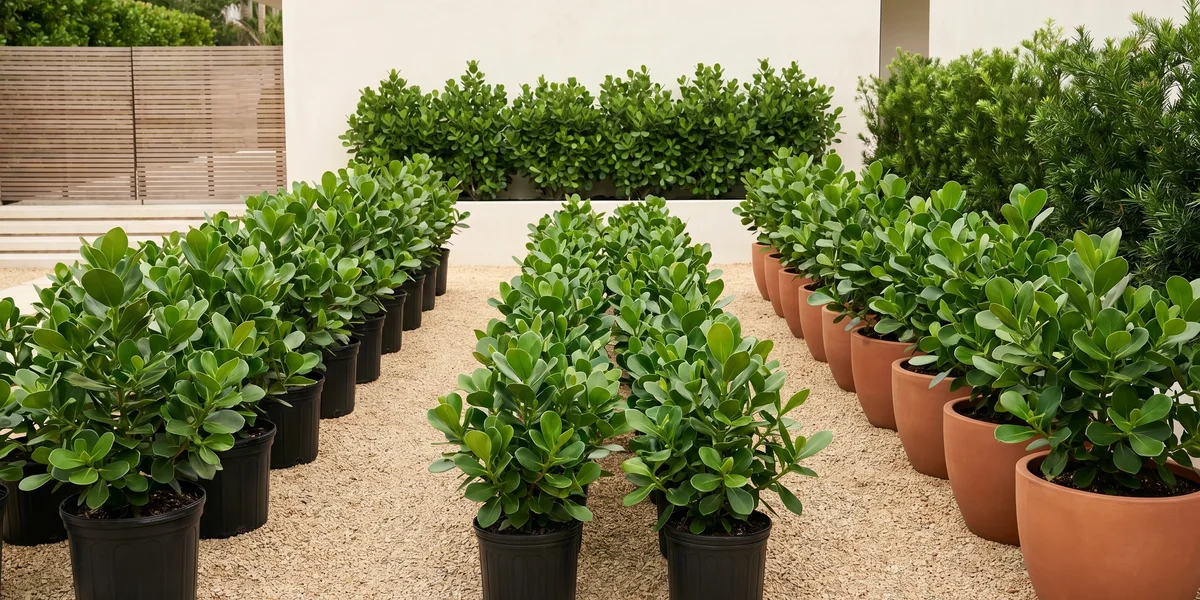
For most premium residential pool yards, Clusia at 7-gallon or 15-gallon installs is the default recommendation. The 15-gallon at 2 to 2.5-foot centers produces a hedge that reads finished from install day.
2. Cocoplum, best for direct coastal pool yards
Cocoplum, the red-tip or green-tip varieties, is the upgrade pick for pool yards on direct beachfront, canal-front, or Intracoastal-adjacent properties where salt exposure is constant.
Where cocoplum wins over Clusia in a pool yard:
- True salt immunity. Cocoplum handles direct ocean spray with no leaf burn. On a beachfront pool yard, this is the deciding factor.
- Drought hardiness. After establishment, cocoplum needs less supplemental water than Clusia, which matters on lots with restricted irrigation.
- Native status. For FFL-aligned communities and homeowners who specifically want native plantings, cocoplum is the strongest native pool-yard pick.
Where cocoplum is slightly weaker than Clusia for pool work:
- Slightly more leaf drop. Cocoplum’s leaves are larger than Clusia’s and drop more frequently, still manageable, but noticeable on pool surface.
- Small fruit drop. Cocoplum produces small dark fruit that birds eat. Some of it lands in the pool. On bird-active properties this can be a daily skim item.
For pool yards within a few hundred feet of the ocean or the Intracoastal, cocoplum is the right pick. Inland, Clusia is usually the cleaner choice.
3. Podocarpus, best for tall narrow pool screens
Podocarpus is the right call when the hedge line needs to be tall and narrow, typically a side-yard run between the pool and a neighboring property where you don’t have width to spare.
Where Podocarpus wins for pool work:
- Narrow growth habit. Podocarpus stays narrow naturally, fitting planting beds as tight as 3 feet wide.
- Tall reachable height. Podocarpus comfortably reaches 12 to 15 feet and beyond, useful for blocking second-story neighbors’ sightlines into the pool area.
- Fine foliage with minimal drop. The needle-like leaves are small enough that drop is rarely visible in pool water.
- Crisp architectural look. Podocarpus clips into sharp formal lines that pair well with modern pool architecture.
Where Podocarpus is less ideal than Clusia for pool work:
- Slightly more salt-sensitive on direct coastal pool yards. Inland and near-coastal, no issue. Direct oceanfront, prefer cocoplum.
- More shaping required. Podocarpus rewards a consistent trim rhythm. Clusia is more forgiving of inconsistent care.
For narrow pool-yard runs, Podocarpus is often the right pick. For wide pool perimeters, Clusia generally wins.
4. Florida natives (Walter’s viburnum, Simpson’s stopper)
For shaded pool yards or specifically FFL-aligned installations, Walter’s viburnum and Simpson’s stopper are workable pool-yard picks. Both are evergreen, both have manageable leaf drop, and both fit tight or shaded sites better than the imported standards.
The trade-offs:
- Walter’s viburnum handles part shade better than Clusia, useful for pool yards under heavy oak canopy.
- Simpson’s stopper has fragrant white flowers and red berries that attract pollinators and birds. Lovely for backyard wildlife but worth thinking about for the pool area specifically.
- Both grow slightly slower than Clusia. Pool-yard timelines often want finished privacy fast; natives ask for a longer runway.
For most pool yards we install in, Clusia is still the recommendation over the natives, unless the homeowner has a specific reason (FFL certification, shaded site, native-plant preference) to lean native.
Species We Recommend Against for Pool Yards
These come up in conversations regularly. They’re not bad plants, they’re bad pool-yard plants:
Areca palm
Areca palm is a common screening choice in South Florida because it grows fast and produces a tall fringe of greenery. Around a pool, it has three problems:
- Heavy frond drop after every storm. Areca fronds are large, fibrous, and difficult to skim. After a routine summer thunderstorm, the pool can have a dozen fronds in it.
- Leaf-axle litter. Even without storms, areca palms drop leaf material constantly from the base of the fronds.
- Vulnerable crown. A direct hit from a hurricane can topple individual specimens, and the recovery is slow compared to a dense privacy hedge.
If the pool yard has existing arecas, replacement with Clusia or cocoplum is a meaningful upgrade in terms of pool cleanliness and storm resilience.
Ficus
Ficus is the most problematic species for pool-adjacent runs. The root system is genuinely aggressive, mature ficus hedges have caused pool deck cracks, paver lift, and (occasionally) damage to underground pool plumbing on residential installs we’ve seen.
Combined with the rugose spiraling whitefly pressure that’s hit South Florida ficus over the last decade, our standard recommendation is to remove existing ficus around pools and replace with Clusia, Podocarpus, or cocoplum. The install-cost reset is real but the long-term hardscape risk is worse.
Bougainvillea and flowering hedges
Bougainvillea looks beautiful in South Florida and works well in some yard contexts, but not as a pool-perimeter hedge. The flower drop is constant and substantial, the bracts stain pool decks and coping, and the plant itself has aggressive thorns that make pool-side maintenance dangerous. For non-pool yards, fine; for pool-adjacent runs, no.
Other flowering hedges (hibiscus, oleander, mussaenda) have similar issues, flower drop into the pool, pollinator activity in the swim area, and (for oleander specifically) toxicity concerns if children or pets are swimming nearby.
Site-Specific Considerations
A few additional variables that change the species pick on a specific pool yard:
Pool chemistry. Standard chlorinated pools: any of the top 3 species (Clusia, cocoplum, Podocarpus) handles the chemistry. Salt-water pools: lean cocoplum (most salt-immune) or Clusia (well-tolerant). Ozone or mineral systems: any of the top 3 work cleanly.
Pool deck material. Travertine and natural stone tolerate adjacent plantings well as long as setbacks are correct. Concrete decks need extra care with watering plans to avoid efflorescence at the planting bed edge. Wood decking around pools (rare in South Florida but seen) wants more aggressive setbacks to avoid moisture transfer to the wood.
Sun exposure. Full sun: Clusia is the default. Partial shade (e.g., under a chickee or pergola): Podocarpus or Walter’s viburnum hold density better than Clusia. Deep shade under heavy tree canopy: most privacy hedges struggle; we’ll discuss alternatives on a site walk.
Storm exposure. Direct ocean-facing pools: cocoplum for salt and storm resilience. Storm-protected back-yard pools: any of the top 3 work cleanly. After hurricane season, see our hurricane survival blog for more on storm performance by species.
Neighbor sightlines. Single-story neighbors: 6-foot hedge is usually enough. Two-story neighbors with second-floor windows over the pool: 10+ foot hedge is typically needed, which pushes the recommendation toward Podocarpus (which reaches that height more easily than Clusia).
What We Look At on a Site Walk
When we walk a pool yard before quoting, the checklist:
- Run length around the pool and where the hedge needs to start and stop
- Distance from the planting bed to the pool deck edge (drives species and spacing)
- Existing hardscape and whether the bed has been prepped or needs amendment
- Sun exposure across the day (some pool yards have one face in shade)
- Adjacent properties and the sightlines we’re actually blocking
- Pool type (chlorine, salt, mineral) and proximity of the hedge to splash zones
- Whether existing landscaping needs removal before the install
- Salt exposure, coastal, near-coastal, or inland
- Any HOA architectural-review notes the homeowner has
Most of this takes 15 to 20 minutes on the property. The quote afterward is itemized and reflects the actual variables we saw, not a generic average.
Frequently Asked Questions
What’s the best privacy hedge for a South Florida pool yard? For most pool yards, Clusia is the best overall choice, light leaf drop, non-invasive roots, tolerates pool chemistry, year-round dense screen. For direct coastal pool yards with constant salt exposure, cocoplum is better. For tight side-yard runs that need to go tall and narrow, Podocarpus is the right pick.
Will my Clusia hedge drop leaves into the pool? Yes, but minimally. Clusia is one of the cleanest privacy hedges for pool-adjacent runs, light infrequent leaf drop, and the leaves are large enough to skim easily rather than getting through the filter. Most pool owners describe the upkeep as manageable, not high-effort.
Can a privacy hedge damage my pool deck or pavers? Most species we install around pools, Clusia, cocoplum, Podocarpus, Walter’s viburnum, have non-invasive root systems that don’t damage pool decks or pavers. Standard residential clearance (about 18 to 24 inches off hardscape) keeps the planting room open without putting either the hedge or the deck at risk. Ficus is the species to avoid, its root system can lift pavers and crack pool decks over time.
Is Clusia safe for salt-water pools? Yes. Clusia tolerates salt-water pool chemistry well, including the chloride spray that surrounds salt-water systems. For direct coastal pool yards with constant ocean salt exposure on top of the pool’s own chemistry, cocoplum is a slightly stronger pick.
How far from the pool should I plant a Clusia hedge? We typically install Clusia at 18 to 24 inches off the pool deck edge for residential pool yards. This gives the hedge room to fill out without crowding the deck, keeps the root system clear of the deck substrate, and leaves enough space for maintenance access behind the hedge.
Will Clusia attract bees and wasps to my pool area? Minimally. Clusia’s flowers are small and infrequent, and pollinator activity at the hedge is low. For homeowners specifically concerned about bees and wasps near the swim area, this is a meaningful advantage over flowering hedges like bougainvillea or hibiscus.
Can I use areca palm as a pool hedge? We typically recommend against it. Areca palm drops large fibrous fronds after every storm, which become a pool-skimming problem. The leaf-axle litter at the base of the palms also drops constantly. Replacing existing areca with Clusia, cocoplum, or Podocarpus is one of the most common pool-yard upgrades we install.
What about ficus around pools? Avoid. Ficus has the most aggressive root system of any species commonly used as a privacy hedge in South Florida, and we’ve seen ficus root systems crack pool decks, lift pavers, and (in extreme cases) damage underground pool plumbing. Combined with the whitefly pressure, ficus around pools is the most common species we recommend removing and replacing.
How tall should a pool privacy hedge be? Depends on what you’re blocking. For single-story neighbors, 6 to 8 feet is usually enough. For two-story neighbors with second-floor windows that look over the pool, 10 to 12 feet is typical. Podocarpus reaches these taller heights more easily than Clusia.
Does pool chlorine kill privacy hedges? Not the species we install. Clusia, cocoplum, and Podocarpus all tolerate standard residential pool chlorine without damage. The plants closer to the splash zone may see occasional minor leaf burn from heavy chlorine days, but it’s cosmetic and the plant recovers without intervention.
Should I use a salt-tolerant hedge if I have a salt-water pool? Helpful but not strictly necessary. Salt-water pools carry actual chloride that vaporizes and reaches nearby plants, but residential systems are much lower-concentration than ocean salt. Clusia handles it cleanly; cocoplum handles it even better. For salt-water pool yards specifically, cocoplum is a reasonable upgrade pick.
Can I plant a hedge between my pool and the neighbor’s property? Yes, this is one of the most common pool-yard requests we get. The species choice depends on width and target height. For a 4 to 6-foot wide planting strip, Clusia or cocoplum at 2 to 2.5-foot centers works well. For a 3-foot or narrower strip, Podocarpus is the better pick because of its narrower growth habit.
Will planting a hedge near my pool void my pool warranty? This depends on your specific pool builder’s warranty terms. Most residential pool warranties don’t address adjacent landscaping at all. If the warranty does mention plant clearances, we’ll plan the install to respect those distances. The species we install around pools have non-invasive root systems that don’t damage pool structures under normal installation practices.
See also: Clusia Hedges for the most common pool-yard pick. Cocoplum Hedges for coastal pool yards. Podocarpus Hedges for narrow tall pool screens.
Plan Your Pool-Yard Hedge
Every pool yard has its own variables, sun exposure, deck material, neighbor sightlines, salt distance, existing landscape. The right hedge for your pool yard depends on which of those variables are dominant. A site walk takes 15 to 20 minutes and gives us enough to put a real plan in front of you.
Request a free quote or call us at 305-222-7171. We serve Miami, Fort Lauderdale, West Palm Beach, Boca Raton, and Delray Beach.
Tagged
- pool yard hedge
- pool privacy hedge
- south florida pool
- clusia hedge
- pool landscape
Ready for a privacy hedge that looks finished from day one?
Get a free estimate from a South Florida specialist who handles delivery, installation, and the result you actually want.