Buying Guide
Best Privacy Shrubs and Hedge Plants for Florida
An installer's guide to the best privacy shrubs and hedge plants for Florida yards: which species screen well, how fast they fill in, and how to match one to your lot.
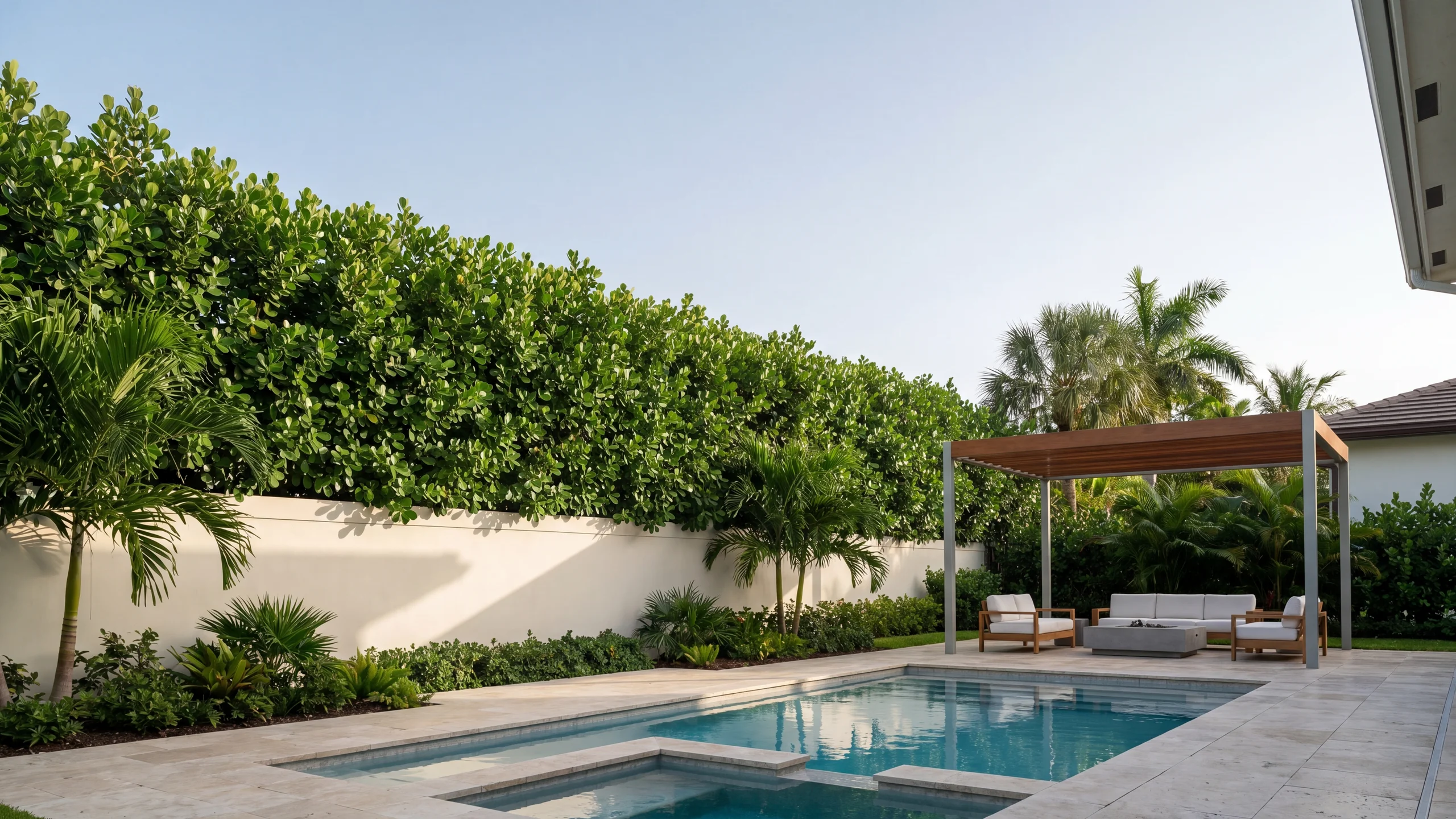
The best hedge plants for Florida privacy are Clusia for sunny open yards, Podocarpus for tall or narrow lines and partial shade, and cocoplum for direct coastal lots. Those three cover the large majority of properties. A short list of Florida natives covers most of the rest. Everything else is either the wrong scale, the wrong pace, or the wrong plant for the heat, salt, and sun that define growing here.
That is the answer. The rest of this guide is the reasoning behind it, from a crew that installs these hedges across Miami, Fort Lauderdale, and West Palm Beach every week. You will find mature sizes, how long each plant takes to close into a solid screen, what each one costs you in maintenance, and the plants we steer people away from.
Ready to plan a privacy hedge? This post covers the plants. For install, spacing, and a real quote, start with our pillar on Privacy Hedges in South Florida.
The Short Answer
The best privacy shrubs and hedge plants for Florida, in order of how often they are the right call:
- Clusia, the default for sunny, open yards. Dense, glossy, fast to fill, and forgiving. The most-planted privacy hedge in the region for good reason.
- Podocarpus, the pick for tall, narrow, or formal lines, and for partly shaded runs where a tropical hedge would thin out.
- Cocoplum, the Florida native for beachfront, canal-front, and any lot where salt spray is a daily condition.
- Florida natives beyond cocoplum, including Simpson’s stopper, Walter’s viburnum, and yaupon holly, for homeowners who want native plants doing the privacy work.
Florida Hedge Plants Compared
| Plant | Mature height | Time to a closed screen | Sun | Salt | Shade |
|---|---|---|---|---|---|
| Clusia | 6 to 12 ft | Fastest | Full sun | High | Poor |
| Podocarpus | 12 to 15 ft or taller | Slower, steady | Sun to partial shade | Moderate | Good |
| Cocoplum | 6 to 10 ft | Moderate | Full sun | Exceptional | Poor |
| Simpson’s stopper | 10 to 15 ft | Moderate | Sun to partial shade | Moderate | Fair |
| Walter’s viburnum | 6 to 12 ft | Moderate | Sun to partial shade | Low | Good |
| Yaupon holly | 12 to 20 ft | Slower | Full sun | Moderate | Fair |
Those ranges assume a healthy install and consistent watering through the first sixty to ninety days. Starter size changes the timeline more than anything else on this table.
Why “Privacy Shrub” and “Hedge Plant” Mean the Same Thing Here
People use “privacy shrub,” “hedge plant,” “privacy bush,” and “screening plant” interchangeably, and for Florida privacy work they all point to the same short list. What matters is not the label but three things: how tall the plant holds, how dense it stays, and how well it handles your specific yard. A privacy shrub that stays airy at the base is not a privacy hedge, no matter what the tag says.
There is one real distinction worth keeping. A shrub is a single plant. A hedge is a line of plants spaced so they grow into one continuous mass. The same species gives you either outcome. What decides it is spacing, and spacing is where most do-it-yourself hedges go wrong.
Clusia: The Default Florida Hedge Plant
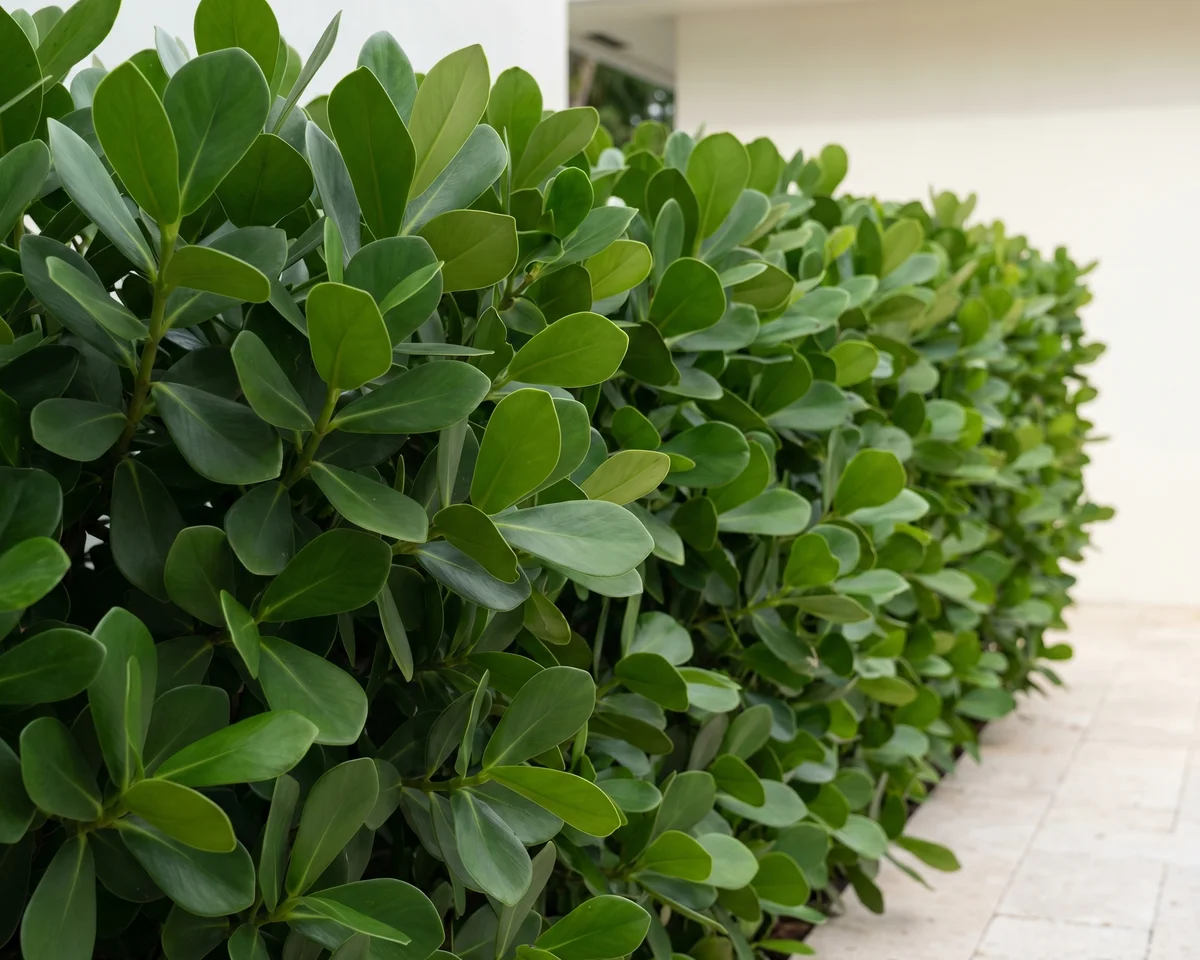
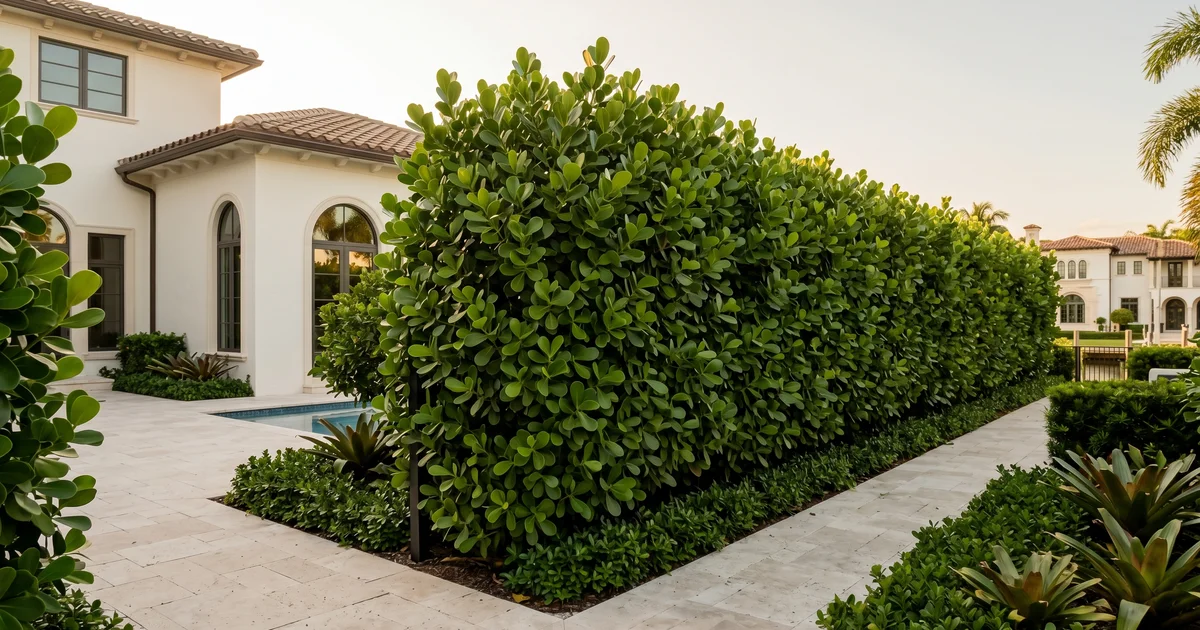
For most Florida yards in zones 10 and 11, Clusia is the answer. It has thick, glossy, paddle-shaped leaves, fills in densely, and takes a clipped line cleanly. It loves full sun and shrugs off the heat. It is salt-tolerant enough for most near-coastal lots and fast enough that a mid-size starter reads as a finished hedge within a season or two.
The species we plant for hedges is Clusia guttifera, the small-leaf form sold as Princess or Nana. Clusia rosea, the autograph tree, shares the name but grows into a spreading shade tree with a much stronger root system. If a plant guide warns you that Clusia roots are aggressive, it is almost always describing rosea.
In healthy conditions Clusia puts on one to two feet of vertical growth per year, with the strongest push in the first two or three years after planting. It closes laterally faster than anything else on this list, which is why it dominates residential installs across Miami-Dade, Broward, and Palm Beach.
Where it is not ideal: deep shade, where it thins at the base, and direct beachfront where salt spray is relentless. Cold is the other limit. Clusia is comfortable in zones 10 and 11 and gets unhappy further north, which matters if your property sits above the Treasure Coast.
Podocarpus: The Tall, Formal, Narrow Pick
Podocarpus is the plant for a formal look, a tall screen, or a narrow planting strip. Its fine, needle-like foliage and naturally upright habit make it read like a clean architectural wall rather than a soft tropical shrub. It goes taller than most privacy hedges, which makes it the common choice for blocking two-story windows and lining driveways.
It also holds density better in partial shade than Clusia, so for the shaded north side of a home or a run under tree canopy, Podocarpus is usually the stronger call. It is more cold-hardy too, which extends its range into central Florida where Clusia struggles.
The trade-off is pace. Podocarpus grows more slowly, especially in the first two seasons. We compensate by installing larger starters at tight spacing so the hedge reads as a full vertical screen on install day rather than asking you to wait for it. If you already have a Podocarpus line that looks thin, our guide on how to make Podocarpus grow thicker covers the pruning that fixes it.
Cocoplum: The Coastal Native
Cocoplum is a Florida native and one of the most salt-tolerant privacy plants you can put in the ground. On a beachfront or canal-front lot where other hedges burn from salt, cocoplum holds up. It evolved on coastal hammocks and mangrove edges, so direct ocean spray is its normal condition rather than a stress.
It grows a little slower than Clusia and has a coarser leaf, but for direct coastal exposure it is often the smartest pick. It also carries native-plant and Florida-Friendly Landscaping credentials that some communities specifically want, which can smooth architectural review.
Cocoplum comes in three forms you will see in the trade. Red tip flushes coppery new growth and is the most popular hedge variety. Green tip is the all-green form for a more uniform look. Horizontal is a low spreading variety that suits borders rather than tall privacy lines. Once established, cocoplum needs noticeably less water than Clusia, which matters on lots without reliable irrigation.
Florida Native Hedge Plants
For homeowners who want native privacy plants, a few beyond cocoplum do real hedge work. Simpson’s stopper is fine-textured and narrow, good for modern homes and tight runs, and it produces small fruit that native birds use. Walter’s viburnum tolerates shade and holds a compact, controlled form, which makes it one of the few good answers for a genuinely dark side yard. Yaupon holly goes tall and formal on inland lots and handles cold better than the tropical options.
Natives generally use less water once established and support local birds and pollinators. They are also the easiest path through review in communities that favor Florida-Friendly Landscaping. Our full breakdown lives on the native hedges in Florida pillar.
Plants to Be Careful With
A few plants show up in Florida privacy searches that we steer homeowners away from, or at least flag:
- Ficus. It grows fast and screens well, but the ficus whitefly turned it into a maintenance and replacement headache across the region. We more often remove failing ficus than plant it. If you are weighing treatment against replacement, our whitefly treatment page covers both paths honestly.
- Areca palm. A clumping palm that can screen, but it is cold-sensitive and reads as a palm cluster rather than a clean hedge. It fits some looks and not others. See our Clusia vs areca palm comparison.
- Arborvitae and other cool-climate privacy trees. They dominate national hedge guides but are the wrong plant for subtropical heat and humidity. Arborvitae in particular tends to brown out and thin in South Florida.
- Hibiscus and other flowering shrubs. Beautiful, and genuinely useful as an accent, but they go leggy at the base and do not hold a solid screen over a full property line.
- Seagrape. A true native with excellent salt tolerance, but it grows coarse and large. It reads as a natural coastal screen rather than a tidy clipped hedge, and it needs real room.
How Long Until the Hedge Actually Screens
This is the question behind most hedge plant searches, and the honest answer depends more on starter size than species.
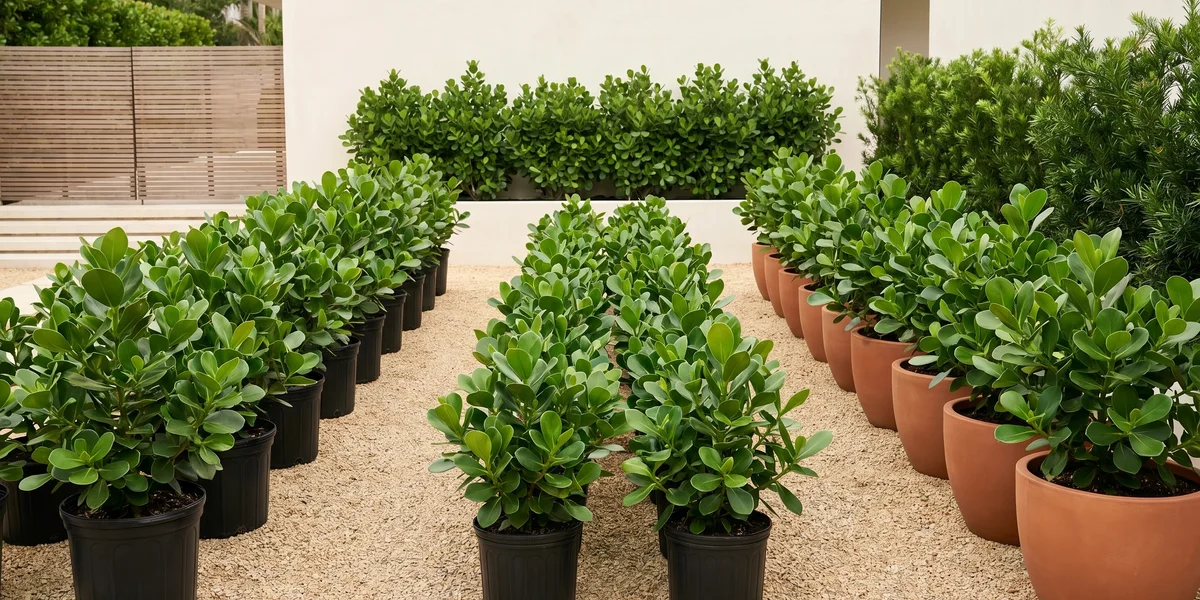
A 3-gallon Clusia is roughly 2 to 3 feet tall on delivery day and takes twelve to eighteen months to read as a finished hedge. A 7-gallon starter is near-finished in six to nine months. A 15-gallon plant is hedge-grade density the day it goes in the ground, and a 25-gallon plant gives estate-scale maturity immediately.
Podocarpus follows the same logic on a slower curve, which is why we usually recommend a larger starter for it. Cocoplum and the natives sit in between. Across every species, a larger starter buys time and a smaller starter buys patience. Our guide to Clusia by container size shows what each pot size actually looks like planted.
Spacing then follows the starter size you choose. Smaller plants go on tighter centers so the line closes, and larger plants sit a little wider and still meet. The most common failure we are called out to fix is small plants set too far apart, which leaves gaps that take years to close if they ever do. Our hedge spacing guide walks through the exact numbers by container size.
What Changes the Price of a Florida Privacy Hedge
There is no useful per-plant number, because the plant is rarely the biggest variable. Four things move a hedge quote more than species choice:
- Starter size and plant count. These move together and in opposite directions. Larger plants cost more each but sit on wider centers, so a run needs fewer of them.
- Run length and access. A long straight line along an open side yard installs very differently from a short run behind a pool cage that equipment cannot reach.
- Site prep. Removing a failed ficus hedge, amending poor soil, or working around irrigation adds real labor before a single plant goes in.
- Delivery and install scope. Delivery-only, delivery plus install, and full site prep are three different projects.
For what it is worth, species choice is usually a minor line item next to those four. We put all of it on one itemized quote rather than publishing a list price that would be wrong for most yards. Our hedge installation cost guide covers what should appear on a real quote.
Care and Maintenance, Realistically
None of these plants are demanding once established, but they are not zero either.
Watering matters most in the first sixty to ninety days while roots establish. After that, Clusia is moderately thirsty, cocoplum and the natives need noticeably less, and Podocarpus sits in between. Overwatering causes more problems than underwatering. Root rot from a bed sitting in a soaked turf-irrigation zone is the single most common cause of a struggling hedge we get called about.
Shaping is light on all of them. Most owners run a seasonal trim to keep the line tidy and let it keep thickening. Feeding during the growing season helps, especially in sandy coastal soil that drains nutrients quickly. Beyond that these are low-drama plants in Florida conditions.
How to Pick the Right Privacy Plant for Your Yard
Match the plant to the conditions, not to a favorite:
- Sunny, open yard: Clusia.
- Tall, narrow, or formal line: Podocarpus.
- Shaded side yard: Podocarpus or Walter’s viburnum.
- Direct coastal or canal-front: Cocoplum.
- Native-plant priority: Cocoplum, then the other Florida natives.
- Pool yard: Clusia, for lighter leaf drop that is easier to skim.
- Central Florida or anywhere with real cold snaps: Podocarpus or yaupon holly over the tropical options.
If your property has more than one exposure, it is fine to use different species on different runs. What does not work is mixing species inside a single continuous hedge line, because the textures and growth rates never blend cleanly.
Frequently Asked Questions
What are the best hedge plants for Florida? Clusia, Podocarpus, and cocoplum handle most Florida privacy work. Clusia suits sunny open yards, Podocarpus suits tall, narrow, or partly shaded lines, and cocoplum suits direct coastal lots. Florida natives including Simpson’s stopper, Walter’s viburnum, and yaupon holly cover most remaining situations.
What is the best privacy shrub for South Florida? Clusia is the best privacy shrub for most South Florida yards. It is dense, glossy, fast to fill, sun-loving, and forgiving. Podocarpus is the better pick for tall, narrow, or formal lines, and cocoplum is the choice for direct coastal lots. The right plant depends on your sun, salt, and space.
What are the fastest-growing privacy hedge plants in Florida? Clusia is the fastest to a finished look among the reliable choices, closing laterally within six to twelve months at proper spacing. Cocoplum and the natives are moderate. Podocarpus is steady but slower, which is why we install larger Podocarpus starters so the hedge reads finished on day one.
What privacy shrubs stay green all year in Florida? Clusia, Podocarpus, and cocoplum are all evergreen and hold their color through Miami, Fort Lauderdale, and West Palm Beach winters. You do not lose privacy in the cool season the way you would with a deciduous plant. The Florida natives on this list are evergreen too.
What are the best privacy plants for a small or narrow yard? Podocarpus is the top pick for narrow planting strips because its upright, narrow habit gives you height without width. Simpson’s stopper is a good native option for tight runs. Both give a tall screen where a wide, rounded shrub would crowd the space.
Which hedge plants handle salt on a coastal lot? Cocoplum is the most salt-tolerant privacy plant for direct coastal and canal-front lots, and it takes ocean spray without leaf burn. Clusia handles most near-coastal exposure well. Podocarpus takes moderate salt but is not the first pick for constant beachfront spray.
What hedge plants grow in shade in Florida? Podocarpus and Walter’s viburnum are the two reliable answers for shaded runs. Clusia and cocoplum both need full sun and will thin at the base under a tree canopy. For a genuinely dark side yard, Walter’s viburnum holds the most controlled form.
How far apart should Florida hedge plants be spaced? Spacing follows starter size, not species. Smaller starters go on tighter centers and larger starters sit wider, always set so neighboring plants nearly touch on install day. Planting small plants too far apart is the most common mistake, and it leaves gaps that may never close.
How tall will a Florida privacy hedge grow? Clusia is comfortable between 6 and 12 feet. Cocoplum is happiest between 6 and 10 feet. Podocarpus reaches 12 to 15 feet and can be pushed higher for two-story screening. Yaupon holly also goes tall. Your target height should drive the species choice.
Do I need shrubs or a full hedge for privacy? For a real privacy screen along a property line, you want hedge plants installed as a continuous line at matched spacing, not scattered individual shrubs. The same plants work either way, but true privacy comes from a solid, closed hedge line, which is what we plan and install.
Are Florida native hedge plants lower maintenance? Generally yes, once established. Natives including cocoplum, Simpson’s stopper, and Walter’s viburnum use less supplemental water and need less feeding than Clusia over a ten-year horizon. The trade-off is pace, since most natives fill in more slowly than Clusia does.
Which hedge plants should I avoid in Florida? Ficus is the main one, because the ficus whitefly turned it into a recurring cost across the region. Arborvitae and other cool-climate privacy trees are wrong for subtropical heat. Flowering shrubs such as hibiscus go leggy at the base and will not hold a solid screen.
See also: Privacy Hedges in South Florida, our installer pillar covering species, spacing, and the full install.
Plan Your Privacy Hedge
The best way to pick the right privacy plant is a quick look at your actual yard. We will tell you honestly which shrub fits your sun, salt, space, and style, and whether a full hedge or a lighter screen is the right call. We install across Miami, Fort Lauderdale, West Palm Beach, Boca Raton, and Delray Beach.
Request a free quote or call us at 305-222-7171.
Tagged
- hedge plants florida
- privacy shrubs florida
- best plants for privacy in florida
- south florida hedge plants
- privacy hedge plants
- florida hedges
Ready for a privacy hedge that looks finished from day one?
Get a free estimate from a South Florida specialist who handles delivery, installation, and the result you actually want.