Buying Guide
Cocoplum Varieties: Red-Tip, Green-Tip, Horizontal
A South Florida installer's deep dive on the three cocoplum varieties: red-tip, green-tip, and horizontal. Real differences in form, color, height, and which one belongs in your yard.
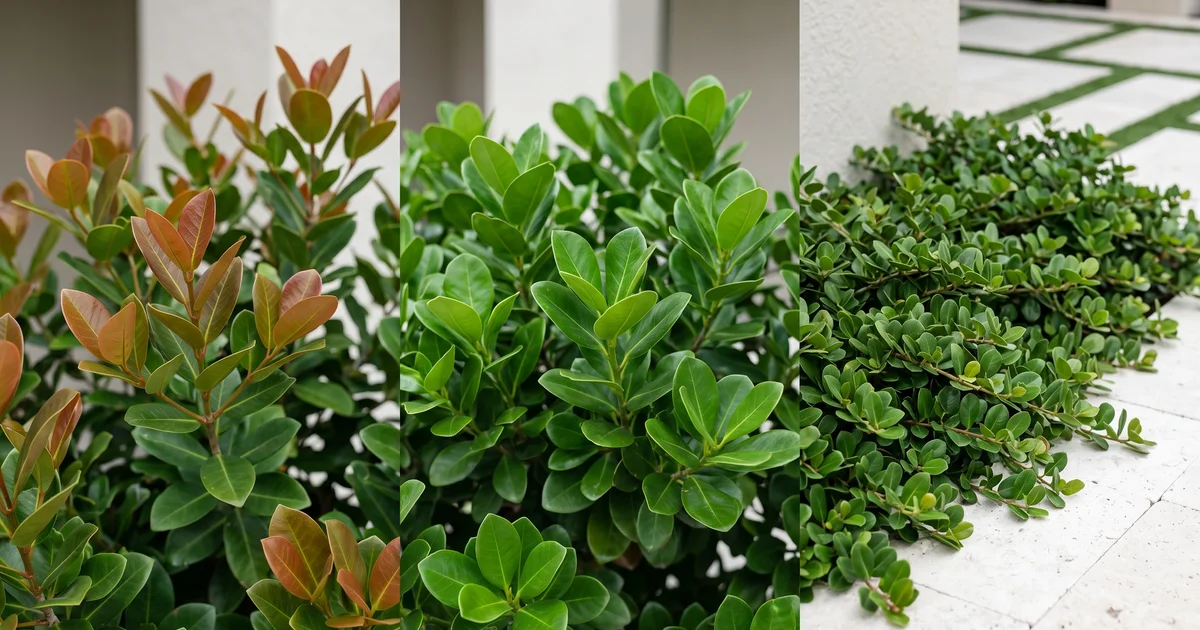
Cocoplum is not one plant. When a South Florida homeowner asks for a “cocoplum hedge,” there are three distinct varieties in play, and the choice between them changes the look, the height, and the use case meaningfully. Most homeowners do not know they are choosing until the plants are in the yard. This post is the version of that conversation we wish more people had before signing the quote.
We plant all three varieties across Miami, Fort Lauderdale, and West Palm Beach. Each one has a real role. Whether you searched for red tip cocoplum, green tip cocoplum, or horizontal cocoplum, this is the breakdown that tells you which form belongs in your yard. Picking the right variety upfront avoids the most common cocoplum regret, which is realizing six months in that the form does not match the yard.
Picking a cocoplum variety for your hedge? This post covers the three forms. For the broader install plan, spacing, pricing, FFL alignment, and HOA review, see our pillar on Cocoplum Hedges in South Florida.
The Short Answer
- Red-tip cocoplum (Chrysobalanus icaco ‘Red Tip’) is the standard residential privacy hedge cocoplum. Coppery red new growth, glossy green mature leaves, holds 6 to 10 feet, the version we install most often.
- Green-tip cocoplum (Chrysobalanus icaco) is the all-green form. Slightly denser, more uniform-looking, no seasonal color change, also holds 6 to 10 feet.
- Horizontal cocoplum (Chrysobalanus icaco ‘Horizontal’) is the spreading low form. Tops out around 3 to 5 feet, used for low borders and ground cover, not for tall privacy hedges.
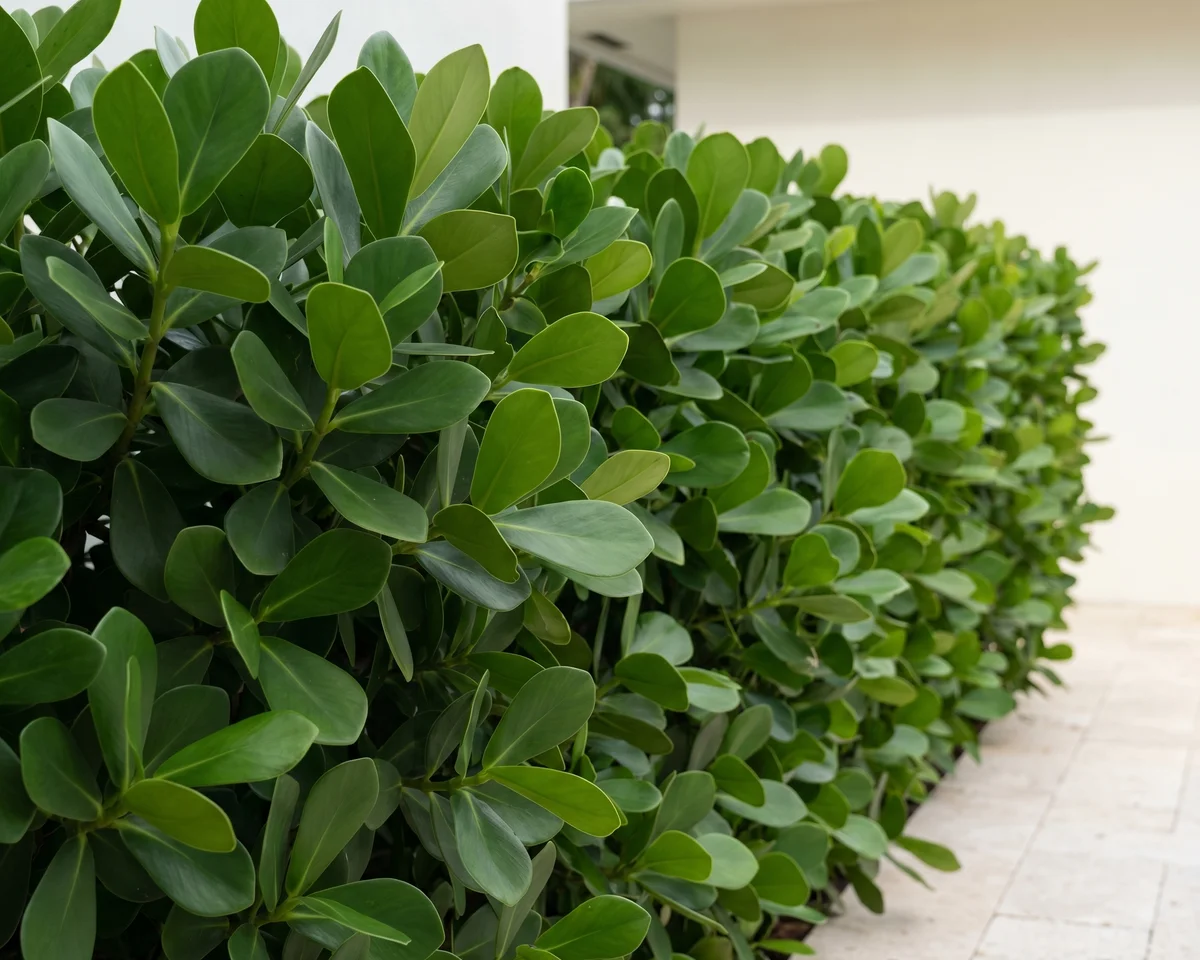
If you want a privacy hedge in the 6 to 10 foot range, pick red-tip or green-tip. If you want a low border under 5 feet, pick horizontal. Mixing them in the same line does not work.
What Cocoplum Is
Cocoplum, Chrysobalanus icaco, is a Florida native evergreen shrub native to coastal hammocks, mangrove edges, and inland swamp margins across south Florida and the Caribbean. It produces broad, oval, glossy leaves about two inches long, small white flowers, and dark red to purple fruit eaten by native birds and historically by people.
The species is exceptionally salt-tolerant, drought-hardy once established, and indifferent to lean sandy alkaline soils. It is one of the few Florida natives we plant in volume as a privacy hedge, mainly because the form, density, and resilience all line up with what a residential privacy run needs.
The three varieties below are all the same species. The differences are growth habit and leaf coloration, not species-level botany.
Red-Tip Cocoplum
Red-tip cocoplum is the privacy hedge variety we install most often. New growth flushes coppery red, sometimes leaning more orange or pinkish depending on light and season, and matures to deep glossy green over four to six weeks. The hedge produces multiple flushes of new growth per year, which means the red color is visible most of the time on a healthy plant.
Mature size as a privacy hedge: 6 to 10 feet, with light shaping holding it at any target height in that range. Mature width as a hedge: 4 to 6 feet. Growth rate: roughly one foot per year vertically in healthy conditions, slightly less in tighter spacing.
The color is the main reason homeowners pick red-tip over green-tip. The coppery flush on the upper third of the hedge gives the run a layered visual interest that an all-green hedge does not have. On modern, contemporary, and tropical-coastal homes, the color reads as warm and intentional. On strictly formal estate-style landscapes, some designers prefer the cleaner uniformity of green-tip, but most residential hedges we plant end up red-tip.
Other red-tip notes:
- The new growth flush is reliable through the warm months. Cool months produce less new growth and less visible red. The hedge looks slightly more uniform in winter.
- Red-tip handles full sun and part sun. It produces more vivid color in full sun.
- Red-tip is the most common cocoplum cultivar in Florida nurseries. Hedge-grade starter sizes are reliably available.
- Pricing is in line with green-tip and slightly higher than horizontal at equivalent starter sizes.
For a side-by-side against Clusia, see our cocoplum vs Clusia comparison. Most of the comparison points apply to red-tip specifically.
Green-Tip Cocoplum
Green-tip cocoplum is the all-green form of the species. New growth emerges green and matures green. There is no red flush. The hedge reads as more uniformly green-on-green throughout the year, with a slightly denser branching pattern in our experience.
Mature size as a privacy hedge: 6 to 10 feet, the same range as red-tip. Mature width as a hedge: 4 to 6 feet. Growth rate: similar to red-tip, possibly very slightly faster lateral fill.
Why homeowners pick green-tip over red-tip:
- A cleaner, more uniform look that fits formal estate landscapes well
- Designers working on Mediterranean-style or classic-formal homes sometimes specifically request green-tip for this reason
- Slightly tighter natural form, which can help on runs where every inch of density matters
- Easier to clip into very sharp formal lines because there is no color contrast between new and mature growth
Why some homeowners specifically avoid green-tip:
- Less seasonal interest
- Reads as plainer than red-tip in casual landscapes
- Slightly less common in nursery production, which can mean lead time on large hedge-grade starters
Both red-tip and green-tip serve the same hedge use case. The choice is mostly aesthetic, and a site walk with both varieties side by side is the cleanest way to settle the question.
Horizontal Cocoplum
Horizontal cocoplum is a different beast. Despite sharing the species name, it is not a privacy hedge variety. It produces a low-spreading habit, tops out around 3 to 5 feet, and grows wider than tall.
Use cases for horizontal cocoplum:
- Low borders along front-yard beds, walkways, and pool edges
- Mass plantings as a tall ground cover under trees
- Low foundation plantings against the front of a house
- Property lines where the goal is delineation, not screening
Use cases where horizontal cocoplum does not belong:
- Privacy hedges of any kind. The plant simply does not grow tall enough.
- Tall screens. Even with feeding and forgiveness, mature height stops well short of where a privacy hedge needs to be.
We have walked into yards where a previous landscaper installed horizontal cocoplum in a 100 foot privacy line because it was on hand. Those installs do not work. The hedge looks intentional but never reaches the height the homeowner expected. Our typical recommendation in those cases is to pull the horizontal cocoplum and replant with red-tip or green-tip, or repurpose the existing horizontal plants as a low border on a different part of the property.
Side-By-Side, In Detail
Mature Height
- Red-tip: 6 to 10 feet, can be pushed slightly higher with shaping
- Green-tip: 6 to 10 feet, same range as red-tip
- Horizontal: 3 to 5 feet maximum, often lower
Form
- Red-tip: upright dense privacy hedge habit with distinctive coppery new growth
- Green-tip: upright dense privacy hedge habit with all-green color
- Horizontal: low-spreading mounding habit, more like a tall ground cover than a hedge
Density Per Linear Foot
All three are dense for their respective forms. Red-tip and green-tip produce nearly identical density at hedge height. Green-tip may run very slightly tighter. Horizontal is dense at low height but cannot deliver privacy at any height above its mature ceiling.
Salt And Coastal Performance
All three varieties handle direct ocean spray, sand, and high wind with no leaf burn. Cocoplum is the species we recommend most often for true beachfront and canal-front lots. Within the species, all three varieties perform identically on coastal exposure. The difference is whether the use case calls for a privacy hedge (red-tip or green-tip) or a low coastal-tolerant border (horizontal).
Sun And Shade
All three prefer full sun and tolerate part sun. None of the three perform well in deep shade. For shaded runs, the conversation shifts to Walter’s viburnum or wild coffee, which we cover in the Walter’s viburnum vs Podocarpus post and the native privacy hedges guide.
Spacing
For a finished hedge on day one with red-tip or green-tip, we typically install at:
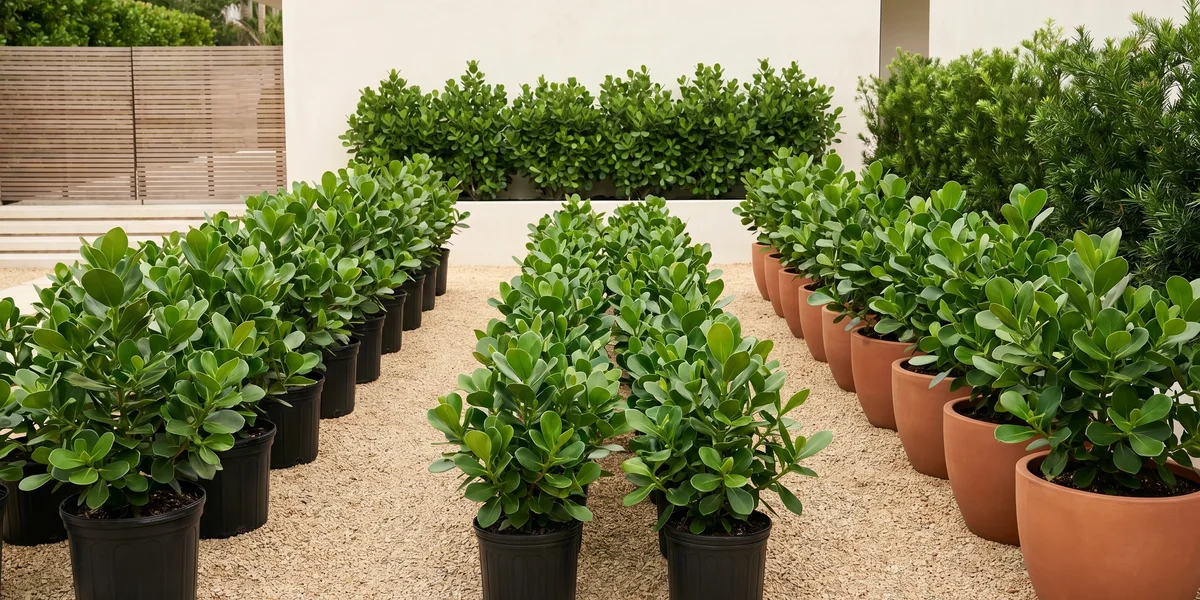
- 15-gallon at 2 to 2.5 foot centers for an immediately-finished privacy wall
- 7-gallon at 1.5 to 2 foot centers for a near-finished run that closes up in a season
- 3-gallon at 1 to 1.5 foot centers for a longer-runway DIY-friendly install
For horizontal cocoplum used as a low border:
- 3-gallon at 2 to 2.5 foot centers
- 7-gallon at 2.5 to 3 foot centers
The spacing logic mirrors what we cover in the Clusia spacing guide. Same principles, different species.
Cost
Within the species, red-tip and green-tip are priced similarly. Horizontal cocoplum is typically slightly less expensive per plant at equivalent starter sizes because it is grown in larger commercial volumes for ground cover use. Total installed price depends much more on starter size, run length, and site conditions than on variety choice. Our hedge installation cost guide covers the real cost drivers.
Mixing Varieties On The Same Property
A pattern we recommend more often than people expect: red-tip cocoplum on the privacy hedge, horizontal cocoplum as a low border in front of it. The two varieties belong to the same species and pair visually because the leaf is the same. The privacy run handles screening. The horizontal mass at the front handles a softer transition to lawn or hardscape.
This approach works especially well on:
- Front-yard hedges where the homeowner wants a layered look from the street
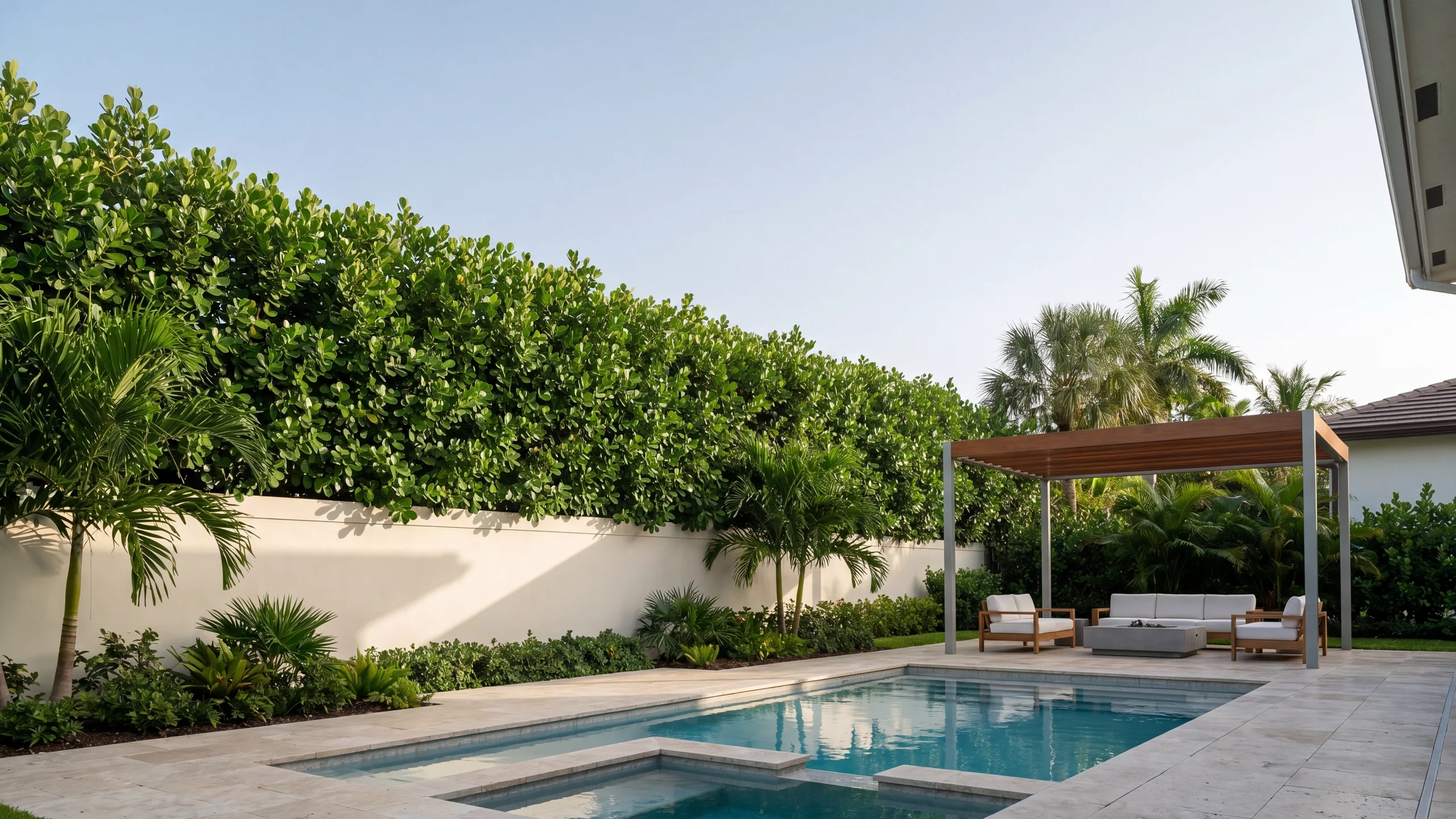
- Pool yards where a tall hedge wraps the perimeter and a low border sits along the deck
- Coastal lots where every part of the landscape needs to be salt-tolerant
What we do not recommend:
- Mixing red-tip and green-tip in the same continuous hedge line. The color contrast between the new-growth flushes reads as inconsistent, even though both varieties grow at similar rates. Pick one or the other for any single run.
How To Pick
Three questions usually settle the choice:
- What height does the hedge need to reach? Above 5 feet, it is red-tip or green-tip. At or below 5 feet, horizontal might work, but a true privacy hedge requires red-tip or green-tip.
- What is the look you want? Coppery seasonal interest favors red-tip. Uniform formal green favors green-tip.
- Is the home modern, formal, or naturalistic? Modern and naturalistic homes lean red-tip. Formal estate homes sometimes lean green-tip.
If most or all answers point to red-tip, that is your variety. If they point to green-tip, that is yours. Horizontal is its own answer for its own use case.
Frequently Asked Questions
What is red-tip cocoplum? Red-tip cocoplum is a cultivar of the Florida-native shrub Chrysobalanus icaco, named for the coppery-red flush on its new growth that matures to green. It is the most common cocoplum used for privacy hedges in South Florida, growing dense and rounded to a maintained 6 to 10 feet, salt-tolerant enough for direct coastal lots. It is the same plant sold as “cocoplum red tip.”
What is the difference between red-tip and green-tip cocoplum? Both are the same species, Chrysobalanus icaco. Red-tip produces coppery red new growth that matures to green, providing seasonal color and warm tones year-round. Green-tip produces all-green new growth and reads as a more uniform formal hedge. Both reach the same 6 to 10 foot height range and have nearly identical performance on coastal lots.
Which cocoplum variety is the best privacy hedge? Red-tip is the standard residential privacy hedge cocoplum across South Florida. Most installs we do are red-tip. Green-tip is a strong alternative for formal estate landscapes that want a uniformly green look. Horizontal cocoplum is not a privacy hedge variety and tops out too low for screening.
How tall does horizontal cocoplum get? Horizontal cocoplum tops out around 3 to 5 feet, often closer to 3 feet on most installs. It grows wider than tall. It is used for low borders, mass plantings, and tall ground cover. It cannot serve as a privacy hedge because it does not reach the height a privacy run needs.
Can I plant horizontal cocoplum as a privacy hedge? No. Horizontal cocoplum does not grow tall enough to function as a privacy hedge. Even with feeding and shaping, it tops out around 3 to 5 feet. For privacy in the 6 to 10 foot range, pick red-tip or green-tip cocoplum, or another tall hedge species.
Is red-tip cocoplum the same as Florida native cocoplum? Red-tip cocoplum is a cultivar of the Florida native species Chrysobalanus icaco. It is selected for the coppery red new growth, but it is the same native species. From an FFL and HOA standpoint, red-tip qualifies as Florida-native and is on most approved-species lists.
Will red-tip cocoplum keep its red color year-round? The coppery red color appears on new growth and fades to green as leaves mature. A healthy red-tip cocoplum produces multiple flushes of new growth per year, so red is visible on the upper third of the hedge most of the time. Cool winter months produce less new growth and less visible red.
Does green-tip cocoplum grow faster than red-tip? Lateral fill on green-tip can be slightly faster than red-tip in our experience, but the difference is small and varies by individual plant and growing conditions. Vertical growth rates are essentially identical at one to one and a half feet per year in healthy conditions. Both varieties reach the same mature size range.
Are all cocoplum varieties salt tolerant? Yes, all three. Cocoplum as a species is exceptionally salt-tolerant, including direct ocean spray exposure. Red-tip, green-tip, and horizontal all share this tolerance. The choice between them is about form and use case, not coastal performance.
Can I mix red-tip and green-tip cocoplum in one hedge? We do not recommend it. The color contrast between the new-growth flushes reads as inconsistent along a single hedge line, even though both varieties grow at similar rates. Pick one or the other for any continuous run. Different runs on different sides of the property can use different varieties.
How far apart should I plant cocoplum? Spacing follows the starter size. For 3-gallon, 1 to 1.5 foot centers; for 7-gallon, 1.5 to 2 feet; for 15-gallon red-tip or green-tip, 2 to 2.5 feet; for 25-gallon, 3 to 3.5 feet. Smaller plants go tighter so the row closes, larger plants sit wider and still touch. The same spacing logic applies as in the Clusia spacing guide.
Is cocoplum HOA approved in South Florida? Yes. All three cocoplum varieties are on most South Florida HOA approved-species lists. Red-tip and green-tip qualify as privacy hedge species. Horizontal cocoplum qualifies as a ground cover or low border. FFL-aligned communities specifically favor cocoplum for its native status and water tolerance.
Which cocoplum variety is cheapest? Horizontal cocoplum is typically the least expensive per plant because it is grown in larger commercial volumes. Red-tip and green-tip are priced similarly to each other and slightly higher than horizontal at equivalent starter sizes. Total install cost depends mostly on starter size and site conditions, not variety choice.
How fast does a cocoplum hedge fill in to full privacy? In full sun with consistent watering, a cocoplum hedge adds roughly one to one and a half feet of height per year and closes up laterally within the first year at hedge-grade starter sizes. Larger 15-gallon red-tip or green-tip starters read as a finished privacy wall on install day. See our full cocoplum hedge growth-rate guide for timelines by starter size.
See also: Cocoplum Hedges in South Florida, our installer-side pillar covering the full cocoplum install plan.
Get The Right Cocoplum Variety On Your Yard
The fastest way to settle red-tip vs green-tip vs horizontal is a site walk. We will tell you honestly which variety fits the height, the look, and the role you need on your specific property. We install all three varieties across Miami, Fort Lauderdale, West Palm Beach, Boca Raton, and Delray Beach.
Request a free quote or call us at 305-222-7171.
Tagged
- cocoplum varieties
- red tip cocoplum
- green tip cocoplum
- horizontal cocoplum
- Chrysobalanus icaco
- Florida native hedge
Ready for a privacy hedge that looks finished from day one?
Get a free estimate from a South Florida specialist who handles delivery, installation, and the result you actually want.