Buying Guide
Cocoplum vs Clusia: Which Privacy Hedge Wins?
A side-by-side comparison of cocoplum and Clusia for South Florida privacy hedges. Real differences in speed, salt tolerance, density, cost, and where each one belongs in your yard.
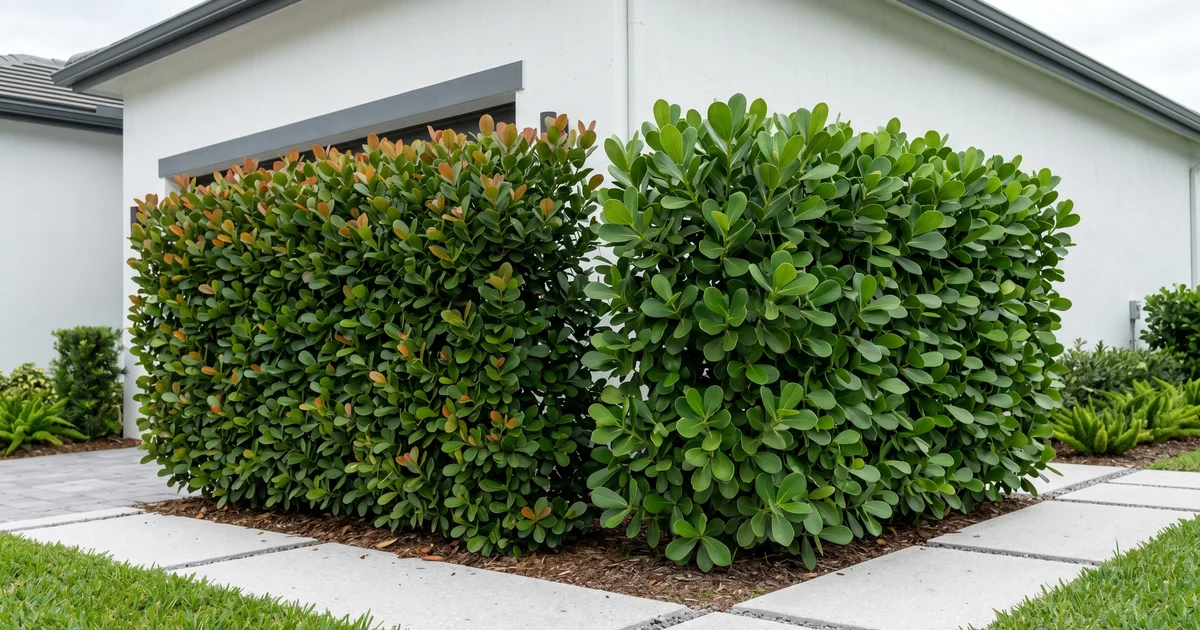
Cocoplum and Clusia are the two most legitimate dense privacy hedges that fit a tropical South Florida yard. They both produce a glossy, evergreen wall in the 6 to 10 foot range. They both tolerate full sun and salt. They both look beautiful when planted right. So why do we plant ten times as much Clusia as cocoplum on residential installs across Miami, Fort Lauderdale, and West Palm Beach?
This post is the honest answer. We install both. We have nothing against cocoplum, and we steer homeowners toward it on the right yards. But the differences between these two species are real, and they matter for the decision.
Planning a cocoplum hedge install? This post is the side-by-side comparison vs Clusia. For the full plan, species selection, spacing, pricing, FFL alignment, and installation, see our pillar on Cocoplum Hedges in South Florida.
The Short Answer
For most South Florida residential yards, Clusia is still the default privacy hedge, mostly because it fills in faster and is easier to source in any starter size on demand.
For direct coastal exposure, drought-prone lots, wildlife priorities, and Florida-Friendly Landscaping (FFL) communities, cocoplum is the better hedge, and we will recommend it on the site walk if those conditions apply to your yard.
If you are stuck between the two and the yard is not a clear case, Clusia is usually the safer pick. If the yard is on the water, the case for cocoplum gets much stronger.
Quick Scorecard
| Feature | Cocoplum | Clusia |
|---|---|---|
| Florida native | Yes | No |
| Mature height | 6 to 10 ft | 6 to 12 ft |
| Salt tolerance | Exceptional, direct spray | Very high |
| Drought tolerance | Excellent once established | Good |
| Speed to filled-in look | Moderate | Fast |
| Wildlife value | High | Neutral |
| HOA acceptance | Standard | Standard |
| Supply in hedge-grade sizes | Reliable but narrower | Abundant in all sizes |
| Best modern home pairing | Subtle, naturalistic | Bold, tropical |
| Best estate home pairing | Coastal estates | Tropical and modern estates |
This is a simplification. The full picture is below.
Where Clusia Wins
Speed Of Fill
The single biggest reason Clusia dominates South Florida privacy hedge installs is how fast it closes up laterally. A 7-gallon Clusia hedge planted at 1.5 to 2 foot centers usually reads as a continuous wall within six to twelve months. Cocoplum at the same starter size and spacing typically takes one and a half to two seasons. For homeowners who want a finished hedge inside one calendar year, Clusia is hard to match.
We dig into the timeline in detail in our how fast Clusia hedges grow guide, and the pattern there applies to most yards we install.
Density Per Linear Foot
A clipped Clusia hedge is more visually solid than a clipped cocoplum hedge at equal age and spacing. Both are dense, but Clusia wins the density contest, especially in the first two years. For a homeowner who wants a perfectly opaque privacy wall on day one, that gap matters.
Tropical Bold Look
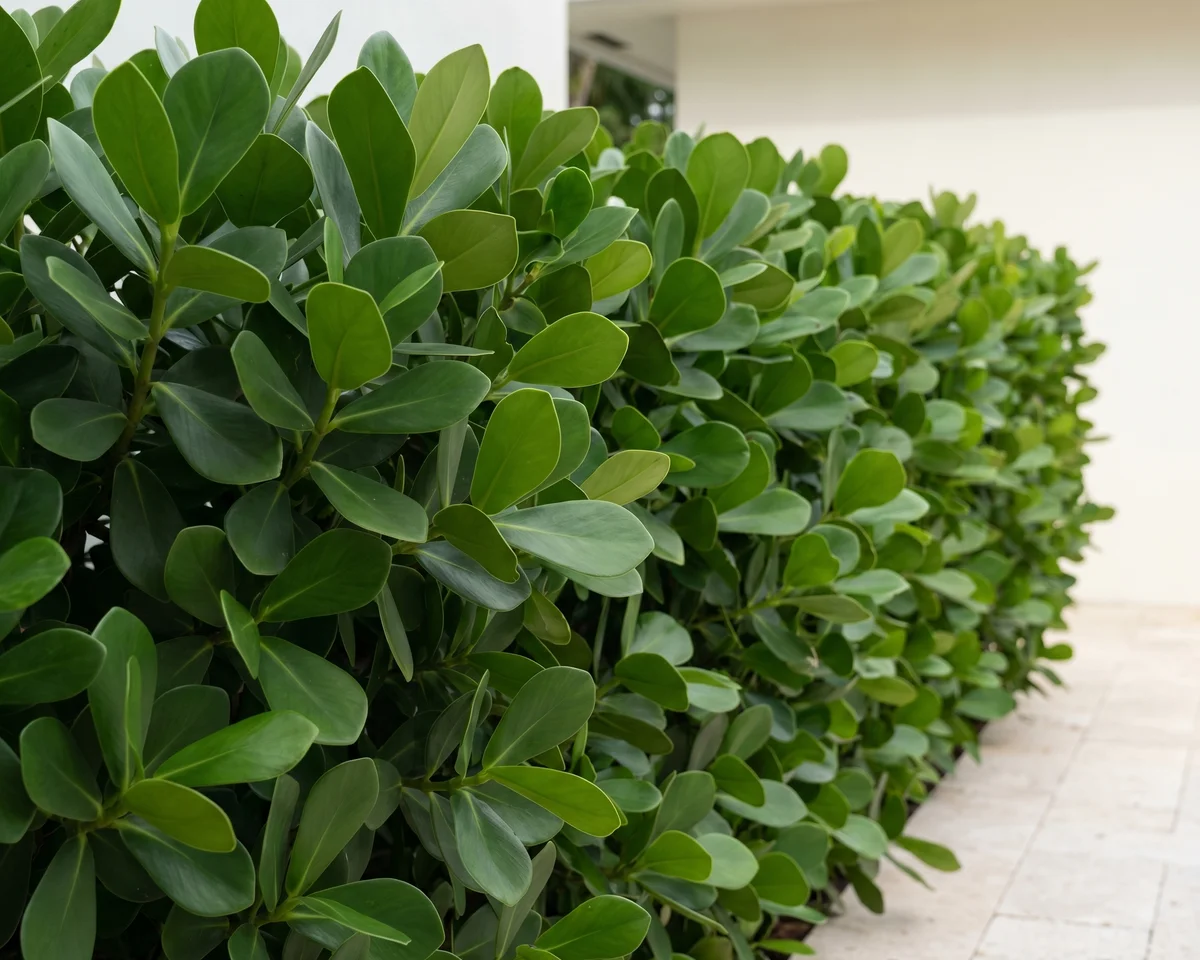
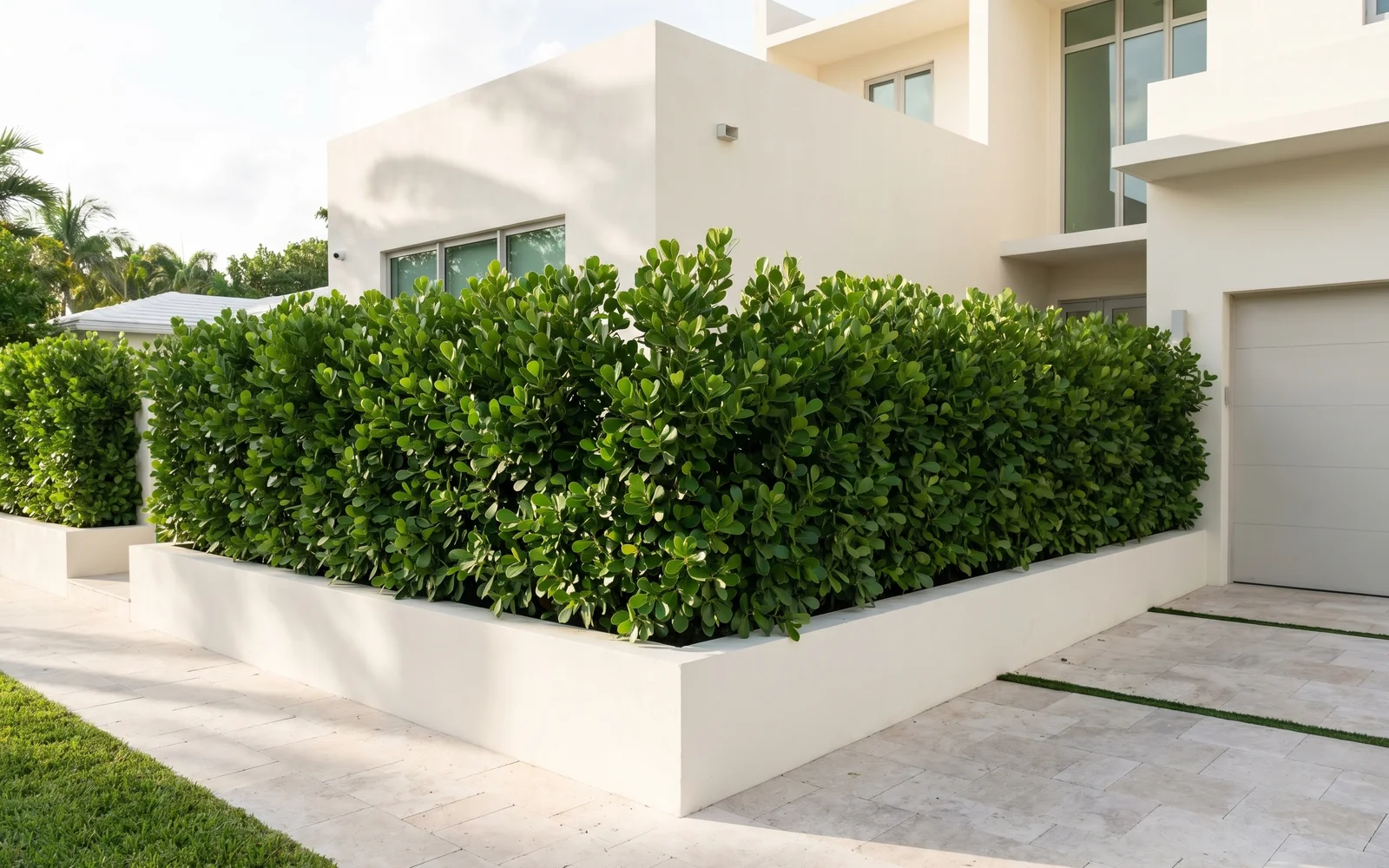
Clusia leaves are larger, glossier, and bolder than cocoplum leaves. The plant pairs naturally with modern, contemporary, and tropical-coastal South Florida architecture. Cocoplum reads as more naturalistic and less assertively tropical. Both are attractive. They are different aesthetics, and the right pick depends on the house and the rest of the landscape.
Predictable Nursery Supply
Clusia is grown in massive volume across Florida nurseries. We can usually source any starter size we want in the quantities a residential install needs. Cocoplum is widely available, but hedge-grade large starter sizes sometimes take a lead time, especially when several jobs in the area are pulling stock at once.
Forgiving On Less-Than-Ideal Watering
Both hedges need consistent watering through the first sixty to ninety days. After that, Clusia is slightly more forgiving than cocoplum during establishment if a homeowner misses a watering or two. Cocoplum recovers fine, but the early window is less generous.
Where Cocoplum Wins
Direct Coastal Exposure
This is the clearest case for cocoplum. On true beachfront, oceanfront, and canal-front lots with direct salt spray, cocoplum is more bulletproof than even Clusia. It evolved on these sites. Clusia handles coastal exposure well but can show some leaf burn under sustained spray. Cocoplum essentially does not.
Drought And Sandy Soil
Once established, cocoplum needs less supplemental irrigation than Clusia. Cocoplum evolved on lean, sandy, alkaline soils. It does not need rich loam or constant moisture to thrive. For homeowners who cannot reliably irrigate or who live on naturally sandy lots without much soil amendment, cocoplum has a long-term edge.
Wildlife Value
Cocoplum is a Florida native. It produces small fruit that birds eat, and the dense canopy provides cover for native species. Clusia is wildlife-neutral. For homeowners who want a privacy hedge that also attracts birds and butterflies, cocoplum is the only honest answer between these two species.
Florida-Friendly Landscaping And Eco HOAs
A small but growing list of South Florida HOAs and a handful of municipal sustainability programs favor or require Florida-Friendly plant choices. Cocoplum is on every FFL list. Clusia is not. In communities where FFL credit matters, cocoplum is the path of least resistance through architectural review.
Ten-Year Maintenance Economics
Over a decade, cocoplum generally needs less water, less fertilizer, and fewer pest interventions than Clusia. Both are low-maintenance hedges, but cocoplum is closer to truly self-sufficient once it is rooted in. For a homeowner thinking about long-term landscape costs rather than first-year speed, that gap is real.
Side-By-Side, In Detail
Growth Speed
Clusia outpaces cocoplum in vertical growth and lateral fill in nearly every condition. In full sun with good water, Clusia puts on one to two feet per year. Cocoplum runs closer to half a foot to one foot per year vertically and is slightly slower than that to fill laterally.
Mature Size
Clusia comfortably reaches 12 feet and can be pushed slightly higher. Cocoplum is happiest at 6 to 10 feet. If the goal is a tall hedge of 10 to 12 feet, Clusia hits it more easily. For shorter privacy walls, both species reach the height fine.
Salt And Wind
Both species are excellent on coastal South Florida lots. Cocoplum has the slight edge under direct ocean spray. Clusia is essentially equal on near-coastal and waterfront lots that are not directly oceanfront.
Drought Tolerance
Cocoplum wins. After the first establishment year, cocoplum needs noticeably less water than Clusia. In a drought year with watering restrictions, cocoplum keeps its color and density longer.
Sun Versus Shade
Clusia loves full sun and tolerates partial sun. Cocoplum loves full sun and tolerates partial sun. Neither species is the right pick for deeply shaded sites. If the hedge run is shaded, Walter’s viburnum or wild coffee belong in the conversation, and we cover both in our native privacy hedges guide.
Pool Yards
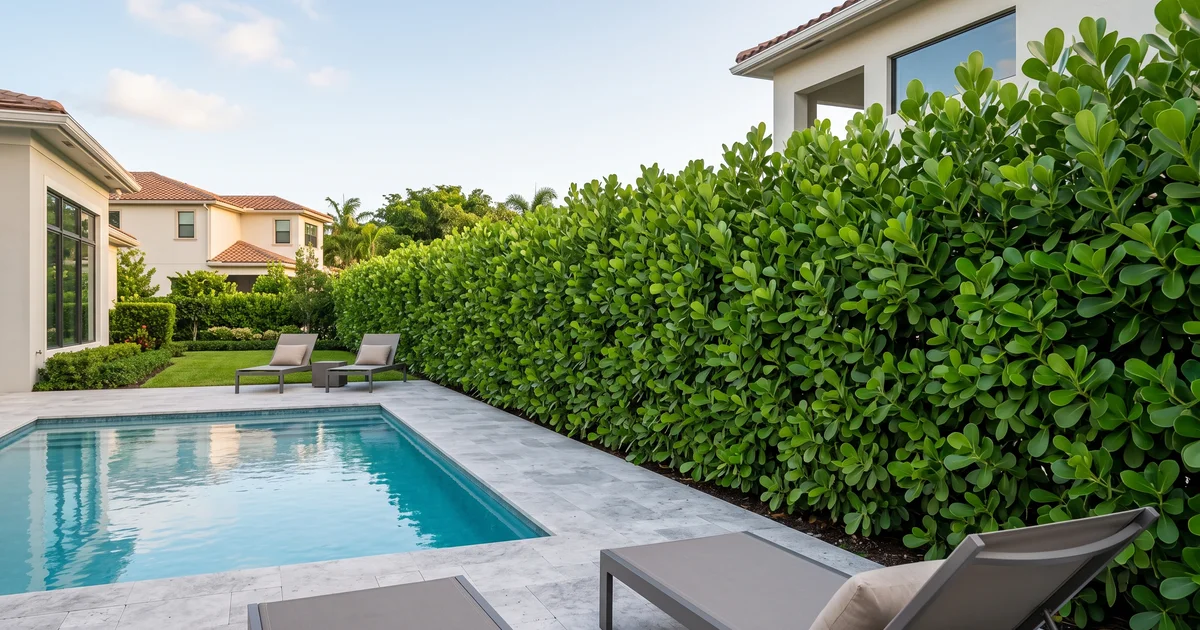
Clusia is the better pool-yard pick. Leaf drop is lighter than cocoplum, and the leaves are easier to skim. Cocoplum can work around a pool, but the smaller fruit and slightly heavier leaf drop make it a less convenient choice when the hedge is close to the pool deck.
Cost
For a similar starter size, cocoplum and Clusia are in a comparable range, with cocoplum running slightly more expensive at large hedge-grade sizes due to nursery supply patterns. Total install cost for a 100-foot hedge depends much more on starter size, spacing, soil prep, and existing hedge removal than on species choice. Our hedge installation cost guide breaks down what should be on a real quote.
Maintenance
Both are low-maintenance once established. Clusia takes slightly less shaping to still look good and has fewer pest events on average. Cocoplum needs less water, less fertilizer, and slightly less attention overall once it is rooted in. Different maintenance profiles, both reasonable.
The Yards Where Each One Belongs
A short version of how we make the call on a site walk:
Pick Clusia on: modern Miami, Fort Lauderdale, or West Palm Beach yards on standard residential lots, pool yards, fast-timeline projects, anywhere that needs a finished hedge inside one season, and almost any sun-exposed property where the homeowner cares more about a tropical look than wildlife value.
Pick cocoplum on: beachfront and canal-front lots, drought-prone sandy interior lots, FFL-aligned communities, properties where the homeowner specifically wants more wildlife in the yard, and homes where the design lean is naturalistic rather than overtly tropical.
Pick a mix on: larger properties with multiple exposures. Use cocoplum on the coastal property line, Clusia on the pool yard, Walter’s viburnum on shaded side yards. Do not mix species along the same continuous hedge line. The textures do not blend cleanly.
What We Actually Recommend Most Often
If a homeowner has not told us their priorities, we lean Clusia. It is the simplest path to a finished privacy hedge in most South Florida yards, and it is the most forgiving species on imperfect installs.
When a homeowner tells us the lot is on the water, that they cannot reliably irrigate, that they want native plants, or that they care about wildlife in the yard, we lean cocoplum.
About one in ten homeowners tells us they want both species used together for different parts of the property. That is usually the right call when the yard has clearly different exposures, and it is the install that produces the most resilient long-term landscape.
Cocoplum Varieties Are Worth Knowing About
A quick note before the FAQ. Cocoplum is not one plant. The three forms you will see in the trade are:
- Red-tip cocoplum. New growth flushes coppery red and matures to glossy green. The most popular privacy hedge variety, and the one we plant most often.
- Green-tip cocoplum. All-green new growth, slightly denser form, less seasonal color change. A clean choice for homeowners who want a more uniform look.
- Horizontal cocoplum. A lower-growing variety that tops out around 3 to 5 feet. Good for low borders and short privacy lines, not for tall hedges.
The variety changes how the hedge looks in person. Most homeowners we install for end up with red-tip cocoplum unless they have a reason to pick another form. We cover the variety differences in more depth in our cocoplum varieties guide (publishing later this week).
Frequently Asked Questions
Is cocoplum the same as Clusia? No. Cocoplum (Chrysobalanus icaco) is a Florida native. Clusia, usually Clusia guttifera, is not native to Florida. Both produce dense, glossy, evergreen privacy hedges. Cocoplum has stronger salt and drought tolerance. Clusia fills in faster and produces a more uniformly dense clipped wall.
Which grows faster, cocoplum or Clusia? Clusia. In healthy South Florida conditions, Clusia puts on one to two feet per year and closes up laterally faster. Cocoplum runs about half a foot to one foot per year vertically and takes one to two seasons longer to read as a finished privacy wall at equal starter size and spacing.
Which hedge is more salt tolerant? Cocoplum, slightly. Both species are excellent on coastal South Florida lots, but cocoplum handles direct ocean spray with no leaf burn. Clusia handles near-coastal exposure well but can show light burn under sustained direct spray. For true beachfront, cocoplum is the safer pick.
Which hedge is better around a pool? Clusia is generally the better pool-yard pick. Leaf drop is lighter than cocoplum, and the leaves are easier to skim from a pool surface. Cocoplum works fine farther from the pool deck. Right against the pool, Clusia is more convenient over the long run.
Is cocoplum drought tolerant? Yes, exceptionally so once established. After the first establishment year, cocoplum needs noticeably less supplemental water than Clusia. On drought-prone or sandy lots without consistent irrigation, cocoplum has a clear long-term edge.
Will a cocoplum hedge attract wildlife? Yes. Cocoplum is a Florida native that produces small fruit eaten by birds and provides dense cover for native species. It is a better wildlife hedge than Clusia, which is essentially neutral. Homeowners who want a privacy hedge that also attracts birds and butterflies usually lean toward cocoplum.
Is cocoplum or Clusia easier to maintain? Both are low-maintenance hedges. Clusia takes slightly less shaping over time and has fewer pest events on average. Cocoplum needs less water and less fertilizer once established. Different profiles, both reasonable. Over a decade, cocoplum is slightly cheaper to keep alive on most yards.
How tall does a cocoplum hedge grow? Cocoplum is comfortable as a privacy hedge in the 6 to 10 foot range. With shaping, mature plants can be held a bit taller, but this is the sweet spot for residential privacy walls. For taller formal screens above 10 feet, Podocarpus is usually a better match.
Can I plant cocoplum and Clusia next to each other? Yes, on the same property, but not in the same continuous hedge line. Use cocoplum on the coastal-facing line and Clusia on the pool yard. Mixing the two species inside one hedge run produces uneven texture, density, and growth rates that rarely look intentional.
Is cocoplum HOA approved in South Florida? Yes, in nearly every South Florida HOA community. Cocoplum is a long-standing standard South Florida hedge species and is on most approved-species lists. A growing share of HOAs actively favor it under Florida-Friendly Landscaping or sustainability initiatives. Architectural review is usually straightforward.
Is cocoplum more expensive than Clusia? At similar starter sizes, cocoplum and Clusia are in a comparable price range. Cocoplum at large hedge-grade sizes can run slightly more expensive due to narrower nursery supply. Total install cost depends much more on plant size, run length, and site conditions than on species choice.
Should I pick cocoplum if I cannot decide? Pick cocoplum if your yard is on the water, if you cannot reliably irrigate, if you want a Florida native, or if wildlife and FFL credit matter to you. Otherwise, Clusia is usually the simpler answer for South Florida residential privacy hedges. A site walk settles the question quickly.
See also: Cocoplum Hedges in South Florida, our installer-side pillar covering species selection, spacing, pricing, and FFL alignment.
Get A Real Recommendation On Your Yard
The fastest way to settle cocoplum vs Clusia on your specific property is to have someone who plants both walk the yard with you. We will tell you honestly which species fits which line and why. We install both species across Miami, Fort Lauderdale, West Palm Beach, Boca Raton, and Delray Beach.
Request a free quote or call us at 305-222-7171.
Tagged
- cocoplum vs Clusia
- cocoplum hedge
- Clusia hedge
- native privacy hedges
- South Florida hedges
- coastal privacy hedge
Ready for a privacy hedge that looks finished from day one?
Get a free estimate from a South Florida specialist who handles delivery, installation, and the result you actually want.