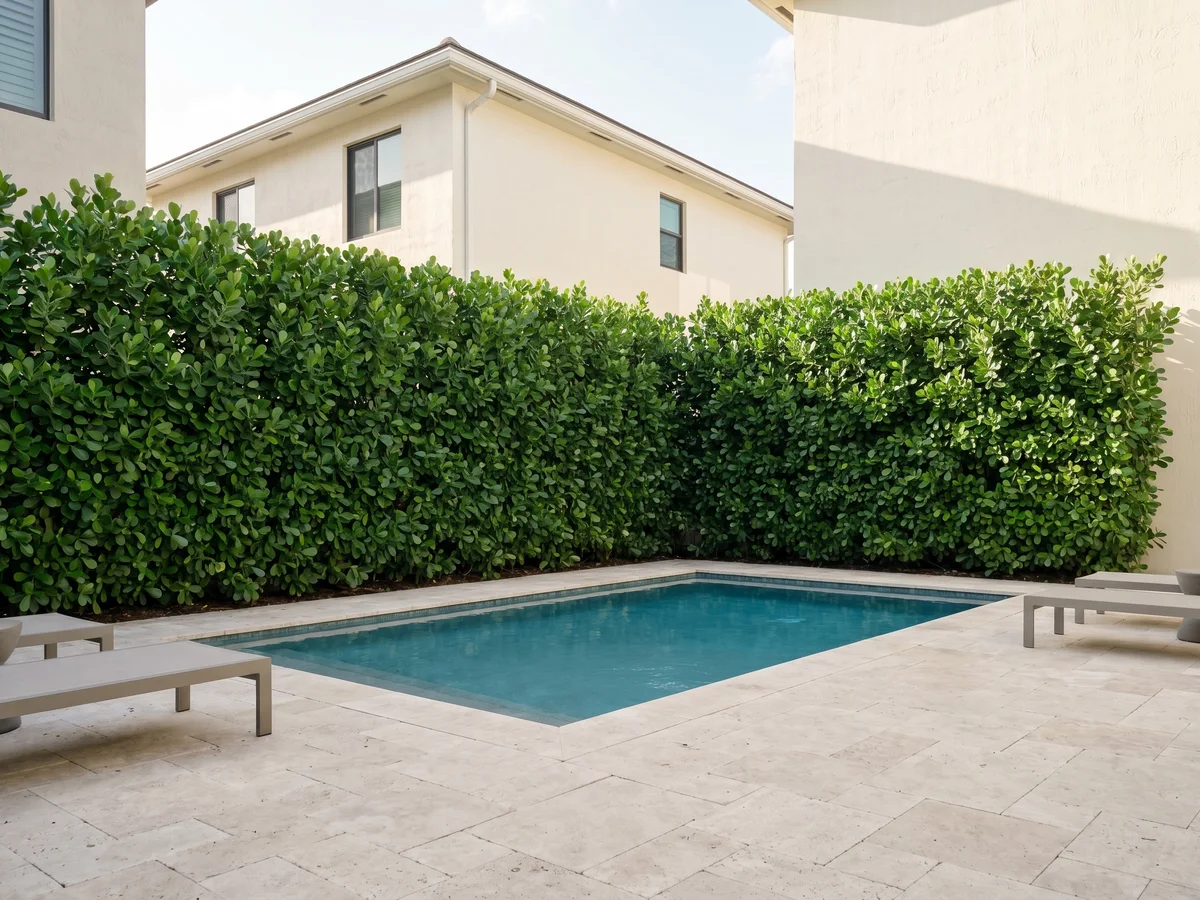
Comprehensive Privacy Hedge Solutions in Key Biscayne
Key Biscayne is a barrier island village just east of mainland Miami, reached by the Rickenbacker Causeway and ringed by Crandon Park to the north and Bill Baggs Cape Florida State Park to the south. The yards in between sit in some of the most exposed coastal conditions in Miami-Dade, and the hedges have to live up to it. Mr. Clusia plans every island install around that reality, not around a one-size template borrowed from the mainland.
Our Key Biscayne work covers Clusia hedges along single-family rear and side property lines, screens for pool decks that face beach access cut-throughs, perimeter hedges around condo enclave shared spaces, and street-facing screens along Crandon Boulevard and the side streets that feed off it. Each yard gets its own scope. The install logic on a Galen Drive lot is not the same as on a beachfront-adjacent block near Cape Florida, and we plan with the difference in mind.
Why Key Biscayne Homeowners Choose Mr. Clusia
The easiest way to spot a hedge that was installed by someone unfamiliar with Key Biscayne is to look at the inland-facing side after a storm. Plants picked for the mainland lose density and color in coastal exposure. Plants set without enough rooting time get loosened by the first hard wind. Spacing that works in a Pinecrest backyard does not always carry on the island.
We have learned the difference by installing Clusia hedges across Key Biscayne for years. The plant selection is consistent. The execution adapts to the lot. We stand behind the finished line, and our island clients tend to stay clients across multiple yards and properties because the hedge keeps doing what we said it would.
Clusia Strategy and Execution in Key Biscayne
The Clusia strategy on Key Biscayne starts with one fact. Salt is constant. The wax-coated, broad leaf of Clusia is one of the most salt-tolerant of any hedge plant available in South Florida, which is why it shows up so often in oceanfront and bayfront landscapes from Miami Beach down through the Keys. Our role is to take that natural fit and convert it into a hedge that looks finished from the day we leave the property.
That means starter sizes that already screen on day one, tight consistent centers so the line reads as a single mass, and bed preparation that gives the root system room to anchor before the first major weather event. On Key Biscayne we also factor wind direction. Plants set on the windward side of a property are spaced and rooted slightly differently than those on the leeward side. The differences are subtle. The longevity gain is not.
Salt tolerance, leaf health, and longevity
Clusia leaves shed salt rather than absorbing it, which is why they keep their glossy green color in coastal exposure. We rinse newly planted hedges with fresh water during heavy salt-spray weather in the first season, which speeds the rooting window. After the first year, the hedge is largely self-sufficient. Most Key Biscayne Clusia hedges we install need only seasonal shaping and a fertilizer pass during peak growing months.
Wind, hurricane resilience, and rooting
Hurricane resilience starts in the planting bed. We set Clusia root balls slightly proud of grade, widen the bed beyond a single plant footprint, and amend the sandy island soil so the new roots have something to grip. Plants installed in late spring usually get a full rooting season before the peak of hurricane months, which is the install window we recommend whenever the homeowner has flexibility on timing.
Clusia Options for Key Biscayne Homes
Clusia guttifera, the small-leaf form, is the workhorse of our Key Biscayne installs. It clips clean, holds a tight wall, and takes the salt and wind without losing density. For yards that want a more rustic, larger-leaf look, Clusia rosea (the autograph tree form) is a fit, especially for accent corners or yards leaning into a Florida-tropical aesthetic. Most of our island work is guttifera. Most of the rosea we install on Key Biscayne lives at gates, entries, and corner accents rather than along long hedge runs.
The mistake we steer clients away from is mixing the two within a single hedge line. The leaf scale difference does not blend over time and the line never reads consistent. Pick one form per run.
Custom Clusia Deliverables for Key Biscayne
Every Key Biscayne project we quote includes the same scope. An on-island walk-through. A measured plan with run lengths, plant counts, and spacing. A line-item written quote with starter size, soil work, and the install window. Plants delivered from our nursery with timing scheduled around causeway traffic. Soil prep tuned to barrier island conditions. A tight, straight Clusia line installed by our own crew. A clean post-install site. A walkthrough covering early watering, salt rinsing, and the seasonal rhythm the hedge will follow.
The deliverables stay the same on a small condo enclave job and on a long Harbor Drive estate run. The standard is the standard. That consistency is part of why our Key Biscayne client list keeps growing through neighbor referrals rather than ad spend.
Real Key Biscayne Case Studies and Client Results
A homeowner near Galen Drive asked for a Clusia screen between their pool deck and the public beach access lane that runs along the side of their property. Foot traffic during peak weekends had become a privacy concern. We installed an eight-foot starter Clusia line on tight centers along the access-facing edge, finished with mulch, and the family reported the pool area felt private the first weekend after install.
A bayfront family on Harbor Drive replaced a thinning mixed hedge along their rear lot line with a continuous Clusia run. The previous hedge had been losing plants every storm season. The new line, set with proper rooting time and matched starter sizes, made it through the next two storm seasons without losing a plant. The homeowner has since added a side-yard run with the same approach.
A condo enclave board asked us to plan a perimeter Clusia line along the shared boundary with a neighboring property. The job needed to look intentional, hold up to direct salt exposure, and respect a height ceiling agreed between the two associations. We installed at the maximum allowed height, set the spacing for a tight finished face, and scheduled deliveries around weekend resident traffic at the gate.
About Key Biscayne
Key Biscayne is a barrier island village in Miami-Dade County, sitting between Crandon Park to the north and Bill Baggs Cape Florida State Park to the south. The island is reached only by the Rickenbacker Causeway, which gives the village a distinct sense of separation from the mainland even though the city skyline is visible across the bay. The ZIP code 33149 covers the entire residential and commercial footprint.
The streets shape daily life as much as the geography does. Harbor Drive carves through the heart of the residential west side. Galen Drive, Buttonwood, Mashta Drive, and Crandon Boulevard each carry their own mix of homes and condo enclaves. The island leans into outdoor living year-round, with a community built around the beach, the lighthouse at Cape Florida, the soccer fields and tennis at Crandon Park, and the family-oriented walkability that has defined the village for decades. A privacy hedge here does not just screen a yard. It frames a coastal way of life.