Plant Care
Can Podocarpus Grow in Shade? A South Florida Installer's Answer
Yes, in partial shade. How much light a Podocarpus hedge needs, how shade changes growth and spacing, where it stops working, and how to keep a shaded hedge dense.
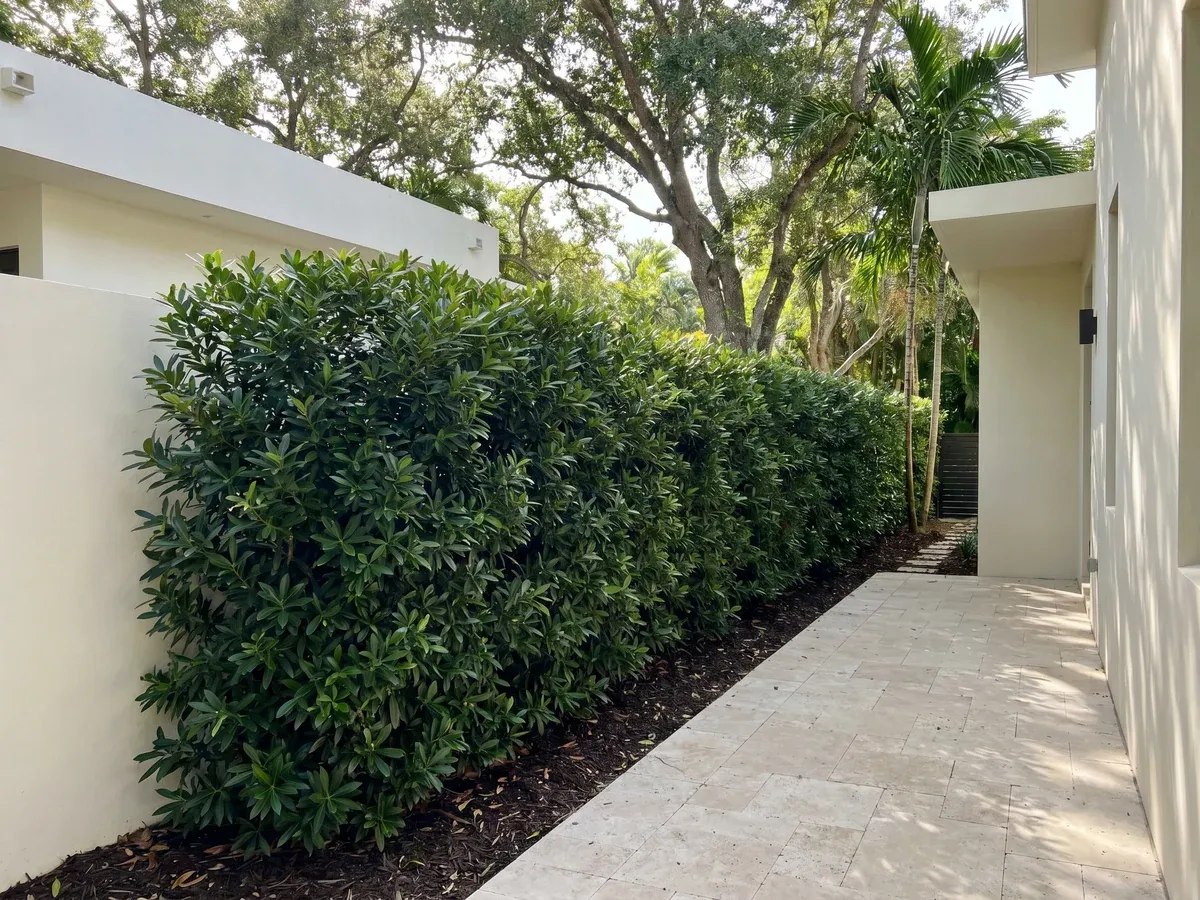
Yes. Podocarpus grows well in partial shade, and it is one of the best privacy hedges for shaded South Florida yards. It stays dense with about four to six hours of sun or bright, dappled light a day. It grows more slowly there than in full sun, and it thins out in deep, all-day shade under heavy canopy.
This guide is for homeowners with a shaded side yard, a north-facing wall, or a hedge line under oaks who want to know if Podocarpus will actually fill in. It covers how much light the plant needs, what shade does to growth and spacing, where the limit is, and how to keep a shaded hedge thick for years.
How Much Light Podocarpus Needs
Light is the whole question, so it helps to name the levels the same way we do on a site walk.
| Light on the hedge line | What Podocarpus does |
|---|---|
| Full sun, 6 or more hours | Fastest growth and the densest hedge |
| Partial shade, 4 to 6 hours of sun | Grows well and stays dense, just a little slower |
| Bright dappled light under high canopy | Grows well if the light moves across the row through the day |
| Deep shade, under 4 hours or dense canopy | Survives, but thins out, mostly on the lower half |
Morning sun with afternoon shade is close to ideal in Miami-Dade, Broward, and Palm Beach. The plant gets enough light to grow, and it skips the hottest hours. Afternoon sun with morning shade works too.
The trap is the run that looks bright at noon but sits in a building’s shadow the rest of the day. Watch the line at 9 a.m., noon, and 3 p.m. before you decide. That ten-minute test tells you more than any plant tag.
Why Podocarpus Handles Shade Better Than Most Hedges
Most popular South Florida privacy hedges are sun plants. Clusia and cocoplum start to thin and stretch once they drop below about six hours of sun. Areca palm gets leggy. Simpson’s stopper opens up.
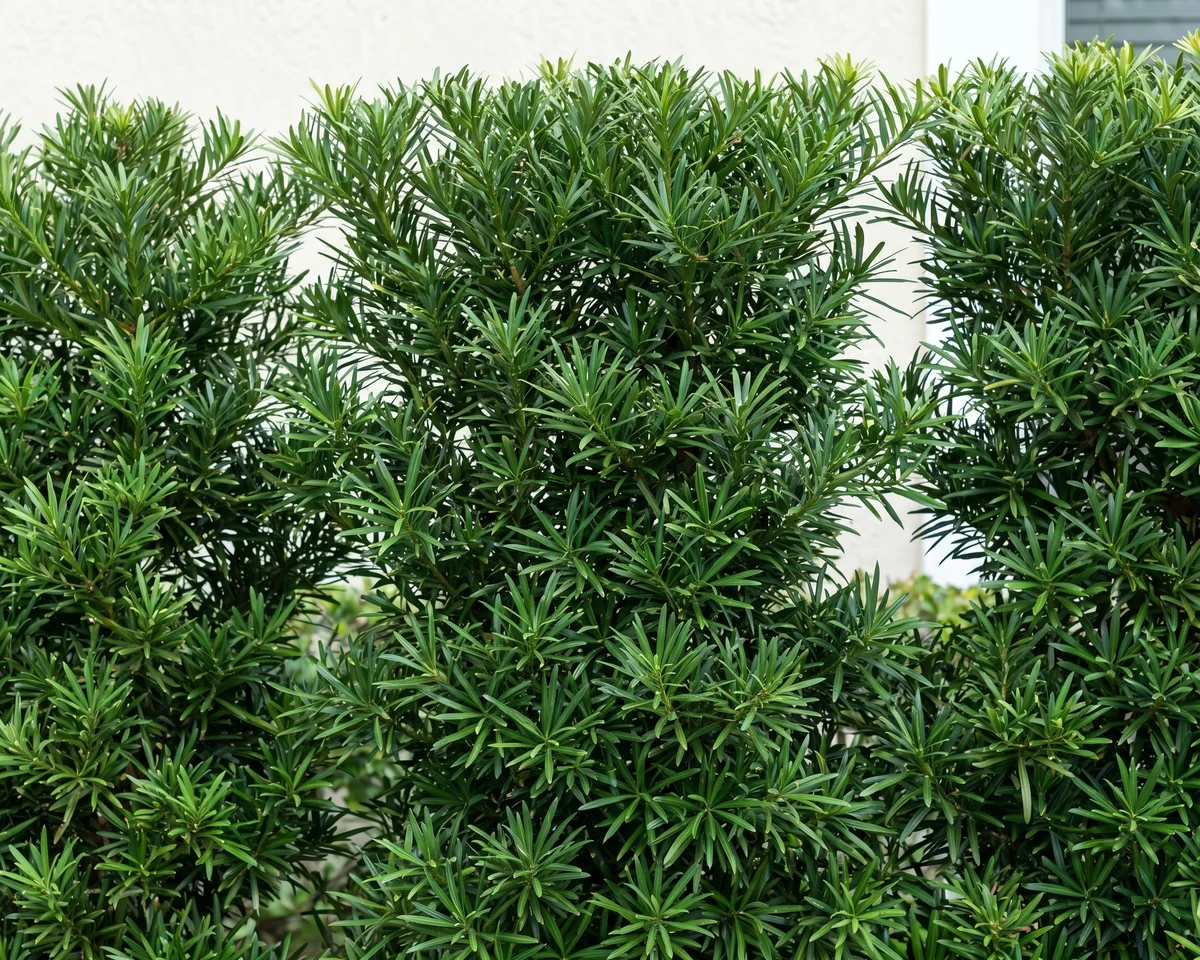
Podocarpus holds its form in lower light for two reasons. Its narrow, needle-like leaves are packed tightly along every branch, so the hedge stays solid even when each branch grows a bit less. And its upright habit puts growth where you need it, building height instead of reaching sideways toward the light.
That is why Podocarpus is the plant we suggest most often when a hedge line sits under tree canopy or along the shady side of a two-story house. Our Clusia vs Podocarpus comparison covers how the two trade off on sunnier runs.
What Shade Changes About the Hedge
Shade does not stop Podocarpus. It changes the timeline and a few details of the plan.
Growth slows
In full sun, a healthy Podocarpus hedge puts on about six inches to one foot of height a year. In partial shade, expect the low end of that range, and in heavier shade, about three to six inches. Our Podocarpus growth rate guide has the full timelines by starter size.
Larger starters make more sense
Because growth is slower in shade, the plant you start with matters even more. A 3-gallon Podocarpus that would take two to three years to close up in sun can take noticeably longer in a shaded side yard. Starting with 15-gallon or 25-gallon plants puts most of the growth in place on install day, so the hedge does not depend on light it may not get.
Tighter spacing helps
Lateral fill is already slow on Podocarpus, and shade slows it further. Setting plants at the tight end of their spacing range closes the row sooner. For example, 7-gallon plants go at 1 to 1.5 feet on center, and in shade we lean toward 1 foot. The Podocarpus spacing guide lists centers for every container size, and its calculator gives you a plant count for your run.
Water needs drop
Shaded soil dries out more slowly. A shaded Podocarpus hedge still needs steady water for its first 60 to 90 days, but it needs less of it than the same hedge in full sun. After that, overwatering becomes the bigger risk, because Podocarpus does not tolerate soggy roots.
Where Podocarpus Stops Working
Podocarpus is shade tolerant, not shade proof. Three spots are a stretch for it, or for any privacy hedge.
Under dense, low canopy. A mature banyan, a thick ficus, or a cluster of large oaks with branches close to the ground can block nearly all direct light. Podocarpus will live there, but the lower half of the hedge goes thin and you will be able to see through it.
Deep north-side runs between tall walls. A narrow strip between two-story homes on the north side may get almost no direct sun. Bright reflected light from light-colored walls helps, but the run needs at least a few hours of real light to stay dense.
Wet, shaded ground. Shade plus poor drainage is the hardest combination. The soil stays wet, the roots struggle, and growth stalls. Fix the drainage first, or choose another spot.
In these conditions we usually suggest raising the tree canopy with an arborist, moving the hedge line a few feet into better light, or using a different solution for that stretch.
Macrophyllus or Gracilior for Shade?
For a shaded hedge, choose Podocarpus macrophyllus, the yew pine, and most often its compact ‘Maki’ form. Its dense branching holds up best in lower light. Podocarpus gracilior, the fern pine, has a softer, more open habit that thins faster when light drops. Our macrophyllus vs gracilior comparison covers the rest of the differences.
How to Keep a Shaded Podocarpus Hedge Dense
A few habits make the difference between a shaded hedge that stays full and one that slowly opens up at the bottom.
- Shape it slightly wider at the base than the top. A gentle taper lets light reach the lower branches. A hedge that is wider at the top shades its own base and goes bare there first.
- Trim lightly and less often. Shaded plants regrow more slowly, so heavy cuts take longer to recover. One to three light shapings a year is plenty for most shaded runs.
- Feed lightly. A balanced slow-release fertilizer once or twice a year is enough. Heavy feeding in shade pushes soft, weak growth.
- Thin the canopy above. Having an arborist lift or thin overhead branches every few years can add an hour or two of light, and that matters more to the hedge than any fertilizer.
- Watch for scale. Stressed, low-light plants are more prone to scale insects and the black sooty mold that follows them. Catch it early on the undersides of the leaves.
A Shaded Side Yard in Coconut Grove
One of our installs in Coconut Grove shows what a shaded run needs. The side yard sat under mature tree canopy, and the homeowner’s existing hedge had thinned out because it was a sun plant in a shady spot. We replaced it with Podocarpus, the plant those conditions actually called for, and the new hedge holds its density under the canopy.
The pattern repeats across Miami. A sun-loving hedge goes into a shaded side yard because it looked good at the nursery, thins over two or three years, and gets replaced. Picking a shade-tolerant plant at the start saves that second install.
Podocarpus or Walter’s Viburnum for Shade?
Walter’s viburnum is the other strong shade hedge in South Florida. It is a Florida native, fits narrower beds, and is comfortable at 6 to 12 feet. Podocarpus wins for taller screens, crisper formal lines, and slightly deeper shade. Our full Walter’s viburnum vs Podocarpus comparison walks through the choice.
Frequently Asked Questions
How many hours of sun does Podocarpus need? Podocarpus stays dense with about four to six hours of sun or bright dappled light a day. It grows fastest with six or more hours of direct sun. Under four hours, or under dense canopy, it survives but thins out, mostly on the lower branches. Morning sun with afternoon shade is close to ideal in South Florida.
Will Podocarpus grow on the north side of a house? Often, yes. A north-side run that gets bright open sky or a few hours of morning or late-afternoon sun usually supports a dense Podocarpus hedge. A narrow north-side strip boxed in by two tall walls may get too little light. Watch the run at three times of day before you decide.
Does Podocarpus grow under oak trees? Under high, open oak canopy with dappled light, Podocarpus does well and is one of our most common picks for that spot. Under low, dense canopy that blocks most direct light, the hedge thins at the bottom. Lifting or thinning the oak’s lower branches is often enough to make the run work.
How fast does Podocarpus grow in shade? In partial shade, expect the low end of its normal six-inch to one-foot yearly growth. In heavier shade, it may put on only three to six inches a year. Because growth is slower, larger starter sizes and tighter spacing matter more on shaded runs than on sunny ones.
Is Podocarpus better than Clusia for shade? Yes. Clusia is a sun plant and starts to thin and stretch below about six hours of direct sun. Podocarpus holds its density in partial shade where Clusia would open up. For a mixed property, Clusia often goes on the sunny lines and Podocarpus on the shaded ones, never mixed along the same run.
Why is my shaded Podocarpus hedge thin at the bottom? The most common cause is a hedge trimmed wider at the top than the base, which shades its own lower branches. Too little light overall, wet soil, and scale insects are the other usual causes. A gentle taper, a thinner canopy overhead, and better drainage usually bring the lower branches back.
Should I water a shaded Podocarpus less? After the first 60 to 90 days, yes. Shaded soil dries more slowly, and Podocarpus dislikes soggy roots. Keep new installs steadily moist while they root in, then water only when the top few inches of soil are dry. Overwatering in shade causes more problems than underwatering.
Can Podocarpus grow in full shade? Not well as a privacy hedge. In full shade with almost no direct sun, Podocarpus lives but loses density and becomes see-through, especially low down. No privacy hedge stays truly dense in full shade. The usual fixes are more light from canopy thinning, a shifted hedge line, or a fence or screen for that stretch.
What spacing should I use for Podocarpus in shade? Use the tight end of the normal range for your container size. For 7-gallon plants that means about 1 foot on center instead of 1.5 feet, and for 15-gallon plants about 1.5 feet instead of 2 feet. Tighter spacing makes up for the slower sideways fill that shade causes.
Does shade make Podocarpus more prone to pests? It can. Plants under light stress are more likely to pick up scale insects, which leave a sticky residue and black sooty mold on the leaves. Check the undersides of shaded leaves a few times a year. Caught early, scale is easy to treat and rarely threatens a healthy hedge.
Get a Shade Check on Your Hedge Line
The quickest way to know whether your shaded run will hold a dense Podocarpus hedge is to have an installer look at the light. We will tell you honestly if the spot works, which starter size and spacing fit it, and when another plan makes more sense.
Request a free quote or call us at 305-222-7171. We serve Miami, Fort Lauderdale, West Palm Beach, Boca Raton, and Delray Beach.
Tagged
- Podocarpus hedge
- shade hedge
- shaded yard hedge
- side yard privacy
- Podocarpus care
Ready for a privacy hedge that looks finished from day one?
Get a free estimate from a South Florida specialist who handles delivery, installation, and the result you actually want.