Why the establishment window matters more than the install itself.
A privacy hedge install is a one-day event. The plants come off the truck, the bed gets prepped, the spacing gets set, and the hedge goes in the ground. That part of the work is real, and it has to be done right. But it is only the beginning of what determines whether the hedge succeeds.
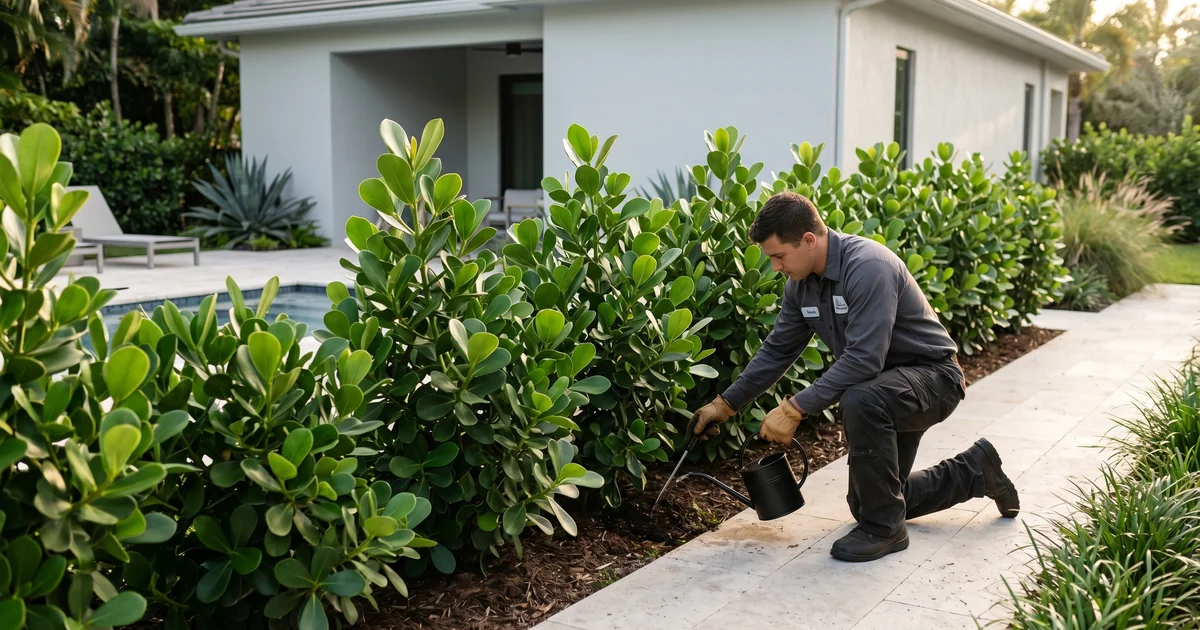
The first six weeks after install are when the plant decides whether it is going to thrive on this property or just survive. The roots have to push out of the original root ball into native soil. The plant has to adjust to the actual sun, wind, and soil conditions of its new home, which are almost always different from the nursery it came from. The irrigation has to settle into a schedule that matches the season and the site.
An installer who walks away after day one is leaving the most important part of the job to chance. The plant might establish cleanly. It also might not. The homeowner is left holding the consequences either way.
Our approach is to treat the install day as the start of the establishment window, not the end of the job. We schedule the post-install care as part of the project, not as an optional add-on. The cost of the follow-through is built into the quote.
What can go wrong during the establishment window, if no one is paying attention.
We have walked many properties where another installer's work was visibly struggling six weeks in, and the homeowner did not know what had gone wrong. The patterns repeat.
Inconsistent water reaching the root zone.
Irrigation that looks like it is running might not actually be reaching every plant at the right rate. A blocked line, a kink in a drip hose, a misaligned sprinkler, or a programming mistake on the controller can leave some plants well-watered and others dry. By the time the visual signs show up in the canopy, the affected plants have already lost ground that is hard to make up.
Soil settlement and root-ball exposure.
New plants are set in soil that has been disturbed during install. As that soil settles, the root ball can shift or get partially exposed. Exposed root balls dry out fast and the plant goes into stress. Without a check-in cadence, this can persist for weeks.
Early pest pressure on weakened plants.
A plant in establishment stress is a target. Whitefly, scale, and mites all find vulnerable plants first. A hedge that is well-established by the end of the establishment window can shrug off pest pressure that arrives later. A hedge that is still struggling at week six often does not.
Lean from wind, irrigation pressure, or settling.
Plants are not always perfectly upright at install. Even those that are can develop a lean during the establishment window from wind, the weight of supplemental water, or soil settling. A lean caught in week two is correctable in five minutes. A lean ignored for six weeks is locked in by the root system and either stays crooked forever or requires an expensive corrective intervention.
The "looks fine from the curb" trap.
A new hedge can look fine from a distance for several weeks even while specific plants are quietly failing. The visual signs of failure are often the last thing to show up. By the time you can see it from the curb, the underlying problem is usually weeks old.
What this work is not.
To be honest, post-install care is not glamorous. It is not the photo-worthy part of the project. It does not look impressive on a website. Most of what we do during the establishment window would not be visible to a homeowner who happened to be watching from inside the house.
We mention this because the absence of post-install care often does not register as a missing service. The hedge looks done on day one. The owner moves on with their life. If the hedge succeeds, the credit goes to the species and the install team. If the hedge fails, the homeowner often does not realize that the failure could have been prevented.
Our work during the establishment window is largely invisible. We think it should be more visible. It is the work that decides whether the hedge you paid for actually pays you back.
How we compare to typical install warranties.
Most South Florida hedge installers, if they offer a warranty at all, offer something in the three-month range, often loaded with exclusions: no pest damage, no weather damage, no plants on sale, no warranty unless the homeowner watered correctly, and so on. Read those warranties carefully and you will find they cover almost nothing in practice.
Our approach is to invest in the work that prevents warranty claims from being needed in the first place. The establishment window care is what catches the issues before they turn into a dead hedge that requires a warranty claim. By the time the standard warranty window of most other installers would have ended, our hedges are well established and on a long-term trajectory.
If a plant does fail during the establishment window despite the follow-through, we replace it. That is not a contractual fine print clause, it is just how we run the business. The replacement is built into the cost of doing the work right.
What we hand off to you at the end of the establishment window.
At the end of month three, the hedge is on its long-term trajectory and our intensive involvement is no longer needed. At that point, we hand off:
- A simple maintenance rhythm for the homeowner. Most established Clusia and Podocarpus hedges in South Florida need very little ongoing care. A trim or two per year, modest fertilization, and normal attention is enough.
- Notes for the homeowner's landscaper, if they use one. We are happy to communicate directly with the landscaper about what to do and what not to do.
- Photo records of the hedge's state at each major check-in, so the homeowner has a reference for what healthy establishment looks like.
- Standing follow-up access. We do not consider the project closed in the sense that we never want to hear from you again. If something comes up later, we want to know.
The honest cost conversation.
The follow-through work is built into the cost of the install. There is not a separate line item for post-install care because it is part of the job. That is by design. We do not want a customer choosing between a "bare install" and an "install plus care" tier and being tempted to skip the care to save money. The hedge needs the care. We include it.
This is part of why our quotes are often higher than the cheapest available option in the market. The cheaper quote is for a different product. It is a hedge that goes in the ground on day one and is left to fend for itself afterward. Sometimes that works out. Often it does not. The savings at the moment of purchase are real and the consequences several months later are also real. We have decided which side of that trade-off we are willing to be on.